Temporal Trends in Transcatheter Aortic Valve Implantation Outcomes: A Six-Year Analysis from the National Inpatient Sample (2016-2021)
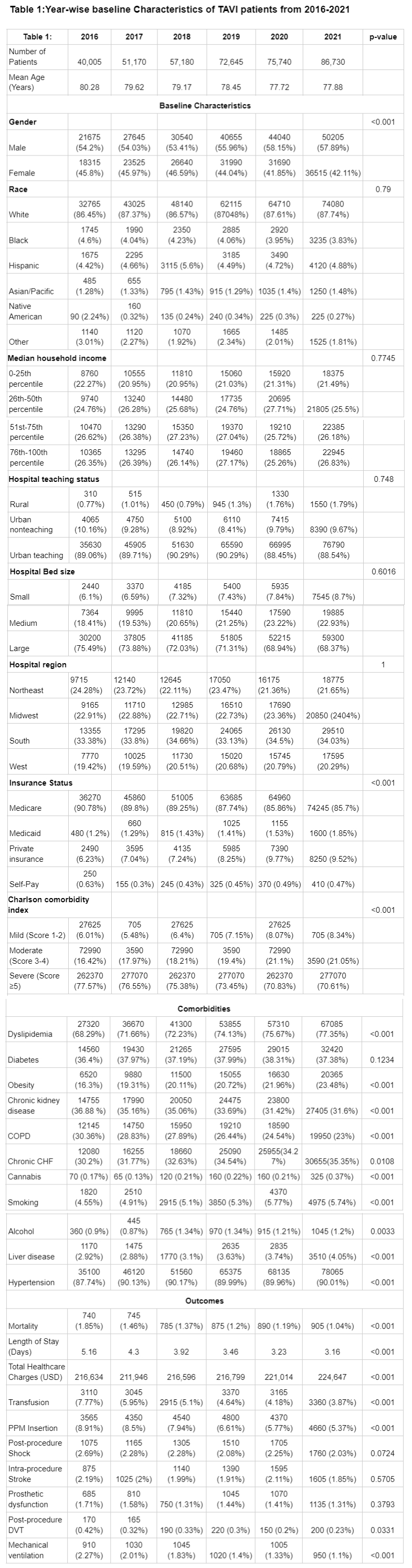
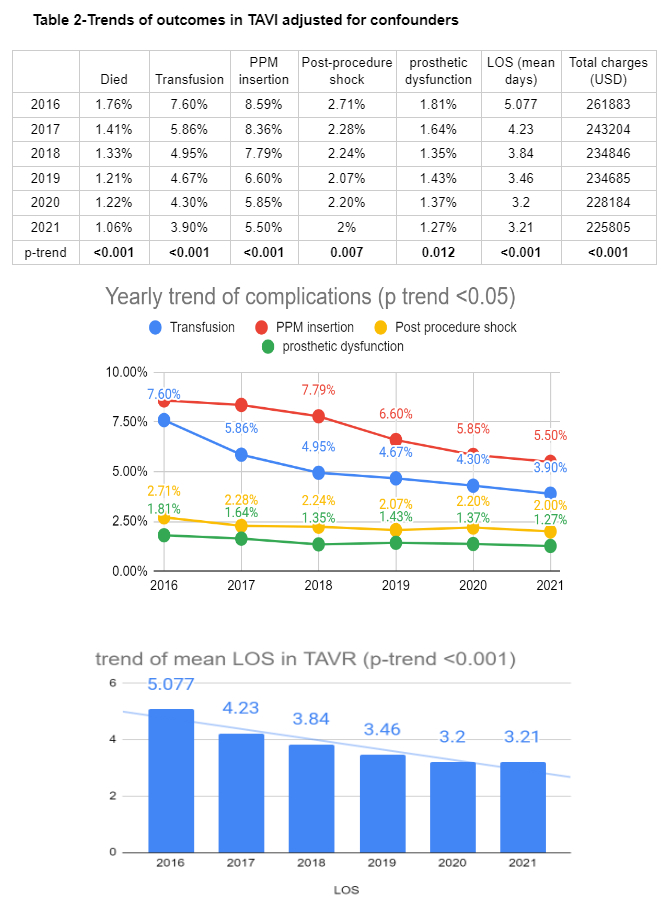
Abstract Body (Do not enter title and authors here): Background: Transcatheter Aortic Valve Implantation (TAVI) is a rapidly evolving procedure with significant implications for patient outcomes. Understanding trends in TAVI outcomes over time can help identify areas for improvement and guide clinical practice. This study aims to analyze trends in mortality, procedural complications, length of stay (LOS), and total charges for TAVI patients from 2016 to 2021. Methods: We performed a trend analysis of TAVI procedures using data from the National Inpatient Sample (NIS) from 2016 to 2021. Outcomes assessed included in-hospital mortality, transfusion rates, permanent pacemaker (PPM) insertion, postprocedure shock, prosthetic valve dysfunction, intraprocedure stroke, LOS, and total hospital charges. The P-trend test was used to determine statistical significance over the six-year period. Results: A total of TAVI procedures were analyzed from 2016 to 2021. In-hospital mortality decreased significantly from 1.76% in 2016 to 1.06% in 2021 (P-trend <0.001). Transfusion rates declined from 7.60% in 2016 to 3.90% in 2021 (P-trend <0.001). The incidence of PPM insertion dropped from 8.59% in 2016 to 5.50% in 2021 (P-trend <0.001). Postprocedure shock rates decreased from 2.71% in 2016 to 2.00% in 2021 (P-trend = 0.007). Prosthetic valve dysfunction rates declined from 1.81% in 2016 to 1.27% in 2021 (P-trend = 0.012). Intraprocedure stroke rates showed a non-significant downward trend, decreasing from 2.20% in 2016 to 1.82% in 2021 (P-trend = 0.168). Mean LOS for TAVI patients decreased significantly from 5.077 days in 2016 to 3.21 days in 2021 (P-trend <0.001). Total hospital charges showed a significant downward trend from $261,883 in 2016 to $225,805 in 2021 (P-trend <0.001). Conclusions: The analysis of TAVI outcomes from 2016 to 2021 demonstrates significant improvements in several key areas, including reductions in in-hospital mortality, transfusion rates, PPM insertion, postprocedure shock, prosthetic valve dysfunction, LOS, and total hospital charges. These findings highlight advancements in TAVI technology and procedural techniques over time. Continued monitoring of TAVI outcomes is essential to maintain and enhance the quality of care for patients undergoing this procedure.
Agrawal, Siddharth
(
Landmark Medical Center
, Woonsocket , Rhode Island , United States )
Patel, Yug
(
Smt. NHL Municipal Medical College
, Ahmedabad , India )
Raval, Maharshi
(
Landmark Medical Center
, Woonsocket , Rhode Island , United States )
Sanghvi, Labdhi
(
Narendra Modi Medical College
, Ahmedabad , India )
Siddiq, Sajid
(
landmark Medical Center. woon. RI
, Lincoln , Rhode Island , United States )
Author Disclosures:
Siddharth Agrawal:DO NOT have relevant financial relationships
| Yug Patel:DO NOT have relevant financial relationships
| Maharshi Raval:DO NOT have relevant financial relationships
| Labdhi Sanghvi:No Answer
| Sajid Siddiq:DO NOT have relevant financial relationships