
Logo

American Heart Association

  168
  0


Final ID: MDP80

Aligned Mechanical Tension Improves Electrophysiology of iPSC-Derived Engineered Heart Tissue

Abstract Body (Do not enter title and authors here): Introduction: Cardiomyocyte alignment increases over time during normal heart development. This alignment is associated with aligned mechanical tension and plays a key role in electromechanical function of the tissue. Myocardial disarray, in which the alignment is disrupted, is a hallmark of cardiomyopathy. This structural disarray is often accompanied by electrophysiological disfunction. Prior work, including ours, suggests that sodium channel function in particular is enhanced in aligned 3D tissues engineered from human induced pluripotent stem cells (iPSC). We hypothesized that cardiomyocyte alignment in 3D tissue could lead to enhanced sodium channel function by improving sodium channel expression.
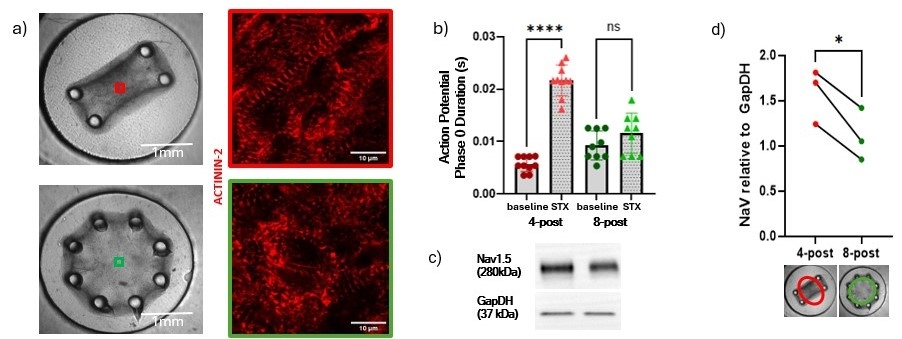
Methods: To test our hypothesis, we developed a micro-engineered heart tissue (μEHT) platform in which total mechanical tension could be decoupled from cardiomyocyte alignment. The μEHTs were cultured for at least 7 days in either a 4-post configuration to induce high uniaxial tension (expected to cause cardiomyocyte alignment), or 8-post configuration to induce multiaxial tension (expected to cause cardiomyocyte disarray; Fig. 1a). Optocardiography was carried out to study calcium dynamics (GCaMP6f reporter) and action potential waveforms (voltage-sensitive dye, BeRST-1), in heart muscle engineered from induced pluripotent stem cells (iPSC) derived cardiomyocytes. A sodium channel blocker, Saxitoxin, was added for drug response study. Sodium channel expression was assessed with Western blot and immunofluorescence analysis.
Results: 4-post mEHTs had a lower action potential excitation threshold and faster phase-0 in action potential duration, which suggests improved electrophysiology compared to 8-post EHT. Calcium dynamics data, however, did not show significant difference. Additionally, 4-post EHTs exhibited a more pronounced response to Saxitoxin. Immunofluorescence shows a trend of higher colocalization of NaV1.5 and N-cadherin in the area with high predicted uniaxial tension and cardiomyocyte alignment. Western analysis suggested that aligned mechanical tension led to higher overall expression of NaV1.5, the cardiac sodium channel (paired t-test n=3, p=0.0315).
  • Ramahdita, Ghiska  ( Washington University in St. Louis , Depok , West Java , Indonesia )
  • Chau, Thao  ( Washington University in St. Louis , Depok , West Java , Indonesia )
  • Bhakta, Riya  ( Washington University in St. Louis , Depok , West Java , Indonesia )
  • Pobee, Charlene  ( Washington University in St. Louis , Depok , West Java , Indonesia )
  • Jiang, Huanzhu  ( Washington University in St. Louis , Saint Louis , Missouri , United States )
  • Genin, Guy  ( Washington University in St. Louis , Depok , West Java , Indonesia )
  • Huebsch, Nathaniel  ( Washington University in St. Louis , Saint Louis , Missouri , United States )
  • Author Disclosures:
    Ghiska Ramahdita: DO NOT have relevant financial relationships | Thao Chau: DO NOT have relevant financial relationships | Riya Bhakta: DO NOT have relevant financial relationships | Charlene Pobee: DO NOT have relevant financial relationships | Huanzhu Jiang: DO NOT have relevant financial relationships | Guy Genin: DO have relevant financial relationships ; Ownership Interest:Caeli Vascular, Inc:Active (exists now) ; Individual Stocks/Stock Options:ACatechol:Active (exists now) ; Ownership Interest:Inflexion Vascular, LLC:Active (exists now) | Nathaniel Huebsch: DO NOT have relevant financial relationships
Meeting Info:

Scientific Sessions 2024

2024

Chicago, Illinois

Session Info:

Ion Channels Biology

Saturday, 11/16/2024 , 11:10AM - 12:25PM

Moderated Digital Poster Session

More abstracts on this topic:
Causal Proteomic Consequences of Clonal Hematopoiesis: Integrated Human Genetic and Murine Validation

Yu Zhi, Griffin Gabriel, Honigberg Michael, Lin Amy, Gibson Christopher, Katz Daniel, Tahir Usman, Fang Shi, Dron Jacqueline, Pan Michael, Haidermota Sara, Vromman Amelie, Ganesh Shriienidhie, Antoine Tajmara, Weinstock Joshua, Austin Thomas, Ramachandran Vasan, Peloso Gina, Hornsby Whitney, Ganz Peter, Manson Joann, Haring Bernhard, Nguyen Ngoc Quynh, Kooperberg Charles, Reiner Alex, Bis Joshua, Psaty Bruce, Min Yuan-i, Lange Leslie, Post Wendy, Rotter Jerome, Rich Stephen, Wilson James, Schuermans Art, Ebert Benjamin, Yu Bing, Ballantyne Christie, Coresh Joe, Sankaran Vijay, Bick Alexander, Jaiswal Siddhartha, Gerszten Robert, Libby Peter, Gupta Rajat, Li Linke, Natarajan Pradeep, Rentz Thiago, Vellarikkal Shamsudheen, Uddin Md Mesbah, Niroula Abhishek

Adipose tissue extracellular vesicles mediate pro-arrhythmic changes in atrial cardiomyocytes

Limpitikul Worawan, Garcia Contreras Marta, Betti Michael, Sheng Quanhu, Xiao Ling, Chatterjee Emeli, Gamazon Eric, Shah Ravi, Das Saumya

More abstracts from these authors:
Mechanistic Characterization of CRYAB-R120G Desmin-Related Cardiomyopathy in Human iPSC-Derived 3D Cardiac Micro-Tissues

Kargar Gaz Kooh Yasaman, Diwan Abhinav, Huebsch Nathaniel, Zhao Chen, Malayath Ganesh, Hayem Leah, Bahmani Bahareh, Ramahdita Ghiska, Jiang Huanzhu, Ma Xiucui, Rawnsley David

Modeling hypertrophic cardiomyopathy in animals, cells, and tissues

Seidman Christine, Huebsch Nathaniel, Tardiff Jil, Helms Adam

You have to be authorized to contact abstract author. Please, Login
Not Available