Multi-Omic Profiling of Adiposity Distribution Patterns
Abstract Body (Do not enter title and authors here): Background: Distribution patterns for visceral (VAT), abdominal subcutaneous (ASAT), and gluteofemoral (GFAT) adipose tissue are strongly associated with cardiovascular disease. Circulating metabolites and proteins are dynamic indicators of biological processes and reflect metabolic health. It is not yet clear how these analytes are associated with adiposity distribution patterns.
Aims: To determine the multi-omic profiles of adiposity distribution and their associated metabolomic and proteomic measurements.
Methods: MRI-derived volumes of VAT, ASAT, and GFAT adjusted for BMI were available for 40,032 UK Biobank participants. Circulating metabolites and proteins were measured using the Nightingale Health NMR biomarker platform and Olink platform, respectively. We used linear regression models to assess the association between each analyte and VAT, ASAT, and GFAT. Models were adjusted for sex, age at MRI, MRI batch, and time between enrollment and MRI. Functional protein pathway enrichment was performed using the DAVID annotation tool.
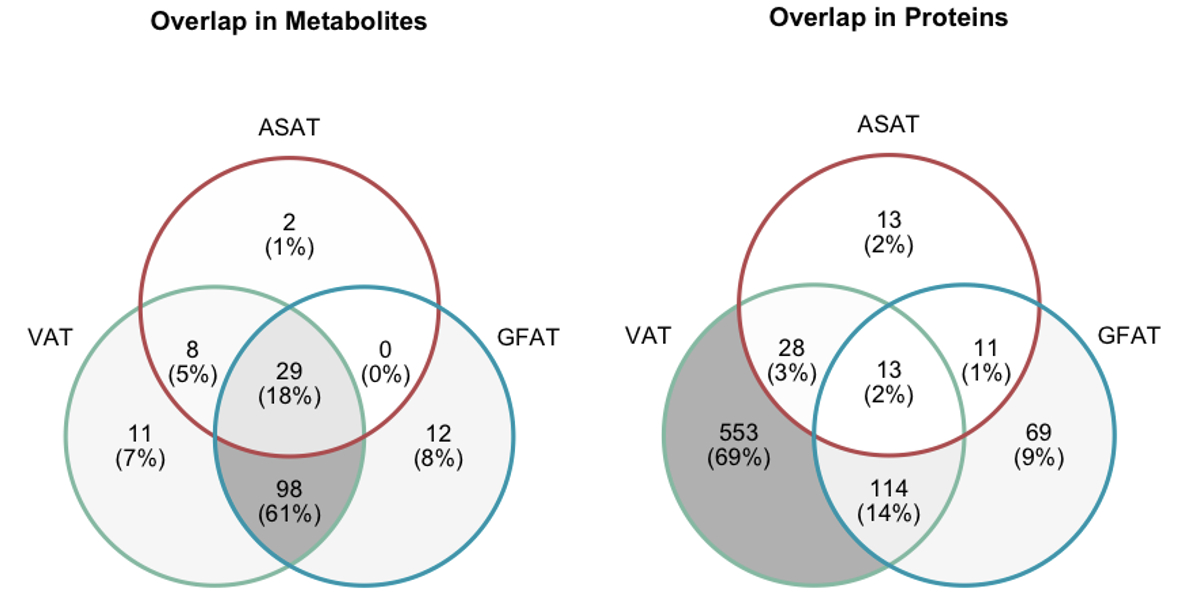
Results: Among 40,032 UK Biobank participants with adiposity volumes, 22,630 (56.5%) and 5023 (12.5%) had 168 metabolomic and 2910 proteomic measurements, respectively. In the metabolomic subset, the mean (SD) age was 55.7 (7.5) years, 10,992 (48.6%) were male, and all self-reported as white. In the proteomic subset, the mean (SD) age was 54.9 (7.8) years, 2417 (48.1%) were male, and all self-reported as white. Multi-variable linear regression revealed 39, 139, and 146 significant metabolite associations (P <1.7e-5) and 65, 207, and 708 significant protein associations (P <1.7e-5) for ASAT, GFAT, and VAT, respectively. We observed opposite directions of effect for 126 (99.2%) metabolites significantly associated with VAT and GFAT, except for pyruvate. Additionally, while proteins involved in cell adhesion were associated with all fat depots, inflammatory response proteins were only associated with VAT.
Conclusion: Among the fat depots, VAT had the most associations with circulating proteins and metabolites, while ASAT had the least. Assessment of associations with coronary artery disease may further delineate connections between fat deposition and cardiometabolic health.
Pan, Michael
(
Broad Institute of MIT and Harvard
, Cambridge , Massachusetts , United States )
Dron, Jacqueline
(
Massachusetts General Hospital
, Boston , Massachusetts , United States )
Schuermans, Art
(
Broad Institute of MIT and Harvard
, Cambridge , Massachusetts , United States )
Agrawal, Saaket
(
Massachusetts General Hospital
, Boston , Massachusetts , United States )
Fourman, Lindsay
(
Massachusetts General Hospital
, Boston , Massachusetts , United States )
Koyama, Satoshi
(
Broad Institute of MIT and Harvard
, Cambridge , Massachusetts , United States )
Hornsby, Whitney
(
Massachusetts General Hospital
, Boston , Massachusetts , United States )
Peloso, Gina
(
, Boston , Massachusetts , United States )
Natarajan, Pradeep
(
Massachusetts General Hospital
, Boston , Massachusetts , United States )
Author Disclosures:
Michael Pan:DO NOT have relevant financial relationships
| Jacqueline Dron:DO NOT have relevant financial relationships
| Art Schuermans:DO NOT have relevant financial relationships
| Saaket Agrawal:DO have relevant financial relationships
;
Consultant:Third Rock Ventures:Active (exists now)
; Consultant:Marea Therapeutics:Active (exists now)
| Lindsay Fourman:DO have relevant financial relationships
;
Research Funding (PI or named investigator):Chiesi Farmaceutici:Active (exists now)
; Consultant:Theratechnologies:Past (completed)
; Speaker:Theratechnologies:Past (completed)
; Consultant:Amryt Pharmaceuticals:Past (completed)
| Satoshi Koyama:DO NOT have relevant financial relationships
| Whitney Hornsby:No Answer
| Gina Peloso:DO NOT have relevant financial relationships
| Pradeep Natarajan:DO have relevant financial relationships
;
Researcher:Allelica:Active (exists now)
; Advisor:Preciseli:Active (exists now)
; Advisor:MyOme:Active (exists now)
; Advisor:Esperion Therapeutics:Active (exists now)
; Advisor:TenSixteen Bio:Active (exists now)
; Consultant:Novartis:Active (exists now)
; Consultant:Genentech / Roche:Active (exists now)
; Consultant:Eli Lilly & Co:Active (exists now)
; Researcher:Novartis:Active (exists now)
; Researcher:Genentech / Roche:Active (exists now)