Unexpected Devastation: Streptococcus mitis Endocarditis Leading to Multisystem Crisis in a Healthy Young Adult
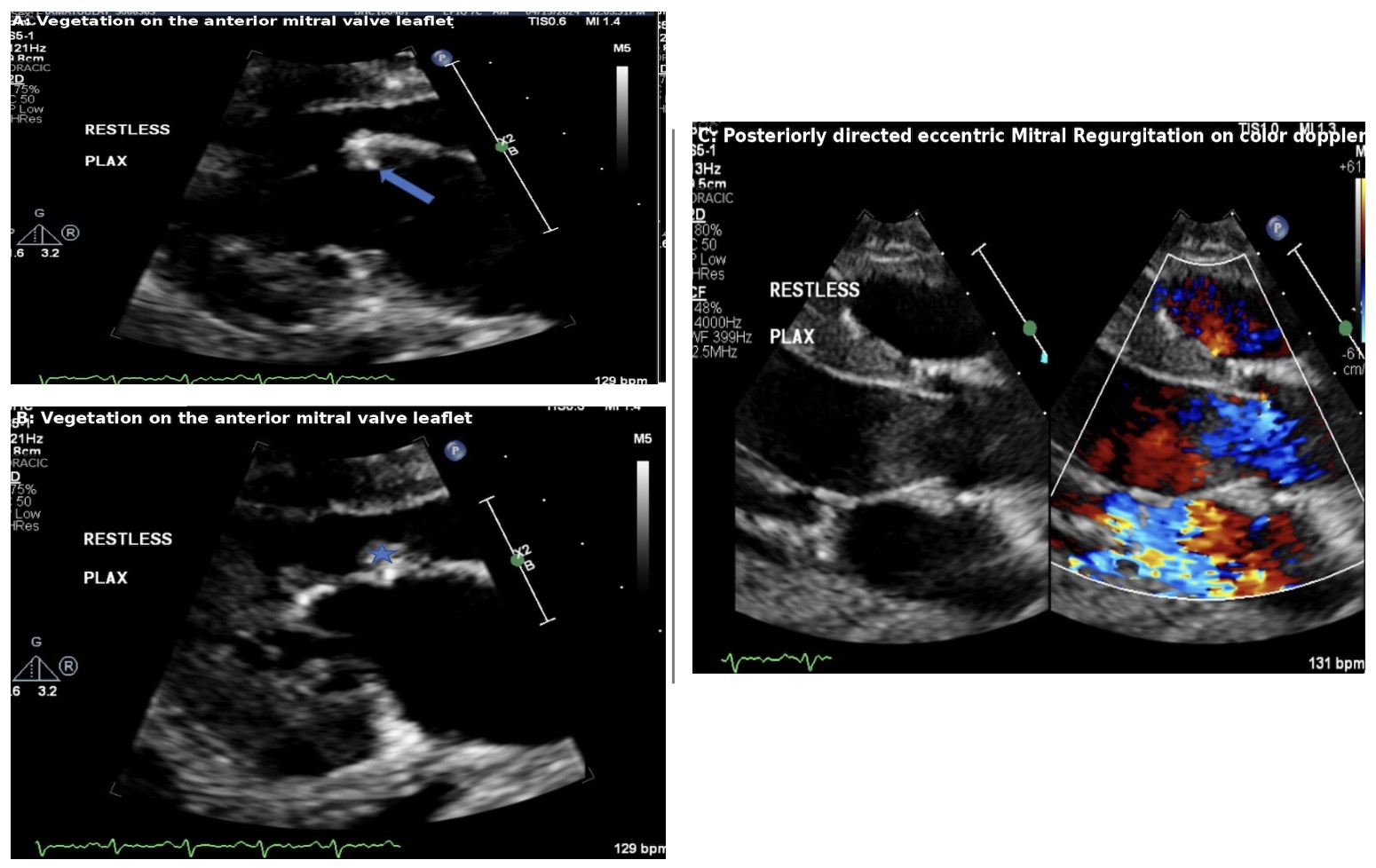
Abstract Body (Do not enter title and authors here): Case Description A 27-year-old woman from outside the United States, with no prior medical history, presented to the emergency room (ER) with fever and unresponsiveness. Upon arrival, she was found to have a basilar tip occlusion with multifocal posterior fossa infarcts. Imaging also revealed a subarachnoid hemorrhage, suspected to be secondary to a ruptured distal basilar aneurysm. The patient experienced associated seizures and acute hypoxic respiratory failure due to aspiration and bulbar weakness, necessitating an upgrade to the neuro-intensive care unit (ICU). Blood cultures drawn in the ER were positive for Streptococcus mitis/oralis. A transthoracic echocardiogram (TTE) showed a thickened mitral valve with a thick shaggy vegetation on the atrial side of the anterior mitral leaflet, as well as vegetation on the posterior leaflet and severe mitral regurgitation (MR). The patient was diagnosed with S. mitis mitral valve endocarditis. Due to the severity of her neurological and cardiac conditions, she was pending cardiothoracic (CT) intervention after stabilization in the neuro ICU.
Discussion Streptococcus mitis endocarditis is relatively rare and typically affects individuals with pre-existing valvular abnormalities or immunosuppression. In this case, the patient had no known predisposing factors, making the diagnosis more intriguing. The pathogenesis of S. mitis endocarditis involves bacterial adherence to damaged or abnormal heart valves, leading to the formation of vegetations composed of fibrin, platelets, and bacteria. These vegetations can embolize to various organs, causing infarctions and other complications as seen in this patient. The management of S. mitis endocarditis involves prolonged antibiotic therapy and, in some cases, surgical intervention to address valvular damage.
Conclusion: This case highlights the severe and multifaceted complications that can arise from Streptococcus mitis endocarditis, even in young and previously healthy individuals. The combination of multifocal posterior fossa infarcts, subarachnoid hemorrhage, severe mitral regurgitation, and acute hypoxic respiratory failure presents a significant clinical challenge. Further studies are needed to better understand the pathophysiology and optimal management strategies for S. mitis endocarditis, particularly in patients without traditional risk factors.
Offor, Rita
(
SUNY Downstate Medical Center
, Brooklyn , New York , United States )
Atere, Muhammed
(
SUNY Downstate Medical Center
, Brooklyn , New York , United States )
Nigussie, Bisrat
(
Richmond University Medical Center
, staten Island , New York , United States )
Fotso Simo, Stefanie Clinton
(
SUNY Downstate Medical Center
, Brooklyn , New York , United States )
Graham-hill, Suzette
(
Kings County Hospital
, Brooklyn , New York , United States )
Author Disclosures:
Rita Offor:DO NOT have relevant financial relationships
| Muhammed Atere:No Answer
| Bisrat Nigussie:DO NOT have relevant financial relationships
| Stefanie Clinton Fotso Simo:DO NOT have relevant financial relationships
| Suzette Graham-Hill:DO NOT have relevant financial relationships