Logo

American Heart Association

  90
  0


Final ID: Mo4103

Factors Associated with Long Term Adverse Limb Events after Endovascular Revascularization: The Boston Femoral Artery Endovascular Revascularization Outcomes (FAROUT) study

Abstract Body (Do not enter title and authors here): Background
Patient, lesion, and procedural characteristics may impact the long-term risks of adverse limb outcomes differently after successful endovascular revascularization for lower extremity peripheral artery disease.

Objective
To assess the relationships of patient, lesion, and procedural characteristics to the subsequent risk of major and minor adverse limb events over the decade after successful endovascular revascularization of the superficial femoral artery for chronic limb threatening ischemia (CLTI) or lifestyle limiting claudication.

Methods
A retrospective cohort of patients who underwent endovascular revascularization between 2003-2011 were followed for a median of 9.3 (25-75%: 6.8, 11.1) years. Hazard ratios and 95% confidence intervals (HR, 95% CI) from Cox proportional hazards models assessed the risk of major adverse limb events (MALE) or minor revascularization, MALE alone, and minor revascularization alone.

Results
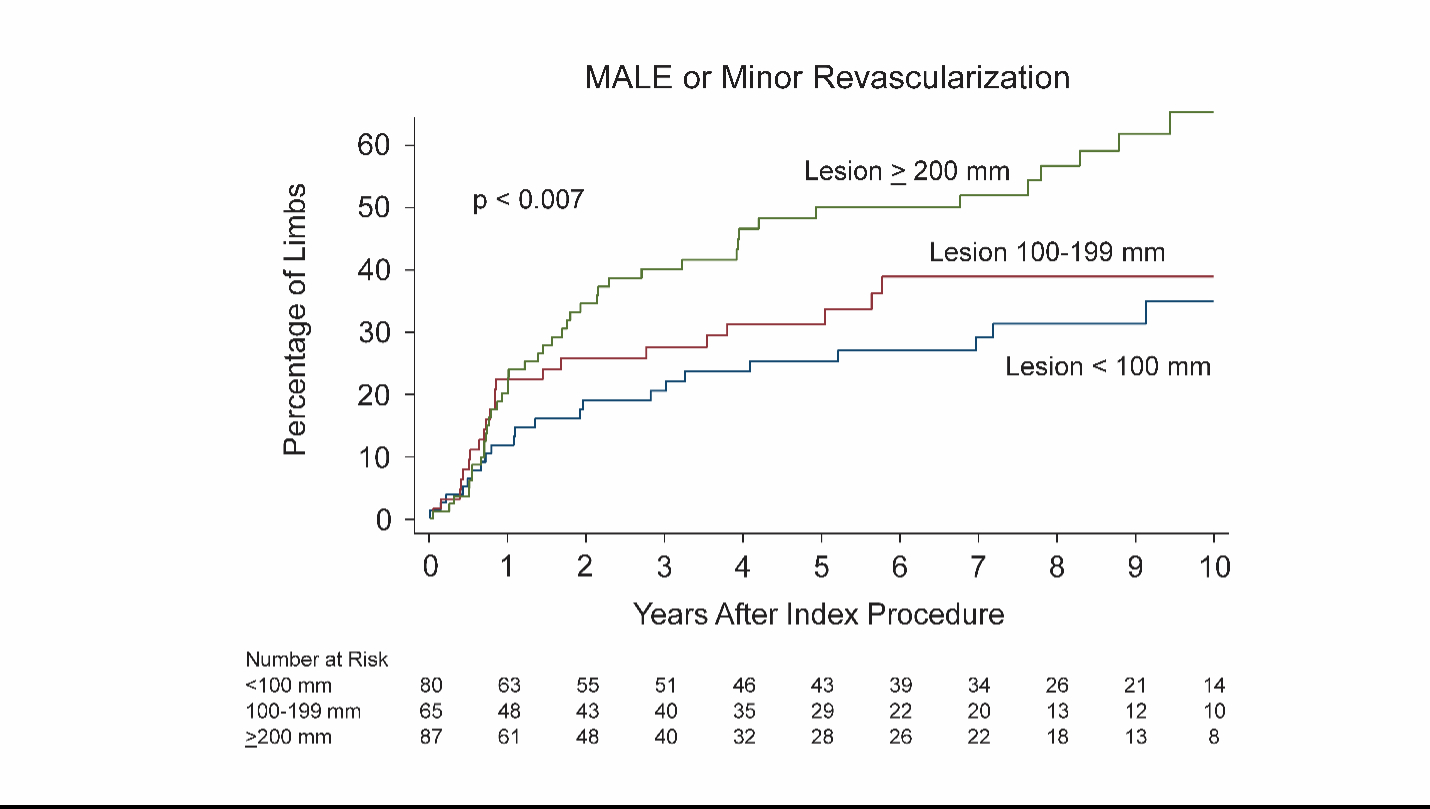
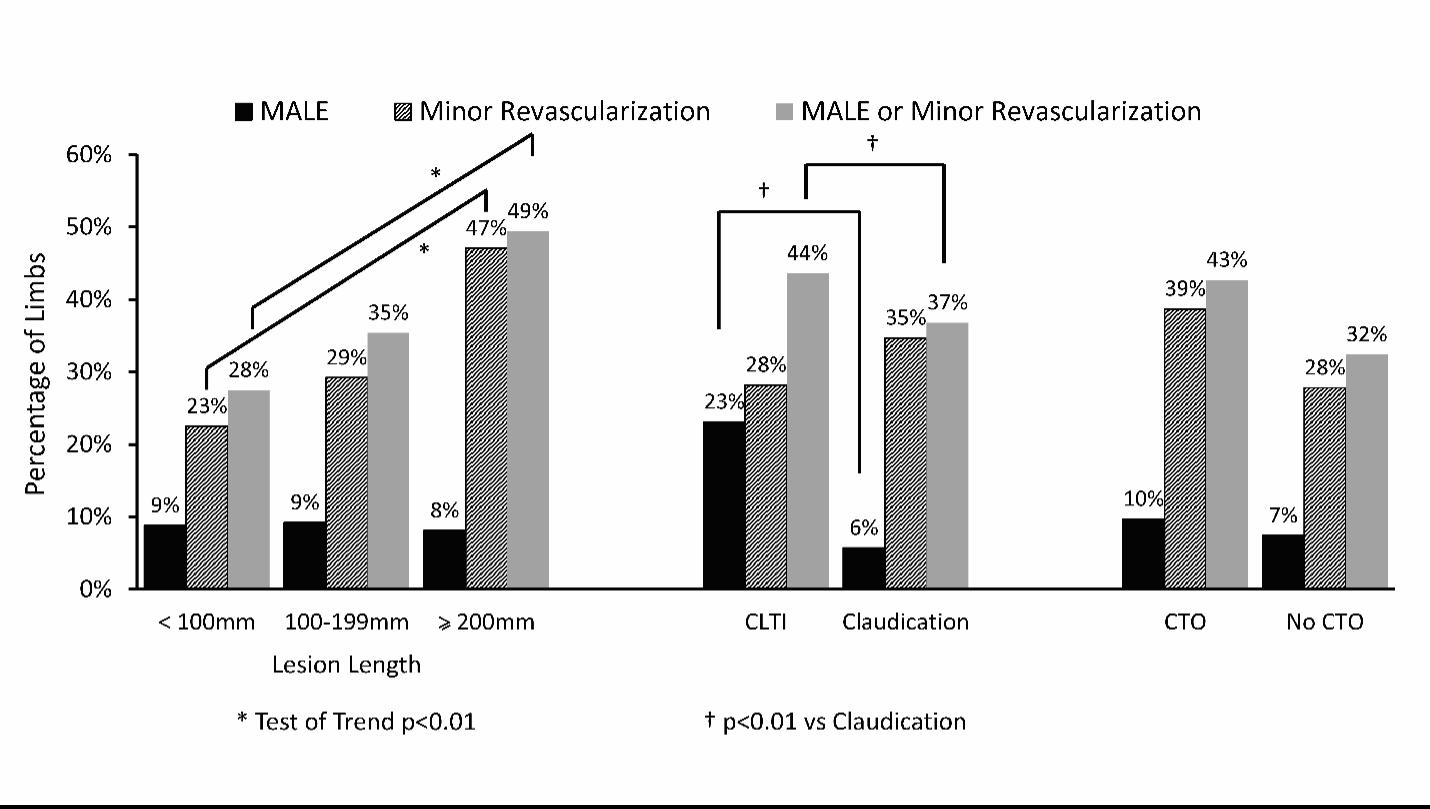
There were 232 index limb revascularizations in 185 patients. Longer lesion length was associated with a higher risk of MALE or minor revascularization (HR=2.09, 95% CI=1.22, 3.60) and minor revascularization alone (HR=2.53, 95% CI=1.39, 4.61). Current smoking was linked with minor revascularization (HR=3.83, 95% CI=1.54, 9.56). CLTI was associated with MALE or minor revascularization (HR=1.89, 95% CI=1.09, 3.29), and MALE alone (HR=7.43, 95% CI=3.11, 17.79). Black race/ethnicity (HR=4.74, 95% CI=1.51, 14.9) and low density lipoprotein (LDL) >100 mg/dL (HR=2.76, 95% CI=1.20, 6.35) were linked to MALE alone.

Conclusion
Factors related to MALE differed from those related to minor revascularization. Lesion length and smoking were linked to minor revascularization, whereas CLTI, Black race/ethnicity and elevated LDL were linked to MALE.
  • Mandieka, Edwin  ( Brigham and Women's Hospital , Boston , Massachusetts , United States )
  • Ohiomoba, Ramael  ( Brigham and Women's Hospital , Boston , Massachusetts , United States )
  • Sobieszczyk, Piotr  ( Brigham and Women's Hospital , Boston , Massachusetts , United States )
  • Eisenhauer, Andrew  ( Brigham and Women's Hospital , Boston , Massachusetts , United States )
  • Todoran, Thomas  ( BRIGHAM AND WOMENS HOSPITAL , Boston , Massachusetts , United States )
  • Kinlay, Scott  ( VA Boston Healthcare System , West Roxbury , Massachusetts , United States )
  • Author Disclosures:
    Edwin Mandieka: DO NOT have relevant financial relationships | Ramael Ohiomoba: DO NOT have relevant financial relationships | Piotr Sobieszczyk: No Answer | Andrew Eisenhauer: No Answer | Thomas Todoran: No Answer | SCOTT KINLAY: DO NOT have relevant financial relationships
Meeting Info:

Scientific Sessions 2024

2024

Chicago, Illinois

Session Info:

Complications of Coronary and Structural Intervention

Monday, 11/18/2024 , 01:30PM - 02:30PM

Abstract Poster Session

More abstracts on this topic:
A Mixed Methods Analysis of Patient Knowledge in Peripheral Artery Disease

Reilly Margaret, Alagna Megan, Iroz Cassandra, Ho Emily, Hoel Andrew, Vavra Ashley, Lundberg Alexander, Ho Karen

A Genome-wide CRISPRi Screen Implicates Coronary Artery Disease GWAS Genes as Key Regulators of Adventitial Fibroblast Proliferation

Jackson William, Zhu Ashley, Gu Wenduo, Berezowitz Alexa, Iyer Meghana, Cheng Paul

You have to be authorized to contact abstract author. Please, Login
Not Available