
The Unexpected Heart Stopper: A Case of Ketamine-Induced Stress Cardiomyopathy Requiring Mechanical Circulatory Support
Abstract Body (Do not enter title and authors here): Background: Stress cardiomyopathy (SCM) is rarely triggered by ketamine and seldom leads to cardiogenic shock. Ketamine-induced catecholaminergic surge can lead to myocardial stunning with transient ischemia and subsequent reversible heart failure. Mechanical circulatory support can be successfully leveraged in SCM-associated cardiogenic shock while awaiting myocardial recovery.
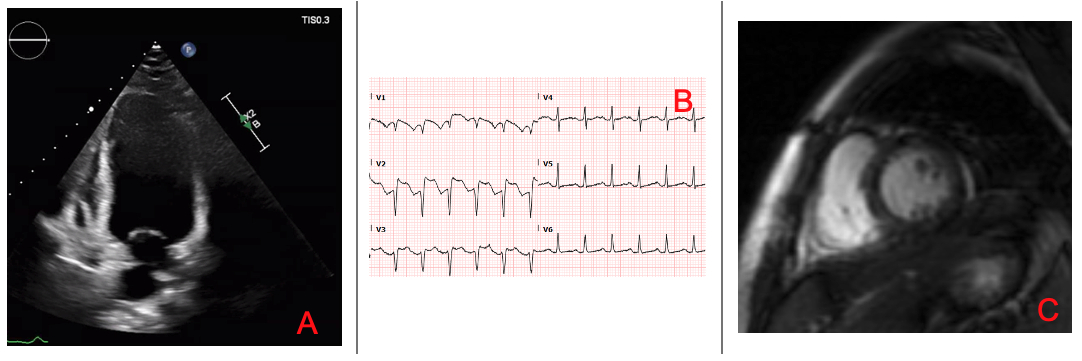
Case Presentation: A 28-year-old female with chronic pain was admitted for failure to thrive secondary to opioid-induced gastroparesis. The patient was weaned off opiates while on ketamine over 4 days. After halting ketamine, the patient had a cardiac arrest with eventual return of spontaneous circulation. After being extubated, she developed chest pain, hypotension, and ventricular tachycardia with anterolateral ST elevations, troponin leak, and lactic acidosis. TTE revealed an EF <20% with severe mid-distal LV dysfunction with preserved basal segments, concerning for SCM. Cardiac catheterization revealed clear coronaries but elevated filling pressures and reduced cardiac index, requiring mechanical circulatory support by IABP and, eventually, VA-ECMO. By 1-week post-arrest, IABP was removed and the patient was decannulated off VA-ECMO. TTE at 1-week post-arrest showed an EF of 45-50% with moderate global hypokinesis. MRI at 1-month post-arrest revealed a normal heart with no abnormal myocardial edema, fatty infiltration, perfusion abnormalities, or scarring. TTE at 1-month post-arrest revealed an EF of 55-60% without wall motion abnormalities. Subcutaneous ICD did not reveal any events on follow-up.
Conclusion: With the rise of ketamine use in pain management, the recognition of rare cardiac complications like SCM should be an important consideration even in patients without underlying cardiac risk factors. Early recognition of shock and initiation of mechanical circulatory support may lead to more favorable outcomes. Increased awareness and prompt intervention can significantly impact a patient’s recovery and prognosis in ketamine-induced SCM.
Hyder, Syed
( University of Alabama at Birmingham
, Birmingham
, Alabama
, United States
)
Gonuguntla, Akhilesh
( UAB
, BIRMINGHAM
, Alabama
, United States
)
Parcha, Vibhu
( University of Alabama
, Birmiham
, Alabama
, United States
)
Mcelwee, Samuel
( UAB
, Vestavia
, Alabama
, United States
)
Author Disclosures:
Syed Hyder:DO NOT have relevant financial relationships
| Akhilesh Gonuguntla:DO NOT have relevant financial relationships
| Vibhu Parcha:DO NOT have relevant financial relationships
| Samuel McElwee:DO NOT have relevant financial relationships