
Sodium Glucose Cotransporter 2 Inhibitors After Acute Myocardial Infarction: An updated systematic review and meta-analysis.
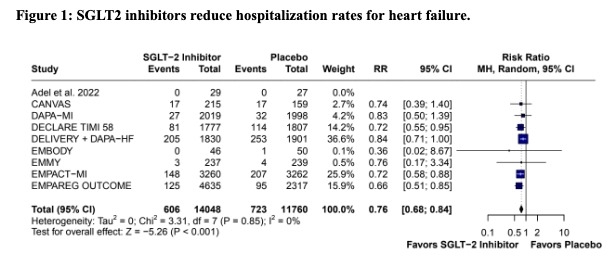
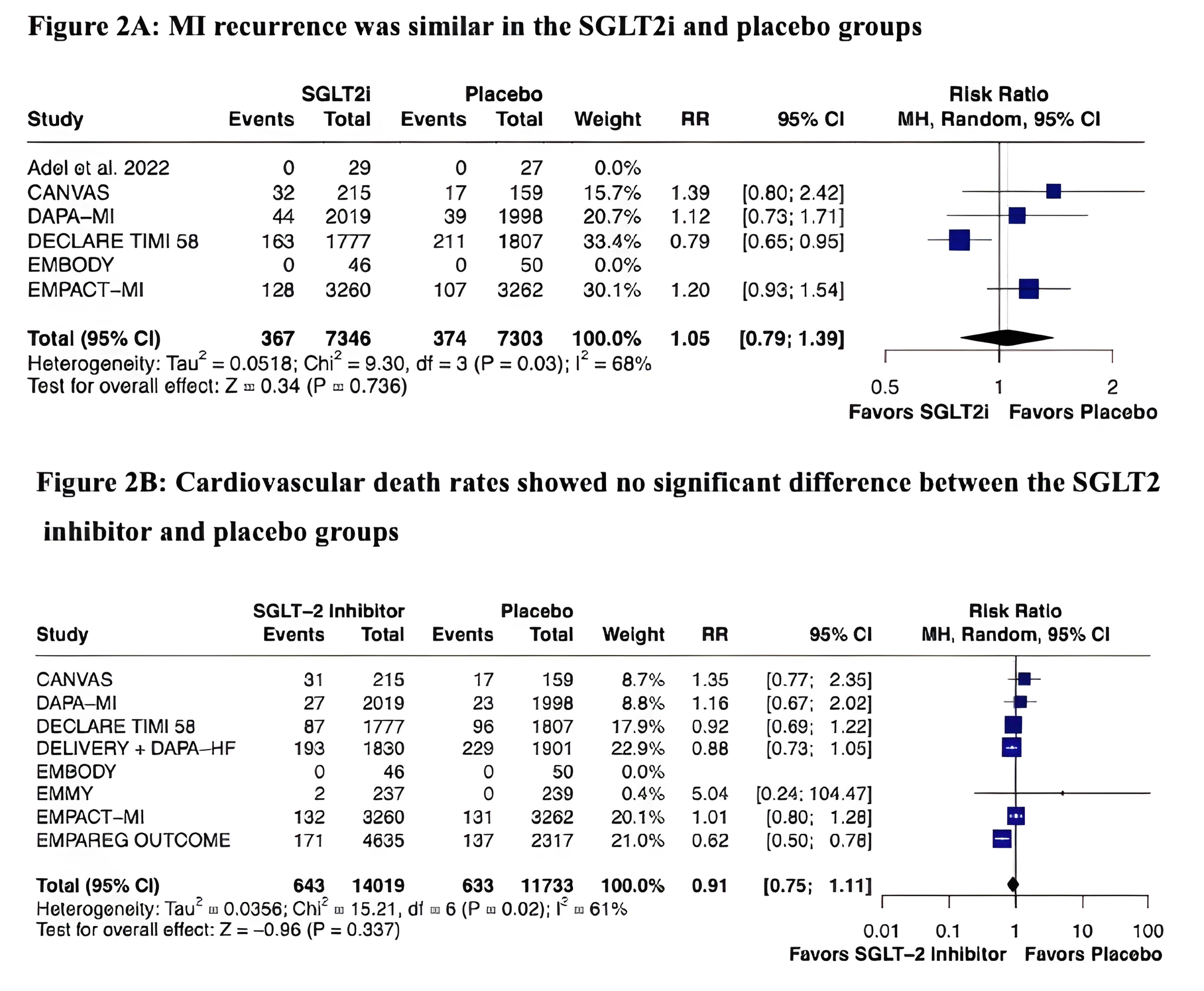
Abstract Body (Do not enter title and authors here): Background: Sodium-glucose co-transporter two inhibitors (SGLT2i) have recently been included in heart failure (HF) guidelines due to their benefits in reducing mortality and hospitalization rates. However, the benefits of SGLT2i in patients with post-acute myocardial infarction (MI) remain controversial. Therefore, we aim to perform an updated systematic review and meta-analysis comparing SGLT2i with placebo in patients after an acute MI. Methods: We performed a systematic review and meta-analysis to determine the impact of SLGT2i in patients with post-acute MI with or without diabetes type II (DM II). We systematically searched Pubmed, Cochrane, and Embase for randomized controlled trials (RCTs) comparing SGLT2i and placebo in patients following an acute MI. The primary outcome assessed was (1) HF hospitalization. In this analysis, we also included the following secondary outcomes:(2) cardiovascular (CV) mortality and (3) MI recurrence. Risk Ratios(RRs) with 95% confidence interval (CI) were pooled across studies using a random effect model. Results: Our meta-analysis included ten RCTs comprising 25908 patients, of whom 14098 (54.4%) received SGLT2i therapy and 15078 (58.2%) had type II diabetes. The mean age was 62 years, and the mean follow-up was 21.2 months. In the pooled analysis, HF hospitalization was significantly lower in the SGLT2is group (RR 0.76; 95%CI 0.68,0.84; p<0.001; Fig. 1). There was no statistically significant difference between the groups in terms of MI recurrence rates (RR 1.05; 95%CI 0.79,1.39; p=0.7; Fig. 2 A) and CV mortality (RR 0.91; 95%CI 0.75,1.11; p=0.34; Fig. 2 B). Conclusion: In this updated meta-analysis of patients with a history of acute myocardial infarction, the administration of SGLT2i was significantly associated with reduced hospitalization rates for heart failure. However, our results show no benefits in MI recurrence and CV mortality endpoints.
Scardini, Pedro Gabriel
( Escola Superior de Ciências da Santa Casa de Misericórdia de Vitória; EMESCAM
, Vitoria
, Brazil
)
Gioli-pereira, Luciana
( Albert Einstein Hospital - SBIBAE
, São Paulo
, Brazil
)
Katsuyama, Eric
( Faculdade de Medicina do ABC
, Sao Paulo
, Brazil
)
Prata, Alonzo
( UFES
, Vitoria
, Brazil
)
Falco Neto, Wilson
( Faculdade de Medicina de Catanduva
, Olimpia
, Brazil
)
Fukunaga, Christian
( Faculdade de Medicina do ABC
, Sao Paulo
, Brazil
)
Coan, Ana Carolina
( UFES
, Vitoria
, Brazil
)
Fernandes, Julia
( Faculdade Israelista de Ciências da Saúde Albert Einstein
, Sao Paulo
, Brazil
)
Petri Santos Pinheiro, Rafael
( Universidade Federal do Rio de Janeiro
, Rio de Janeiro
, Brazil
)
Andrade, Naieli
( Escola Bahiana de Medicina e Saúde Pública
, Salvador
, Brazil
)
Author Disclosures:
Pedro Gabriel Scardini:DO NOT have relevant financial relationships
| Luciana Gioli-Pereira:DO NOT have relevant financial relationships
| Eric Katsuyama:DO NOT have relevant financial relationships
| Alonzo Prata:DO NOT have relevant financial relationships
| Wilson Falco Neto:DO NOT have relevant financial relationships
| Christian Fukunaga:DO NOT have relevant financial relationships
| Ana Carolina Coan:DO NOT have relevant financial relationships
| Julia Fernandes:DO NOT have relevant financial relationships
| Rafael Petri Santos Pinheiro:DO NOT have relevant financial relationships
| Naieli Andrade:No Answer