
Logo

American Heart Association

  107
  0


Final ID: Su3049

Machine learning analysis of serum proteome in the diagnosis of COVID-19 myocarditis

Abstract Body (Do not enter title and authors here): Background: The COVID-19 global pandemic was the third leading cause of mortality in the US in 2020 and is associated with numerous complications, including myocarditis. Diagnosis of COVID-19 myocarditis can involve costly and invasive procedures. In addition, asymptomatic myocarditis could place people at risk for arrhythmias and sudden cardiac death.
Objective: To use machine learning (ML) of serum proteomics to distinguish asymptomatic COVID-19 positive volunteers with and without myocarditis.
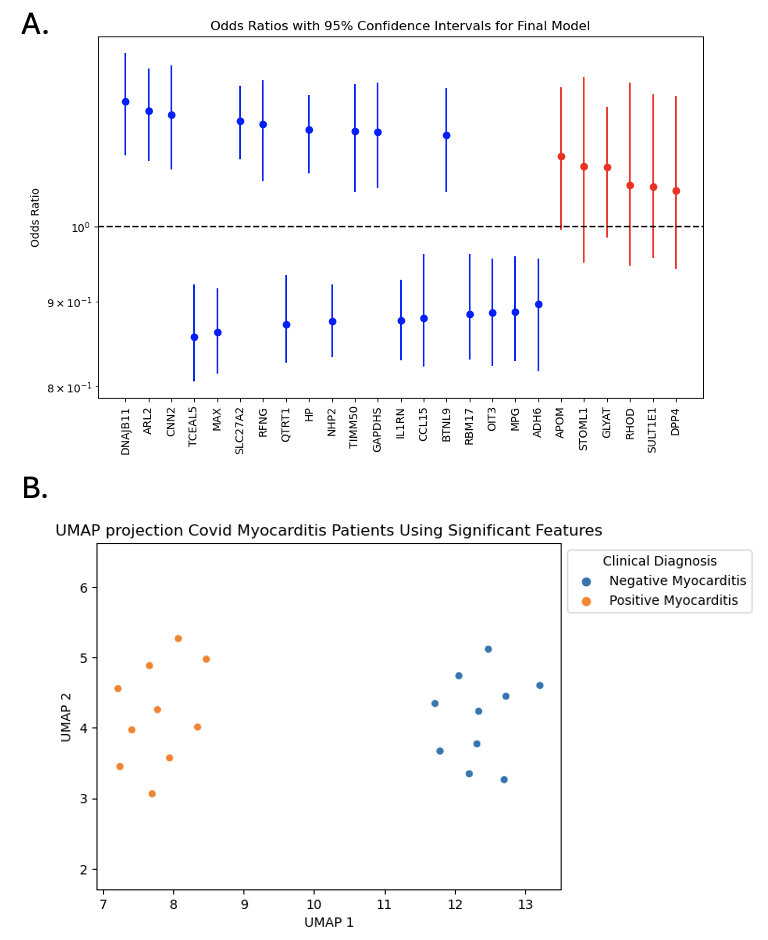
Approach and Results: In 2020, for a cohort of 20 previously healthy 18–23-year-old individuals diagnosed with COVID-19 two weeks after the diagnosis, CMR was performed to assess for evidence of cardiac inflammation and serum samples were obtained the same day (10 were diagnosed as myocarditis positive and 10 negative) We performed proteomic analysis using the SomaScan proteomics assay from SomaLogic. The data were passed through an initial feature selection process of 1000 rounds of bootstrapped multivariate logistic regression using L1-regularization to introduce sparser feature utilization. The top 25 features (largest absolute log-odds) were utilized for a final logistic regression analysis. The feature selection step was optimized to have an average receiver operating characteristic area under the curve (ROCAUC) of 83.29% over 1000 iterations, but the final model utilizing only 25 proteins achieved an average ROCAUC of 99.58%. This method produced 22 proteins with significant odds-ratios for COVID-19 myocarditis (OR 95%CI excluding 1), of particular interest are those involved in inflammatory control and injury response mechanisms. Increases in the heat shock protein DNAJB11 (1.19 [1.10, 1.27]) and calponin-2 (1.17 [1.10, 1.25]), as well as decreases IL1RN (0.88 [0.83, 0.93]) were associated in increased likelihood of CMR diagnosed myocarditis (Fig 1A). Furthermore, a UMAP projection of the data using the 22 significant features yielded a clear visual distinction between those with and without COVID-19 myocarditis via CMR (Fig 1B).
Conclusion:
Utilizing ML on serum proteomic screenings of asymptomatic young COVID-19 patients, we can differentiate between those with CMR myocarditis positive and negative patients.
  • Gordon, Kyle  ( Ohio State University , Columbus , Ohio , United States )
  • Liu, Shan-lu  ( Ohio State University , Columbus , Ohio , United States )
  • Daniels, Curt  ( The ohio state university , Columbus , Ohio , United States )
  • Rajpal, Saurabh  ( Ohio State University , Columbus , Ohio , United States )
  • Madiai, Francesca  ( Ohio State University , Columbus , Ohio , United States )
  • Gumina, Richard  ( The Ohio State University , Columbus , Ohio , United States )
  • Gordon, Cade William  ( UC Berkeley , Berkeley , California , United States )
  • Roman, Ana  ( Ohio State University , Columbus , Ohio , United States )
  • Watson, Samuel  ( Ohio State University , Columbus , Ohio , United States )
  • Tong, Matthew  ( Ohio State University , Columbus , Ohio , United States )
  • Addison, Daniel  ( Ohio State University , Columbus , Ohio , United States )
  • Jones, Daniel  ( Ohio State University , Columbus , Ohio , United States )
  • Oltz, Eugene  ( Ohio State University , Columbus , Ohio , United States )
  • Lozanski, Gerard  ( Ohio State University , Columbus , Ohio , United States )
  • Author Disclosures:
    Kyle Gordon: DO NOT have relevant financial relationships | Shan-Lu Liu: No Answer | Curt Daniels: No Answer | Saurabh Rajpal: No Answer | Francesca Madiai: DO NOT have relevant financial relationships | Richard Gumina: DO NOT have relevant financial relationships | Cade William Gordon: DO have relevant financial relationships ; Researcher:BigHat Biosciences:Past (completed) | Ana Roman: DO NOT have relevant financial relationships | Samuel Watson: DO NOT have relevant financial relationships | Matthew Tong: DO NOT have relevant financial relationships | Daniel Addison: DO NOT have relevant financial relationships | Daniel Jones: No Answer | Eugene Oltz: No Answer | Gerard Lozanski: No Answer
Meeting Info:

Scientific Sessions 2024

2024

Chicago, Illinois

Session Info:

AI at Heart: Revolutionizing Cardiovascular Imaging

Sunday, 11/17/2024 , 11:30AM - 12:30PM

Abstract Poster Session

More abstracts on this topic:
A multi-proteomic Risk Score Predicts Adverse Cardiovascular Outcomes in Patients with Angina and Non-obstructive Coronary Artery Disease

Huang Jingwen, Lodhi Rafia, Lodhi Saleha, Eldaidamouni Ahmed, Hritani Wesam, Hasan Muhammet, Haroun Nisreen, Quyyumi Arshed, Mehta Puja, Leon Ana, Ko Yi-an, Yang Huiying, Medina-inojosa Jose, Ahmed Taha, Harris Kristen, Alkhoder Ayman, Al Kasem Mahmoud

ADP-Ribosylation In a Mouse Model of Atherosclerosis: a Potential Novel Link Between Dyslipidemia and Inflammation in Cardiovascular Disease

Delwarde Constance, Mlynarchik Andrew, Perez Katelyn, Campedelli Alesandra, Sonawane Abhijeet, Aikawa Elena, Singh Sasha, Aikawa Masanori, Santinelli Pestana Diego, Kasai Taku, Kuraoka Shiori, Nakamura Yuto, Okada Takeshi, Decano Julius, Chelvanambi Sarvesh, Ge Rile

More abstracts from these authors:
Endothelial CD39 Deficiency Alters Purinergic Signaling and Increases Susceptibility to Ischemia-Reperfusion Injury

Gordon Kyle, Roman Ana, Dherete Eli, Bermeo-blanco Oscar, Watson Samuel, Sas Kelli, Gumina Richard

Loss of function polymorphism in the ecto-5’-nucleotidase (NT5E) gene increases atherosclerotic burden.

Roman Ana, Gumina Richard, Dittrick Lauren, Gordon Kyle, Bermeo Blanco Oscar, Watson Samuel, Gurumurthy Channabasavaiah, Wells Quinn, Covarrubias Roman, Quadros Rolen

You have to be authorized to contact abstract author. Please, Login
Not Available