
Artificial Intelligence Guided Stress Perfusion Cardiac Magnetic Resonance Versus Standard-Of-Care in Stable Chest Pain Syndromes
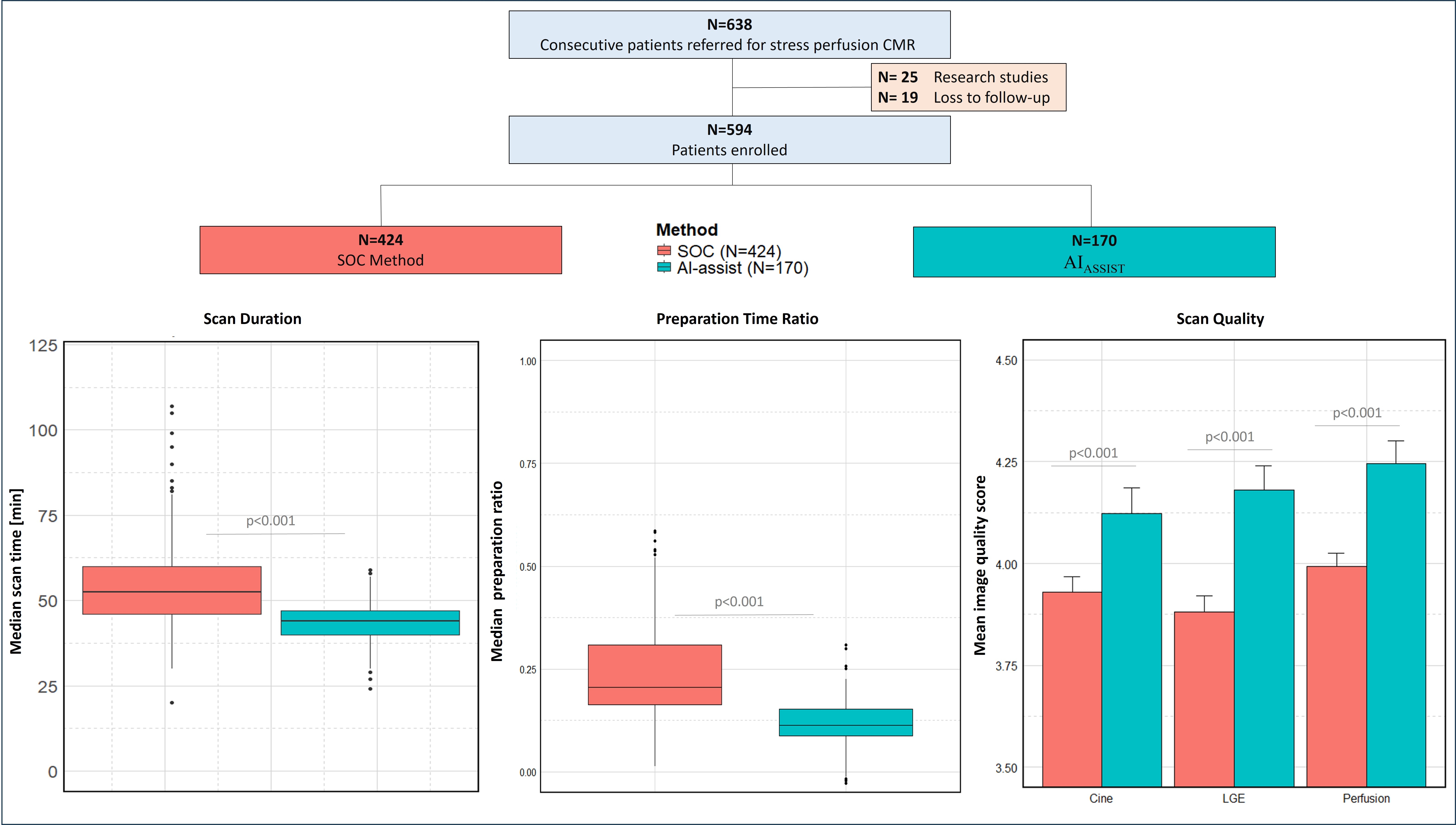
Abstract Body (Do not enter title and authors here): Background Stress perfusion CMR has excellent diagnostic and prognostic values in assessing chest pain syndromes. AI-guided methods may overcome complex scanning and increase clinical adaptation of stress CMR. Aim To assess the benefits of AI-guided stress perfusion CMR. Methods Consecutive patients with stable chest pain underwent stress CMR using either a standard scanning method (SOC) or an AI-assist (AIA) machine learning protocol to automate scan planning, plane prescription, sequence tuning, and image reconstruction. Scan duration, the ratio of scan preparation time over the entire scan duration, and scan quality using a 5-point scale were compared between AIA and SOC. Cox regression models were constructed to associate evidence of ischemia on stress CMR, by either scanning method, with composite endpoints including cardiovascular death, non-fatal MI, unstable angina hospitalization, and late CABG. A second composite endpoint included the performance of additional cardiac imaging tests (stress imaging and CCTA) and invasive coronary procedures after CMR. Results Among 594 patients (62.8 ± 14 years), 29% underwent stress CMR with AIA. 26% had stress-perfusion ischemia, and 39% had LGE present. AIA stress CMR had lower scan duration (median 44.0 [IQR 40-47] vs. 52.5 min [IQR 46-60]; p<0.001), lower preparation time ratio (median 0.11 [IQR 0.09-0.15] vs. 0.21 [IQR 0.16-0.31], p<0.001) and a higher mean image quality score (mean 4.2±0.7 vs. 3.9±0.6; p<0.001) compared to SOC. There was a trend to a lower risk of experiencing the clinical composite endpoint and a lower need to undergo subsequent noninvasive testing among the AIA group (log-rank p=0.33 and p=0.08). Among the 152 patients with ischemia present, the incidence of invasive referral and performance of coronary revascularization within 90 days were not different. Conclusions In this non-randomized observational cohort, AIA significantly improved stress CMR scan duration, preparation time ratio, and image quality compared to SOC.
Reis Marques, Isabela
( Brigham and Women's Hospital
, Boston
, Massachusetts
, United States
)
Kwong, Raymond
( Brigham and Women's Hospital
, Boston
, Massachusetts
, United States
)
Daibes, Marianna
( Brigham and Women's Hospital
, Boston
, Massachusetts
, United States
)
Bernhard, Benedikt
( Brigham and Women's Hospital
, Boston
, Massachusetts
, United States
)
Jerosch-herold, Michael
( Brigham and Women's Hospital
, Boston
, Massachusetts
, United States
)
Heydari, Bobak
( Brigham and Women's Hospital
, Boston
, Massachusetts
, United States
)
Addy, Okai
( Vista.ai
, Palo Alto
, California
, United States
)
Powell, Lori
( Vista.ai
, Palo Alto
, California
, United States
)
Santos, Juan
( Vista.ai
, Palo Alto
, California
, United States
)
Hu, Bob
( Vista.ai
, Palo Alto
, California
, United States
)
Author Disclosures:
Isabela Reis Marques:DO NOT have relevant financial relationships
| Raymond Kwong:No Answer
| Marianna Daibes:No Answer
| Benedikt Bernhard:No Answer
| Michael Jerosch-Herold:No Answer
| Bobak Heydari:No Answer
| Okai Addy:No Answer
| Lori Powell:No Answer
| Juan Santos:DO have relevant financial relationships
;
Employee:Vista.ai:Active (exists now)
; Ownership Interest:Vista.ai:Active (exists now)
| Bob Hu:DO have relevant financial relationships
;
Executive Role:Vista.ai:Active (exists now)