Optimizing Large Language Models for Interpreting American Heart Association Dietary Guidelines in Nutrition Education for Cardiovascular Disease Prevention: A Retrieval-Augmented Generation Framework
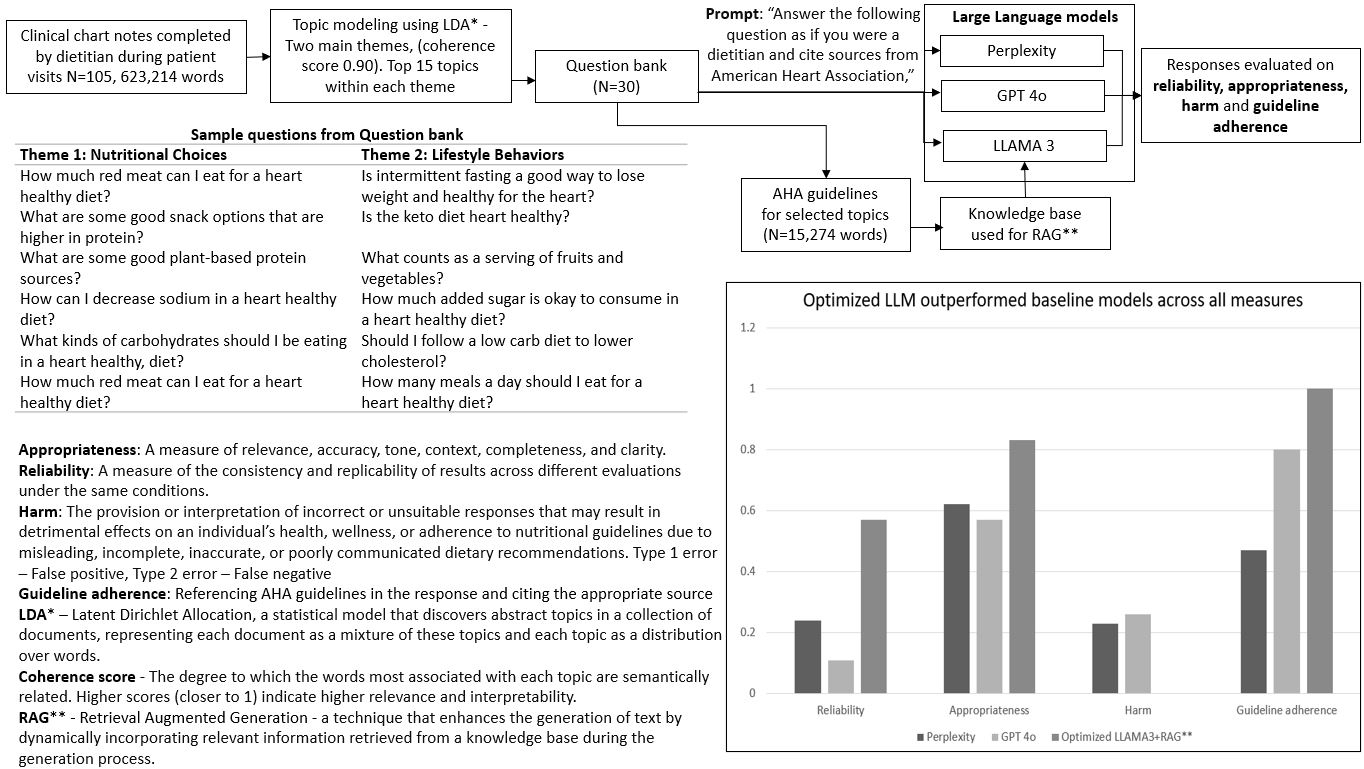
Abstract Body (Do not enter title and authors here): Introduction: Large language models (LLMs) show proficiency in clinical capabilities such as responding to medical inquiries, and summarizing information, but their application in patient education requires evaluation. This study optimizes LLMs' interpretation of dietary guidelines for nutrition education using a framework that integrates American Heart Association (AHA) guidelines with Retrieval Augmented Generation (RAG), outperforming the baseline models. Methods: Analyzing 105 dietitian-authored visit notes (623,214 words) with Latent Dirichlet Allocation revealed two themes (coherence score 0.9). We posed 30 questions on these themes, along with the prompt, “Answer the following question as if you were a dietitian and cite sources from AHA,” three times to the baseline Perplexity (perplexity.ai), GPT-4o (OpenAI) models, and a customized LLM framework using RAG with formatted guidelines and citations applied to the Llama 3 70B model (Meta). Three expert reviewers evaluated the responses, scoring 0 or 1 for reliability, appropriateness, guideline adherence, and harm (Figure 1). Mean scores across groups were compared using analysis of variance. Results: Our LLM framework scored higher than baseline Perplexity and GPT-4o models on reliability (0.57±0.45 vs. 0.24±0.42, 0.11±0.25; p<.001, 95% CI [.07, .25]), appropriateness (0.83±0.28 vs. 0.62±0.34, 0.57±0.37; p<.001, 95% CI [.06, .23]), guideline adherence (100% vs. 47.5%, 80%; p<.001, 95% CI [.21, .41]), readability using the Flesch-Kincaid grade level (11.1±2.4 vs. 9±2.1, 9.4±1.8; p<.001, 95% CI [.07, .25]), and showed no harm (0 vs. 0.23±0.43, 0.26±0.44; p<.001, 95% CI [.02, .17]). Cohen’s kappa coefficient (k>70%, p<.001) indicates high reviewer agreement. Conclusion: The baseline models scored lower across all measures and included Type 2 errors. While the optimized model shows promise, improvements in reliability, readability, and inclusivity of dietary restrictions, preferences, and cultural considerations are needed for ethical and equitable clinical use. Future steps include refining model capabilities, building a comprehensive knowledge base, and field testing to assess impact of these improvements on clinicians' educational and documentation tasks.
Parameswaran, Vijaya
(
Stanford University
, San Jose , California , United States )
Bernard, Jenna
(
Beth Israel Deaconess Medical Center
, Boston , Massachusetts , United States )
Bernard, Alec
(
Stanford Medicine
, Palo Alto , California , United States )
Deo, Neil
(
University of Illinois Urbana Champaign
, Champaign , Illinois , United States )
Bates, David
(
Brigham and Women's Hospital, Harvard Medical School
, Boston , Massachusetts , United States )
Lyytinen, Kalle
(
Case Western Reserve University
, Cleveland , Ohio , United States )
Dash, Rajesh
(
STANFORD UNIVERSITY
, Stanford , California , United States )
Author Disclosures:
Vijaya Parameswaran:DO NOT have relevant financial relationships
| Jenna Bernard:DO NOT have relevant financial relationships
| Alec Bernard:No Answer
| Neil Deo:No Answer
| David Bates:DO have relevant financial relationships
;
Advisor:Clew:Active (exists now)
; Speaker:Guided Clinical Solutions:Active (exists now)
; Advisor:FeelBetter:Active (exists now)
; Advisor:AESOP:Active (exists now)
; Advisor:MDClone:Active (exists now)
| Kalle Lyytinen:No Answer
| Rajesh Dash:DO NOT have relevant financial relationships