
Logo

American Heart Association

  119
  0


Final ID: Sa3160

Peak METs vs. Peak VO2: When is it not predictive?

Abstract Body (Do not enter title and authors here): Introduction:
Metabolic equivalents (METs), a measure of energy use during a specified exercise intensity, and volume of oxygen consumed (VO2) are key measurements in cardiopulmonary exercise tests (CPETs). METs are traditionally converted to VO2 via multiplying METs by 3.5 ml/kg/min when VO2 data is not available, due to the fact that the latter requires more-expensive, accurate measurements of volume of inspired and expired oxygen and CO2. However, it is unclear which populations have significant variation between peak METs and peak VO2.

Research Question:
In a general cardiology population, do older women have a weaker relationship between peak METs and peak VO2?

Methods:
We present a retrospective study analyzing the relationship of peak METs and peak VO2 achieved on a CPET. Patients presenting to the cardiology clinic who received a CPET from 2017-2022 were included. Patients with severe valvular dysfunction, congenital heart disease, prior coronary artery bypass grafting, or ejection fraction < 50% were removed to limit confounding. A Spearman correlation coefficient was calculated for the whole sample comparing peak METs and peak VO2. Subsequently, a subgroup of women age 65 or greater were compared to the general sample by a fisher’s z transformation.

Results:
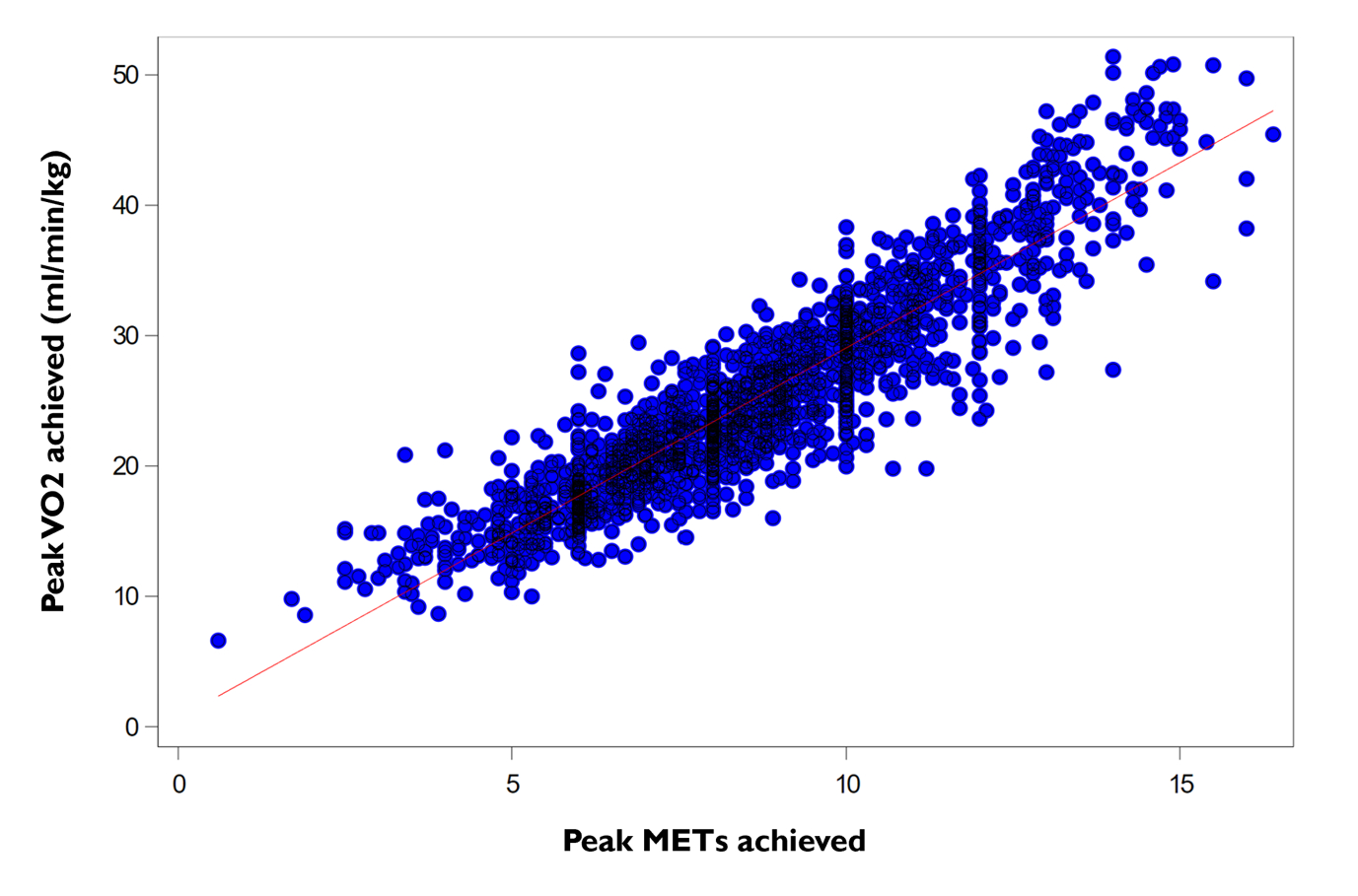
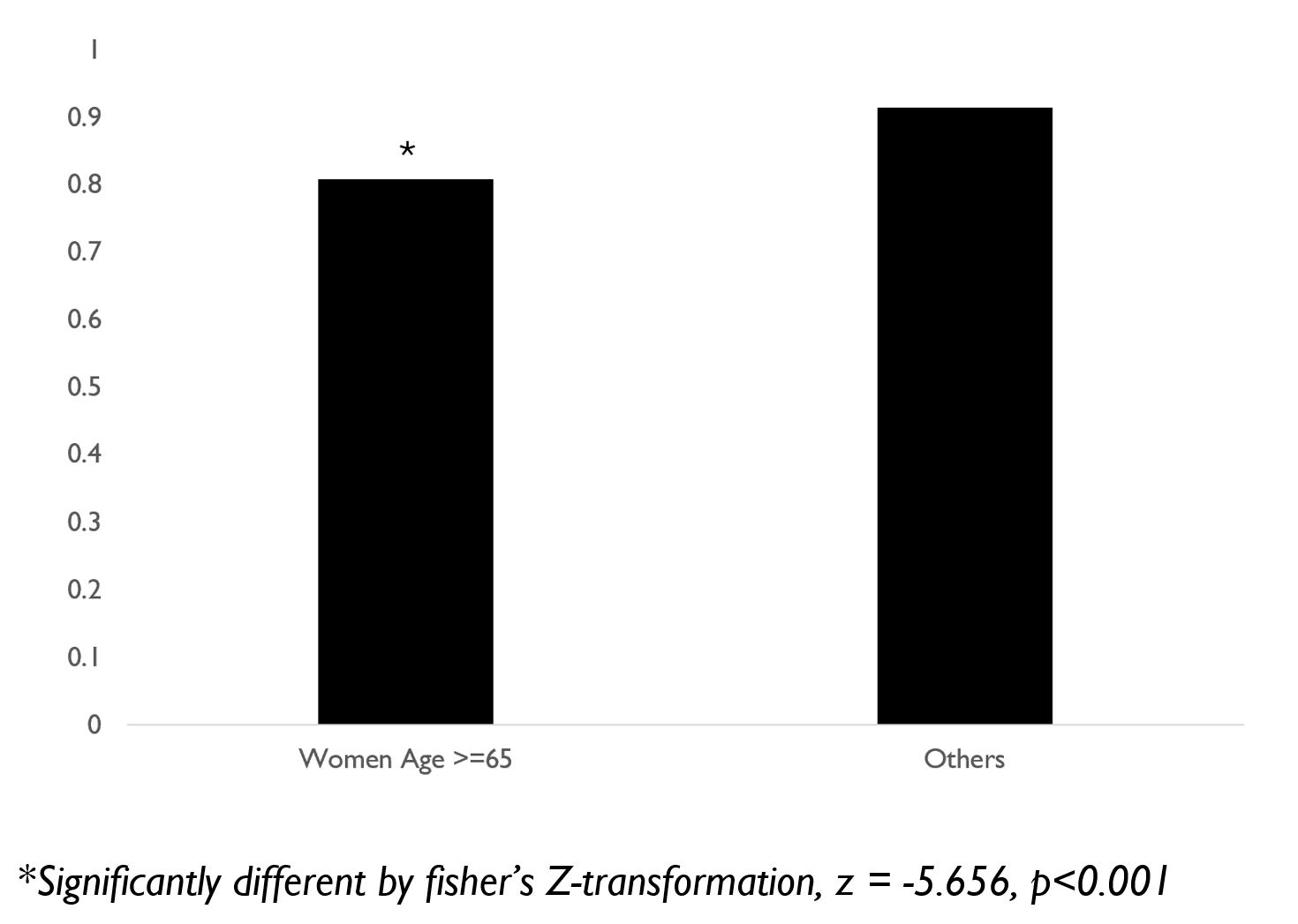
1907 patients were included. There was a strong positive correlation between peak VO2 and peak METs in the whole sample (r(1860) = 0.914), p<0,001), shown in Figure 1. Women age 65 or greater had a weaker correlation (r(190)=0.808, p<0.0001) compared to the those who were not (r(1668) = 0.915, p<0.0001; z = -5.656, p<0.001), shown in Figure 2.

Conclusions:
Peak METs and peak VO2 have an extremely strong positive correlation in a general cardiology population. However, these relationships weaken for women age 65 or greater. METs are an accurate, cost-effective proxy measurement of VO2 in a general population, however may lack reliability for certain demographics.
  • Chaliki, Kalyan  ( University of Arizona College of Medicine - Phoenix , Phoenix , Arizona , United States )
  • Sharma, Anubhuti  ( Mayo Clinic Arizona , Phoenix , Arizona , United States )
  • Sharma, Arundhati  ( Mayo Clinic Arizona , Phoenix , Arizona , United States )
  • Viggiano, Taylor  ( Mayo Clinic Arizona , Phoenix , Arizona , United States )
  • Yee, Claire  ( Mayo Clinic Arizona , Phoenix , Arizona , United States )
  • Reddy, Satyajit  ( Mayo Clinic Arizona , Phoenix , Arizona , United States )
  • Author Disclosures:
    Kalyan Chaliki: DO NOT have relevant financial relationships | Anubhuti Sharma: DO NOT have relevant financial relationships | Arundhati Sharma: DO NOT have relevant financial relationships | Taylor Viggiano: DO NOT have relevant financial relationships | Claire Yee: DO NOT have relevant financial relationships | Satyajit Reddy: DO NOT have relevant financial relationships
Meeting Info:

Scientific Sessions 2024

2024

Chicago, Illinois

Session Info:

Cardiac Rehab Remix

Saturday, 11/16/2024 , 02:00PM - 03:00PM

Abstract Poster Session

More abstracts on this topic:
A scoping review comparing individual and multi-level physical activity interventions in rural women in the United States

Wilhite Katrina, Umstattd Meyer M Renee, Barone Gibbs Bethany, Thrower Alexis, Modlin Sarah, Zheng Meiling, Williamson Carly, Marshall Elly, Desouky Virginia, Abildso Christiaan, Perry Cynthia

Association Between Meeting Physical Activity Time-Intensity Guidelines and Calf Muscle Oxygen Saturation in Patients with Symptomatic Peripheral Artery Disease

Gardner Andrew, Montgomery Polly, Wang Ming, Xu Xifei

More abstracts from these authors:
You have to be authorized to contact abstract author. Please, Login
Not Available