External validation and comparison with REVEAL 2.0 of the 6-strata system for risk stratification in PAH: are we reinventing the wheel?
Abstract Body (Do not enter title and authors here): Background. A recent study from the French Pulmonary Hypertension Network showed that stroke volume index (SVI) or mixed venous oxygen saturation (SvO2) may improve risk stratification at follow-up in pulmonary arterial hypertension (PAH) patients with intermediate-risk (according to the European 4-strata system). This resulted in a refined 6-strata system, associated with a discrimination improvement.
Research Questions. This 6-strata system has not been externally validated and compared with the U.S. based REVEAL 2.0 risk score.
Aims. To externally validate the refined 6-strata system and compare its performance with the current REVEAL 2.0 risk score.
Methods. A harmonized dataset from 8 PAH randomized controlled trials generated in collaboration with the FDA was used for this analysis. The REVEAL 2.0 and the refined 6-strata was calculated for individual patients at first follow-up. The outcome assessed was 1-year all-cause death. Discrimination capacities using C-index and 95% confidence interval were calculated.
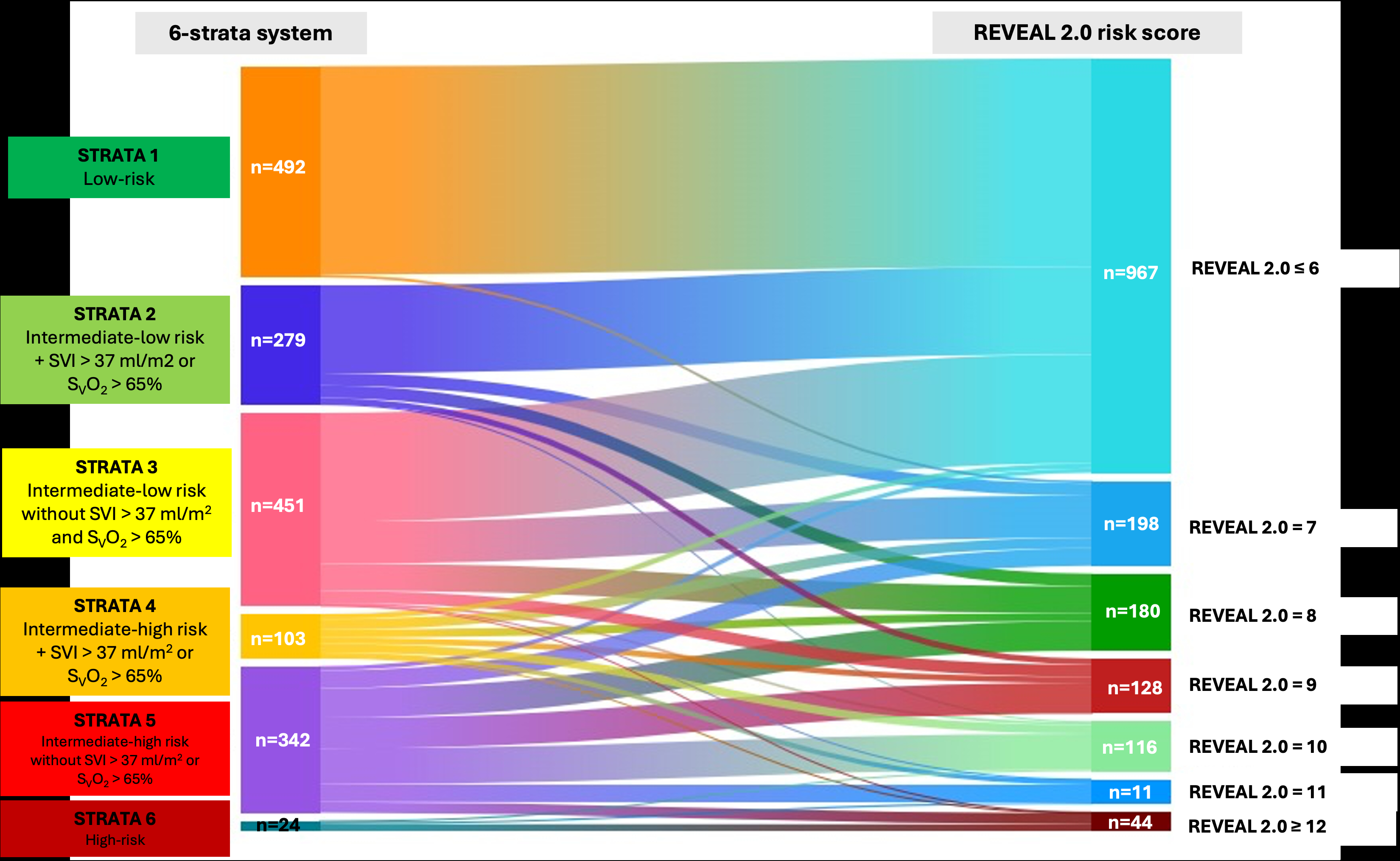
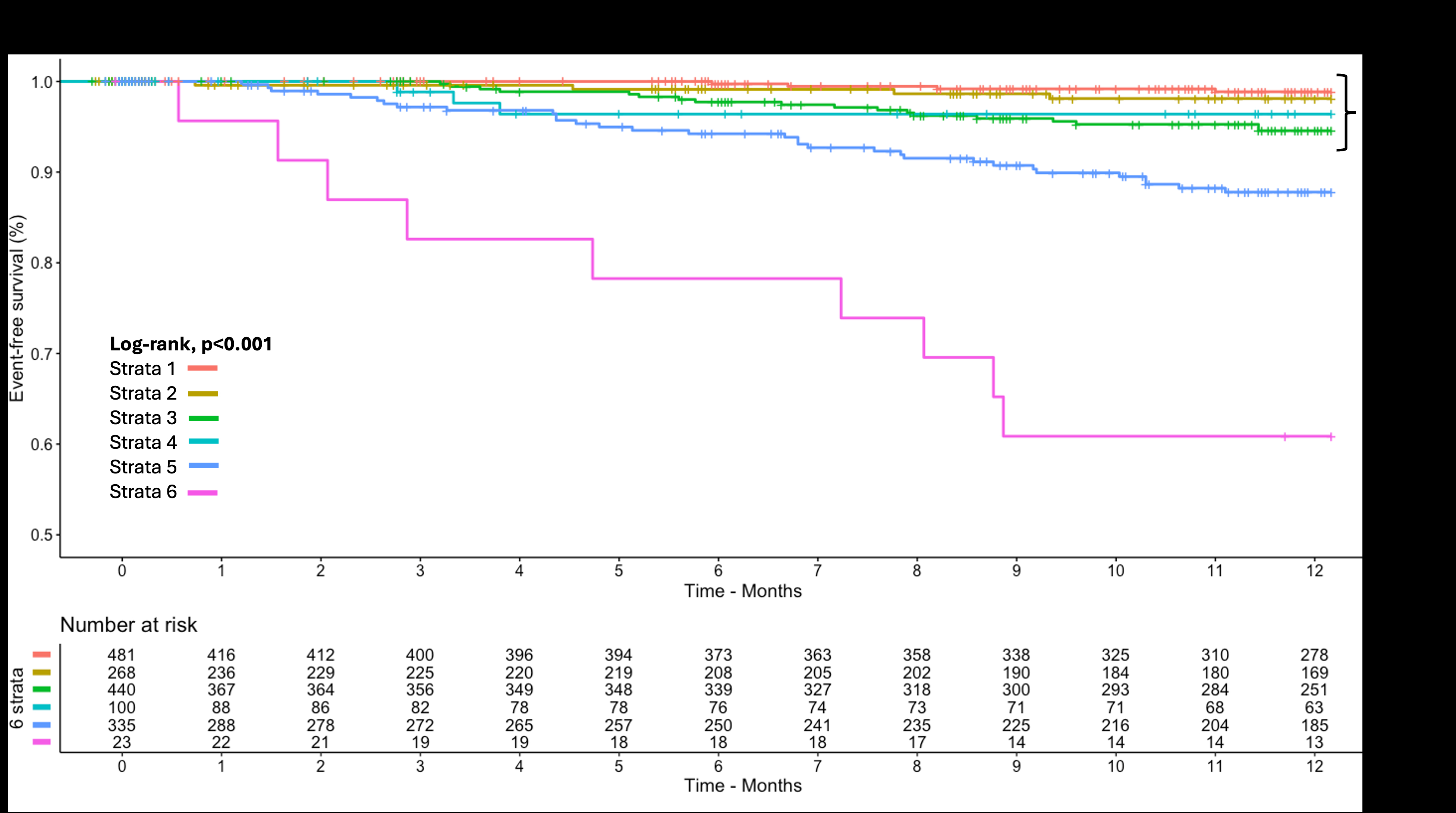
Results. A total of 1,692 PAH patients were included: median age 50 (37, 62) years, mPAP 50 (39, 60) mmHg, PVR 9.0 (6.1, 13.1) WU, 6MWD 393 (330, 441) m, NTproBNP 1,933 (148, 1882) pg/mL. Of these, 99% and 76% of patients classified as strata 1 and 2 (low-risk) by the 6-strata system respectively, were classified as low-risk by REVEAL 2.0. Similarly, majority of patients within the strata 3/4 and 5/6 were classified as intermediate and high risk by REVEAL 2.0, respectively. (Figure 1). C-index were 0.73, 95%CI [0.68, 0.78], 0.75, 95%CI[0.70, 0.80] and 0.78, 95%CI[0.73, 0.83] for the 4-strata, 6-strata and REVEAL 2.0 risk scores, respectively. There were no significant survival differences at 1-year between patients from strata 1 to 4 (Figure 2).
Conclusion. This is the first external validation of the modified 6-strata system. Although the discrimination capacities with the 6-strata is higher than with the 4-strata, yet it does not add incremental information regarding 1-year survival compared to REVEAL 2.0 risk score.
Fauvel, Charles
(
Rouen University Hospital
, Rouen , France )
Liu, Yongqi
(
The Ohio State University
, Columbus , Ohio , United States )
Correa-jaque, Priscilla
(
Mount Sinai Heart
, New York , New York , United States )
Everett, Allen
(
Johns Hopkins University
, Glenwood , Maryland , United States )
Kanwar, Manreet
(
Allegheny Health Network
, Pittsburgh , Pennsylvania , United States )
Vanderpool, Rebecca
(
The Ohio State University
, Columbus , Ohio , United States )
Sahay, Sandeep
(
Houston Methodist Hospital
, Houston , Texas , United States )
Benza, Raymond
(
Mount Sinai Heart
, New York , New York , United States )
Author Disclosures:
Charles Fauvel:DO have relevant financial relationships
;
Consultant:Janssen:Active (exists now)
; Speaker:Alnylam:Past (completed)
; Speaker:Zoll:Past (completed)
; Speaker:AstraZeneca:Past (completed)
; Research Funding (PI or named investigator):Novartis:Active (exists now)
; Research Funding (PI or named investigator):Pfizer:Past (completed)
| Yongqi Liu:DO NOT have relevant financial relationships
| Priscilla Correa-Jaque:DO NOT have relevant financial relationships
| Allen Everett:DO NOT have relevant financial relationships
| Manreet Kanwar:DO have relevant financial relationships
;
Consultant:Abbott:Active (exists now)
; Speaker:Abiomed:Active (exists now)
; Consultant:BiVACOR:Active (exists now)
; Consultant:CorWave:Active (exists now)
; Consultant:Abiomed:Active (exists now)
| Rebecca Vanderpool:DO NOT have relevant financial relationships
| Sandeep Sahay:DO have relevant financial relationships
;
Advisor:Janssen:Past (completed)
; Consultant:Morphic:Active (exists now)
; Research Funding (PI or named investigator):Keros:Active (exists now)
; Research Funding (PI or named investigator):Gossamer:Active (exists now)
; Research Funding (PI or named investigator):United Therapeutics:Active (exists now)
; Consultant:MERCK:Active (exists now)
; Consultant:Roivant:Active (exists now)
; Consultant:Keros:Active (exists now)
| Raymond Benza:DO have relevant financial relationships
;
Advisor:cereno:Active (exists now)
; Advisor:merck:Active (exists now)
; Advisor:respira:Active (exists now)
; Advisor:tectonic:Active (exists now)
; Advisor:gossamer:Active (exists now)
; Advisor:united therapeutics:Active (exists now)