
Clinical Outcomes of Postoperative Atrial Fibrillation Following Non-Cardiovascular Procedures: A Three-Year Study
Abstract Body (Do not enter title and authors here): Background Postoperative atrial fibrillation (AF) is common, often brief, and may recur, with some studies reporting a recurrence rate lower than 30% at one year. The initiation of anticoagulation (AC) in these patients, particularly those at lower stroke risk, remains debatable due to insufficient evidence. This study aims to assess outcomes in postoperative non-cardiovascular procedures with acute AF, focusing on patients at lower stroke risk, comparing those treated with and without AC.
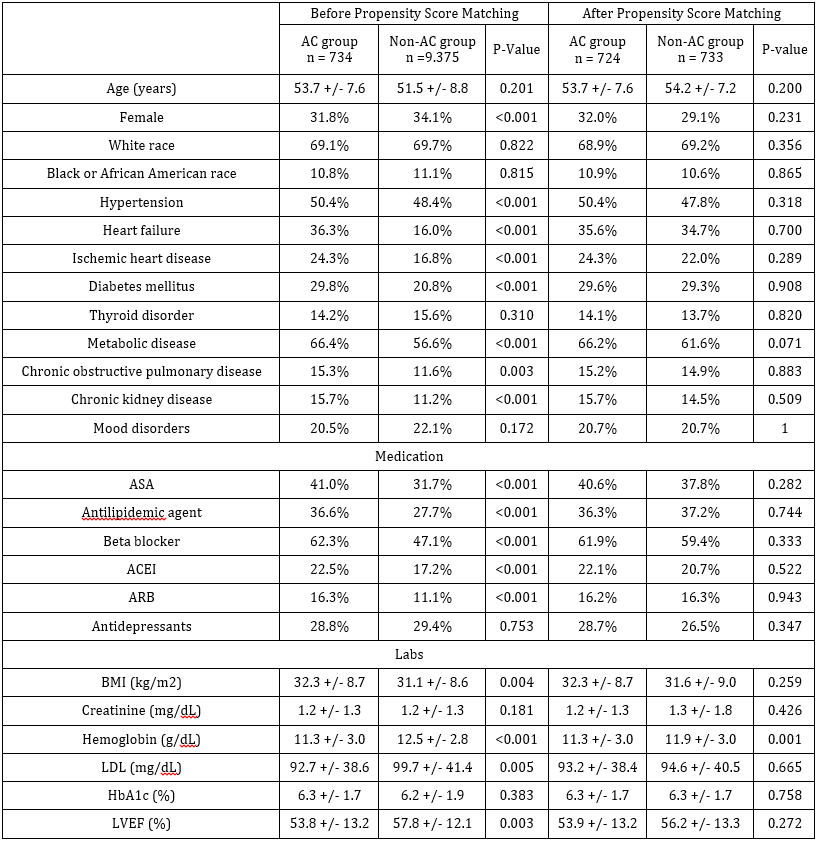
Method Using the TriNetX database, we identified patients aged 18 to 64 years with new-onset AF following non-cardiovascular procedures, excluding those with a history of stroke or other indications for anticoagulation. Patients were divided into AC and Non-AC groups based on AC initiation within two weeks of AF onset, then followed for three years. Propensity score matching (PSM) balanced confounders between groups. Thromboembolic and bleeding outcomes were assessed.
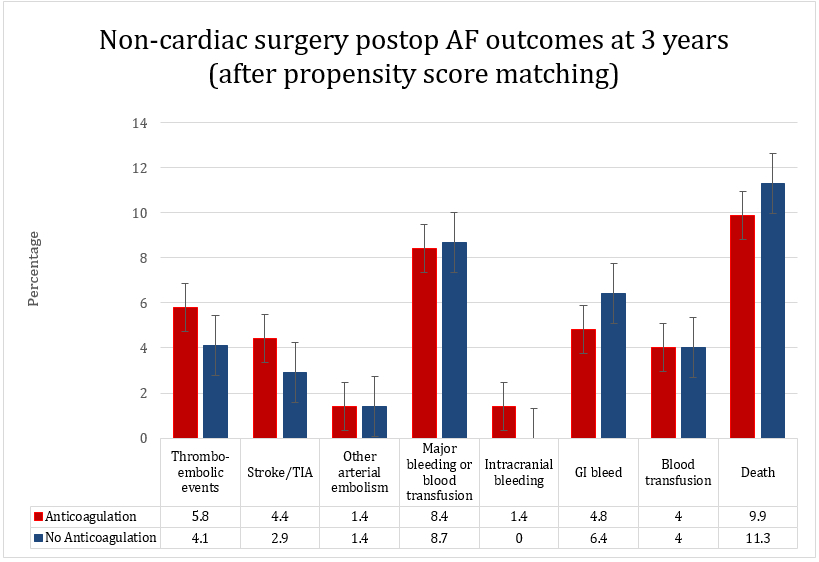
Results Among 10,108 patients, 734 (7%) received anticoagulation within two weeks of postop AF. After PSM, mean ages were 53.7±7.6 years for the AC group and 54.2±7.17 years for the Non-AC group. At 3 years, the incidence of composite thromboembolic events did not significantly differ between AC and Non-AC groups (5.8% vs. 4.1%, OR 0.70 (95% CI: 0.43-1.14)). Most thromboembolic events occurred within one month of AF onset. There were no significant differences in the composite of intracranial bleeding, gastrointestinal bleeding, retroperitoneal bleeding, or need for blood transfusion between the AC and Non-AC groups at 3 years (OR 1.04 (95% CI 0.72-1.50)).
Conclusion At three years, there is no significant difference in thromboembolic and bleeding outcomes in patients undergoing non-cardiovascular procedures who develop new-onset AF. Further randomized controlled trial is needed to determine the necessity of anticoagulation in this patient population.
Thangjui, Sittinun
( West Virginia University
, Morgantown
, West Virginia
, United States
)
Abdelazeem, Basel
( West Virginia University
, Morgantown
, West Virginia
, United States
)
Al Hajji, Mohamed
( West Virginia University
, Morgantown
, West Virginia
, United States
)
Perkowski, Gregory
( West Virginia University
, Morgantown
, West Virginia
, United States
)
Watson, Hangyu
( West Virginia University
, Morgantown
, West Virginia
, United States
)
Santer, Matthew
( West Virginia University
, Morgantown
, West Virginia
, United States
)
Thyagaturu, Harshith
( West Virginia University
, Morgantown
, West Virginia
, United States
)
Balla, Sudarshan
( West Virginia University
, Morgantown
, West Virginia
, United States
)
Arora, Sandeep
( West Virginia University
, Morgantown
, West Virginia
, United States
)
Author Disclosures:
Sittinun Thangjui:DO NOT have relevant financial relationships
| Basel Abdelazeem:DO NOT have relevant financial relationships
| Mohamed Al Hajji:No Answer
| Gregory Perkowski:DO NOT have relevant financial relationships
| HangYu Watson:DO NOT have relevant financial relationships
| Matthew Santer:DO NOT have relevant financial relationships
| Harshith Thyagaturu:DO NOT have relevant financial relationships
| sudarshan balla:DO NOT have relevant financial relationships
| Sandeep Arora:No Answer