
Logo

American Heart Association

  115
  0


Final ID: MDP1269

Evaluation of 3D Bioprinted Pulsatile Conduits Engineered Using Human Stem Cell-Derived Cardiomyocytes in a Murine Model

Abstract Body (Do not enter title and authors here): Introduction
Patients with single ventricle disease and Fontan circulation suffer long-term morbidity due to the lack of a sub-pulmonary ventricle. The concept of a pulsatile Fontan conduit, functioning as a sub-pulmonary ‘neo-ventricle,’ using engineered heart tissue (EHT), may be a potential solution. To this end, we developed a tissue-engineered vascular conduit with EHT that allowed surgical implantation into a murine model for in-vivo assessment.
Methods
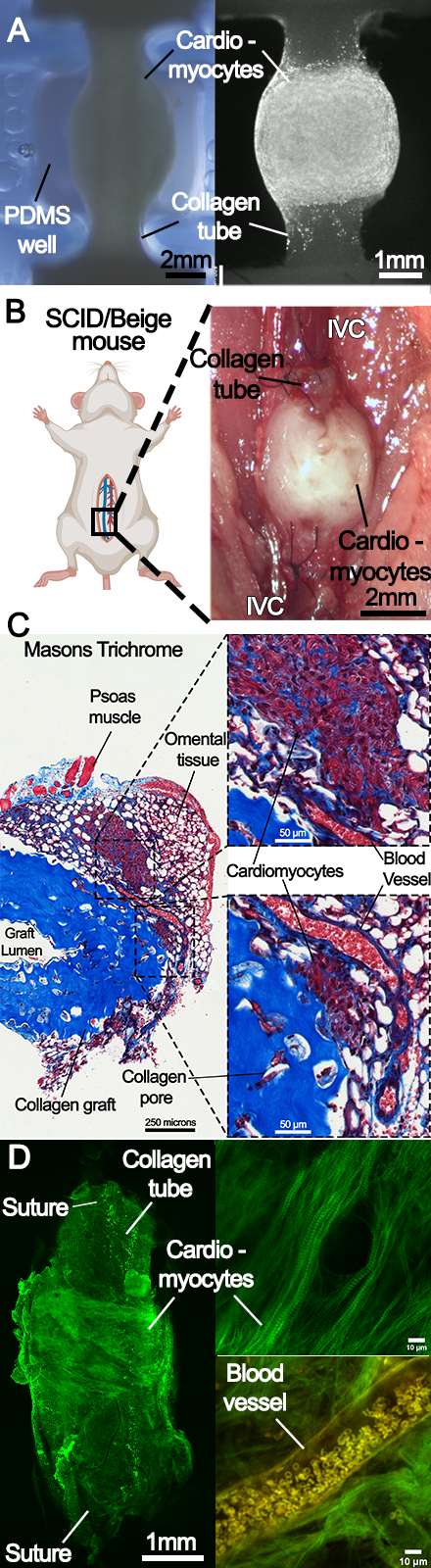
Mouse-scale conduits were fabricated from type I collagen using freeform reversible embedding of suspended hydrogels (FRESH) 3D bioprinting. The conduits were cellularized using human stem cell-derived cardiomyocytes and cardiac fibroblasts. Electrophysiology was assessed using calcium imaging. The conduits were surgically anastomosed to the infra-renal inferior vena cava (IVC) as an end-end interposition graft in severe combined immunodeficiency (SCID)/beige mice. The conduit's patency and the EHT's contractility were monitored with monthly ultrasounds. Explanted conduits underwent histology, immunohistochemistry (IHC), and immunofluorescent (IF) imaging.
Results
Sixteen contractile conduits were produced. In vitro calcium imaging demonstrated anisotropic calcium wave propagation along the conduit at day 14. Twelve grafts were implanted in the mouse IVC and half of the grafts (n=6) were explanted 6 months postoperatively. At explant, five showed synchronous contractile behavior in-vivo of the EHT around the collagen conduit. Interconnected networks of sarcomeric alpha actinin-positive cardiomyocytes were observed on IHC and IF. Neo-vascularization was seen infiltrating the EHT on histology. Six mice remained alive at 11 months post-operatively, three with contractile activity seen via ultrasound. All twelve grafts were patent on ultrasound with no stenosis.
Conclusion
We have produced mouse-scale pulsatile conduits using human embryonic-derived cardiomyocytes and bioprinting that are robust enough to withstand surgical anastomosis to the IVC and remain patent. We observed functional beating of the EHT at 11 months in vivo. This model could be used to assess and improve the in-vivo function of EHT towards producing a larger-scale pulsatile Fontan conduit.
  • Ashraf, Syed Faaz  ( Carnegie Mellon University , Pittsburgh , Pennsylvania , United States )
  • Breuer, Christopher  ( Nationwide Children’s Hospital , Columbus , Ohio , United States )
  • Feinberg, Adam  ( Carnegie Mellon University , Pittsburgh , Pennsylvania , United States )
  • Bliley, Jacqueline  ( Carnegie Mellon University , Pittsburgh , Pennsylvania , United States )
  • Yi, Tai  ( Nationwide Children’s Hospital , Columbus , Ohio , United States )
  • Leland, Joseph  ( Nationwide Children’s Hospital , Columbus , Ohio , United States )
  • Kang, Amanda  ( Carnegie Mellon University , Pittsburgh , Pennsylvania , United States )
  • Stang, Maria  ( Carnegie Mellon University , Pittsburgh , Pennsylvania , United States )
  • Dikyol, Caner  ( Carnegie Mellon University , Pittsburgh , Pennsylvania , United States )
  • Behre, Anne  ( Carnegie Mellon University , Pittsburgh , Pennsylvania , United States )
  • Tzeng, Edith  ( UNIVERSITY PITTSBURGH , Presto , Pennsylvania , United States )
  • Author Disclosures:
    Syed Faaz Ashraf: DO NOT have relevant financial relationships | christopher breuer: DO have relevant financial relationships ; Research Funding (PI or named investigator):gunze limited:Active (exists now) ; Other (please indicate in the box next to the company name):Biostage (DSMB member):Active (exists now) ; Other (please indicate in the box next to the company name):Mezzion (DSMB member):Active (exists now) ; Research Funding (PI or named investigator):Pall (Cytiva):Past (completed) | Adam Feinberg: DO NOT have relevant financial relationships | Jacqueline Bliley: No Answer | Tai Yi: No Answer | Joseph Leland: DO NOT have relevant financial relationships | Amanda Kang: No Answer | Maria Stang: No Answer | Caner Dikyol: DO NOT have relevant financial relationships | Anne Behre: No Answer | Edith Tzeng: No Answer
Meeting Info:

Scientific Sessions 2024

2024

Chicago, Illinois

Session Info:

Novel Approaches and New Models for Cardiovascular Research

Monday, 11/18/2024 , 11:10AM - 12:40PM

Moderated Digital Poster Session

More abstracts on this topic:
Changes in Subcortical Iron Deposition in Adolescents and Young Adults with Fontan Circulation

Gonzalez Zacarias Clio, Wood John, Salcudean Hannah, Carpenter Emma, Xu Botian, Mejia Samantha, Suriany Silvie, Joshi Anand, Leahy Richard, Chiarelli Peter

Cerebral blood flow, Hemodynamics, Brain Injury and Association With Neurodevelopmental Outcome in Single Ventricle Patients After Fontan: A Pilot Study Utilizing Classification and Regression Tree (CART) Analysis

Fogel Mark, Partington Sara, Vossough Arastoo, Flynn Thomas, Murawsky Jessica, Lozano Alicia, Ji Wenyan, Hanlon Alexandra, Whitehead Kevin, Biko David, Harris Matthew, Nicolson Susan

More abstracts from these authors:
Aortic Valve Care 2030: What does the future hold

Yoganathan Ajit, Breuer Christopher

Glucagon-like-peptide-1 Receptor Agonists Are Associated with Lower Postoperative Complication Rates in Patients with Peripheral Artery Disease

Nassereldine Hasan, Reitz Katherine, Jarosinski Marissa, Lowenkamp Mikayla, Yehualashet Elonay, Iams Alexas, Liang Nathan, Tzeng Edith, Sridharan Natalie

You have to be authorized to contact abstract author. Please, Login
Not Available