cusp-overlap view versus three cusp coplanar view during transcatheter aortic valve replacement using self-expandable valves: A meta-analysis of 5947 patients.
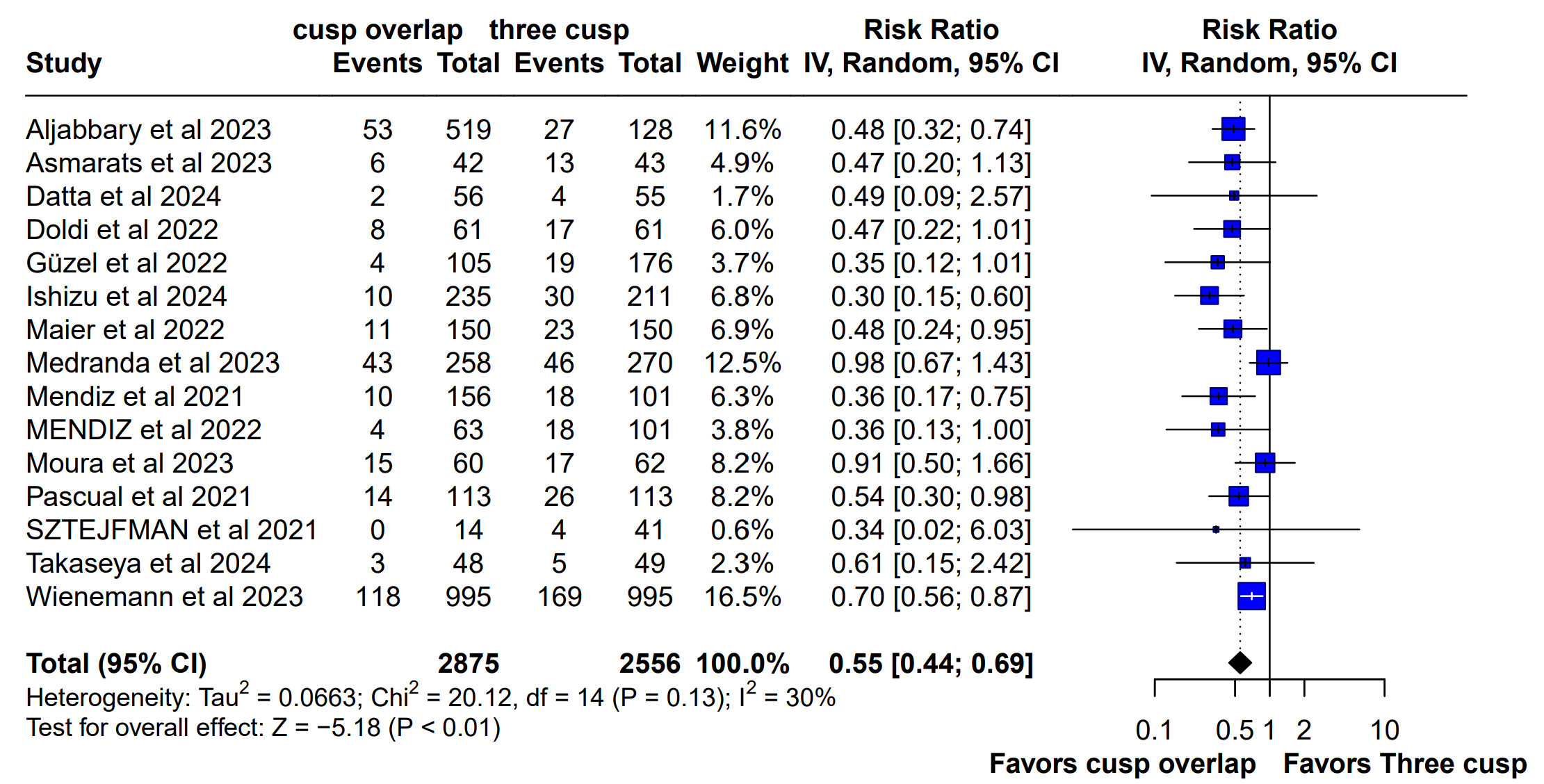
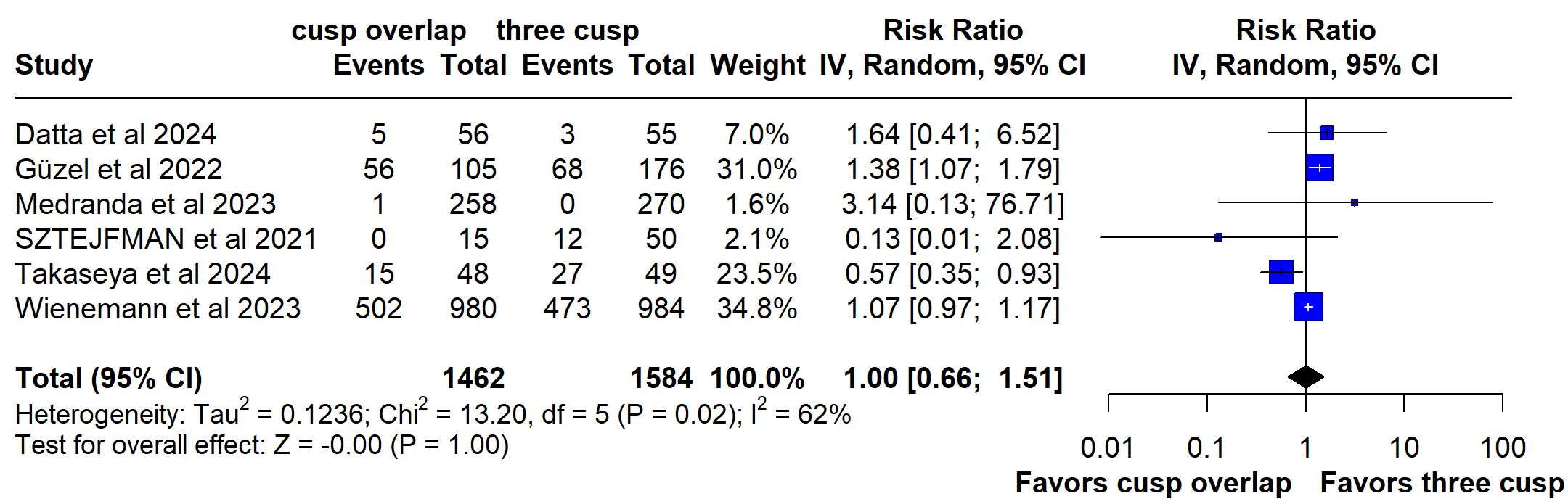
Abstract Body (Do not enter title and authors here): Background& Objectives: Transcatheter aortic valve replacement (TAVR) is currently the treatment of choice for most patients with symptomatic severe aortic stenosis. We conducted this systematic review, and meta-analysis to compare the efficacy and procedural outcomes of using the cusp overlap technique (COT) versus the standard three-cusp technique during self-expandable valves implantation for the management of aortic stenosis. Methodology: We systematically searched PubMed, Scopus, Embase, Cochrane, and Web of Science (WOS) from inception to March 5, 2024, following the Preferred Reporting Items for Systematic Reviews and Meta-Analyses (PRISMA) statement. To estimate the effect size, dichotomous outcomes were pooled as risk ratio (RR), and continuous outcomes were pooled as mean difference (MD) with their respective 95% confidence interval (CI). Results: We included seventeen studies in our systematic review and meta-analysis with a total of 3129 patients in cusp-overlap technique (COT) arm and 2818 patients in standard technique (ST) arm. The rate of 30-day mortality was significantly decreased in COT compared with ST (RR = 0.61; 95% CI: [0.37–1.00], P = 0.05). Regarding conduction abnormalities, COT was related to lower risk of complete atrioventricular (AV) block (RR = 0.51; 95% CI: [0.37–0.69], P < 0.01), reduced likelihood of left bundle branch block (RR = 0.77; 95% CI: [0.61–0.97], P = 0.03) and permanent pacemaker implantation (PPI) (RR = 0.56; 95% CI: [0.46–0.70], P < 0.01). There was also lower likelihood of major and life-threatening bleeding with the COT compared to ST (RR = 0.60; 95% CI: [0.46–0.79], P < 0.01). Our analysis also showed that COT was associated with significantly lower implantation depth compared with ST (MD = -1.00; 95% Cl: [-1.83 to -0.17], P = 0.02). Procedural success was similar between COT and ST (RR = 1.01; 95% CI: [0.98–1.04], P = 0.42). Major vascular complications (RR = 0.90; 95% CI: [0.61–1.33], P = 0.61), and mild to severe paravalvular leak (RR = 1.00; 95% CI: [0.66–1.51], P = 1.00) were also comparable between COT and ST. Conclusion: Our study findings suggest that COT offers several advantages over ST, including reduced 30-day mortality and decreased bleeding complications, without compromising long-term outcomes or increasing procedural complications. The COT most importantly lower risk of conduction abnormalities, and hence permanent pacemaker implantation.
K. Awad, Ahmed
(
Faculty of Medicine, Ain shams University
, Cairo , Egypt )
Khalefa, Basma
(
Ain shams university
, Cairo , Egypt )
R. Gonnah, Ahmed
(
Imperial College Healthcare NHS Trust
, Lo , United Kingdom )
Negmeldin Aly Yassin, Mazen
(
Faculty of medicine, Cairo University
, Cairo , Egypt )
G.hamam, Nada
(
Faculty of medicine, Cairo University
, Cairo , Egypt )
Ramadan, Mohamed
(
Faculty of Medicine, Suez University
, Suez , Egypt )
Dway, Ali
(
Faculty of Medicine, Al-Andalus University for medical sciences
, Tartus , Syrian Arab Republic )
Alsalhi, Karim
(
Faculty of Medicine, Batterjee Medical College
, Jeddah , Saudi Arabia )
T. Osman, Mohamed
(
Faculty of Medicine, Ain shams University
, Cairo , Egypt )
Sicouri, Serge
(
Lankenau Institute for Medical Research, Main Line Health
, Wynnewood , Pennsylvania , United States )
Basel, Ramlawi
(
Lankenau Heart Institute, Lankenau Medical Center, Main Line Health
, Wynnewood , Pennsylvania , United States )
Author Disclosures:
Ahmed K. Awad:DO NOT have relevant financial relationships
| Serge Sicouri:No Answer
| Ramlawi Basel:No Answer
| Basma Khalefa:DO NOT have relevant financial relationships
| Ahmed R. Gonnah:DO NOT have relevant financial relationships
| Mazen Negmeldin Aly Yassin:DO NOT have relevant financial relationships
| Nada G.Hamam:DO NOT have relevant financial relationships
| Mohamed Ramadan:DO NOT have relevant financial relationships
| Ali Dway:DO NOT have relevant financial relationships
| Karim Alsalhi:DO NOT have relevant financial relationships
| Mohamed T. Osman:DO NOT have relevant financial relationships