Abstract Body (Do not enter title and authors here): BACKGROUND: Ischemic stroke remains a dreaded complication of paracorporeal (continuous-PC; pulsatile-PP) ventricular assist devices (VADs) in pediatric patients. Advancements in anticoagulation management have improved the stroke rate to 12-17%, however, the management of antiplatelet therapy varies across centers. This study examines the outcomes of an antiplatelet protocol for patients with paracorporeal VADs at our center.
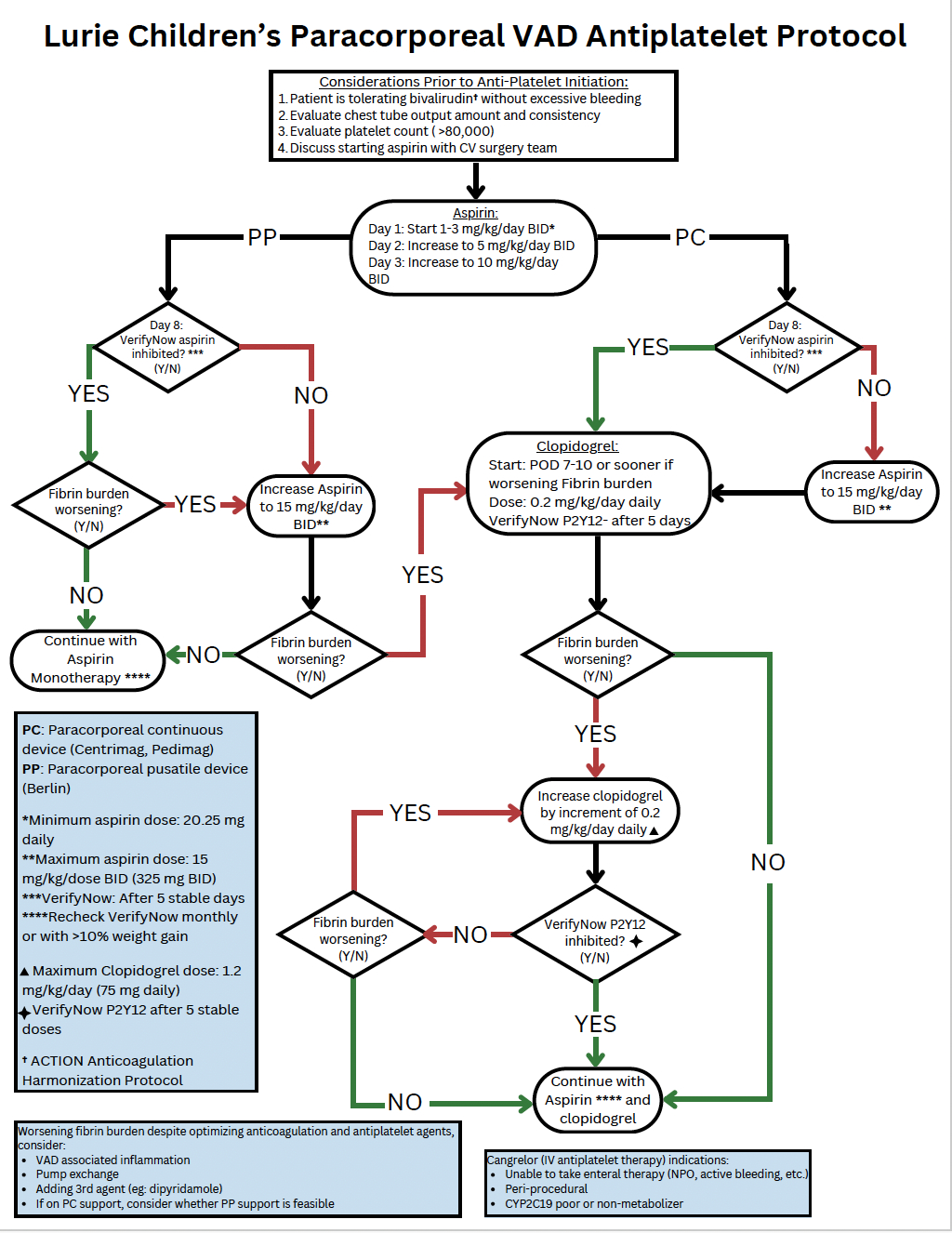
METHODS: We developed an antiplatelet protocol (Fig. 1) with dose adjustments guided by platelet function assays, VAD fibrin burden, and bleeding risk. We retrospectively reviewed patients with a paracorporeal VAD between December 2018 to December 2023. Demographic variables, incidence of thrombotic and bleeding events, and outcomes were assessed using descriptive statistics.
RESULTS: The cohort comprised 44 patients (52% male), median age 19 months (1 month - 8 years), with 22 (50%), 9 (20.5%), and 13 (29.5%) patients supported on PP, PC, and multiple VAD types respectively. Median support duration was 131 (PP; IQR 87, 183), 31 (PC; IQR 16, 46), and 88 (multiple VADs; IQR 66, 196) days. Diagnoses included cardiomyopathy 38% (n=17), congenital heart disease 57% (n=25) and others 5% (n=2). Thrombotic complications included: ischemic stroke in 6.8% (n=3) (1.9 events/100 patient months compared to 6-11 events/100 months reported in recent multicenter registry data); 11% (n=5) patients underwent 6 pump exchanges for fibrin burden. Major bleeding rate was 29.5% (n=13), most commonly gastrointestinal bleed; there were no hemorrhagic strokes. Five (11.3%) patients had an asymptomatic subdural hematoma (n=4 tiny/small, n=1 moderate). A positive clinical outcome was achieved in 86%, with 77% (n=34) bridged to transplant, 5% (n=2) explanted for recovery, and 5% (n=2) alive on device. Overall mortality was 14% (2 died on device, 4 transitioned to ECMO and died).
CONCLUSIONS: Our experience underscores the efficacy of a structured antiplatelet protocol in managing pediatric patients with paracorporeal VADs associated with a low stroke rate. Future studies are needed to assess the generalizability of these findings.
Garg, Ashish
(
Ann and Robert H. Lurie Children's Hospital of Chicago/Northwestern University Feinberg School of Medicine
, Chicago , Illinois , United States )
Bercovitz, Rachel
(
Ann and Robert H. Lurie Children's Hospital of Chicago/ Northwestern University Feinberg School of Medicine
, Chicago , Illinois , United States )
Hammond, Nora
(
Ann and Robert H. Lurie Children's Hospital of Chicago
, Chicago , Illinois , United States )
Monge, Michael
(
Ann and Robert H. Lurie Children's Hospital of Chicago/Northwestern University Feinberg School of Medicine
, Chicago , Illinois , United States )
Thrush, Philip
(
Ann and Robert H. Lurie Children's Hospital of Chicago/Northwestern University Feinberg School of Medicine
, Chicago , Illinois , United States )
Joong, Anna
(
Ann and Robert H. Lurie Children's Hospital of Chicago/Northwestern University Feinberg School of Medicine
, Chicago , Illinois , United States )
Author Disclosures:
Ashish Garg:DO NOT have relevant financial relationships
| Rachel Bercovitz:No Answer
| Nora Hammond:DO NOT have relevant financial relationships
| Michael Monge:DO NOT have relevant financial relationships
| Philip Thrush:No Answer
| Anna Joong:DO NOT have relevant financial relationships