Logo

American Heart Association

  105
  0


Final ID: MDP422

Integrating Clinical, Genetic, and Electrocardiogram-Based Artificial Intelligence to Estimate Risk of Incident Atrial Fibrillation

Abstract Body (Do not enter title and authors here): Background: Atrial fibrillation (AF) risk estimation is feasible using clinical factors, inherited predisposition, and artificial intelligence (AI)-enabled electrocardiogram (ECG) analysis. Whether integrating these distinct risk signals improves AF risk estimation is unknown.
Methods: In the UK Biobank prospective cohort study, we estimated AF risk using three models derived from external populations: the well-validated Cohorts for Aging in Heart and Aging Research in Genomic Epidemiology AF (CHARGE-AF) clinical score, a published AI-enabled ECG-based AF risk model (ECG-AI), and a 1113667-variant AF polygenic risk score (PRS). We estimated discrimination of 5-year incident AF using time-dependent area under the receiver operating characteristic (AUROC) and average precision (AP).
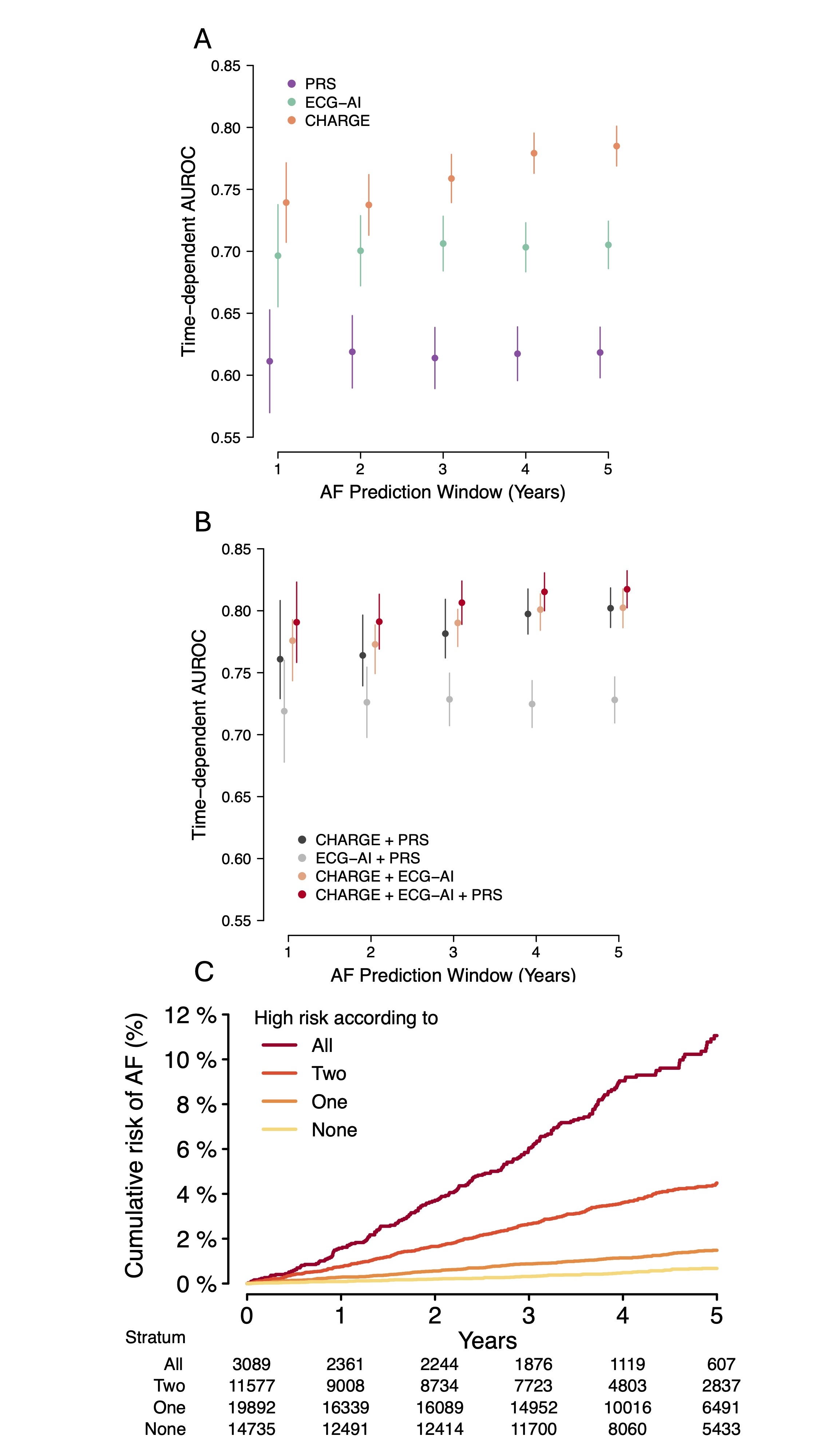
Results: Among 49,293 individuals (mean age 65±8 years, 52% women), 825 (2.4%) developed AF within 5 years. Using single models, discrimination of 5-year incident AF was higher using ECG-AI (AUROC 0.705 [95%CI 0.686-0.724]; AP 0.085 [0.071-0.11]) and CHARGE-AF (AUROC 0.785 [0.769-0.801]; AP 0.053 [0.048-0.061]) versus the PRS (AUROC 0.618, [0.598-0.639]; AP 0.038 [0.028-0.045]). The best performing two component model was CHARGE-AF+ECG-AI (AUROC 0.802 [0.786-0.818]; AP 0.098 [0.081-0.13]), with further improvement observed with inclusion of all components (“Total-AF”, AUROC 0.817 [0.802-0.832]; AP 0.11 [0.091-0.15], p<0.01 vs CHARGE-AF+ECG-AI). Using Total-AF, individuals at high AF risk (i.e., 5-year predicted AF risk >2.5%) had a 5-year cumulative incidence of AF of 5.83% (5.33-6.32). At the same threshold, the 5-year cumulative incidence of AF was progressively higher according to the number of models predicting high risk (zero: 0.67% [0.51-0.84], one: 1.48% [1.28-1.69], two: 4.48% [3.99-4.98]; three: 11.06% [9.48-12.61]. Total-AF achieved favorable net reclassification improvement compared to both CHARGE-AF+ECG-AI (0.039 [0.015-0.066]) and CHARGE-AF+PRS (0.033 [0.0082-0.059]).
Conclusions: Integration of clinical, genetic, and AI-derived risk signals improves discrimination of 5-year AF risk over individual components. Models such as Total-AF have potential to improve the prioritization of individuals for AF screening.
  • Kany, Shinwan  ( Broad Institute , Cambridge , Massachusetts , United States )
  • Ellinor, Patrick  ( Broad Institute of MIT and Harvard , Brookline , Massachusetts , United States )
  • Khurshid, Shaan  ( Broad Institute of MIT and Harvard , Brookline , Massachusetts , United States )
  • Rämö, Joel  ( Broad Institute , Cambridge , Massachusetts , United States )
  • Friedman, Sam  ( Broad Institute , Cambridge , Massachusetts , United States )
  • Weng, Lu-chen  ( Broad Institute , Cambridge , Massachusetts , United States )
  • Kim, Min Seo  ( Broad Institute of MIT and Harvard , Brookline , Massachusetts , United States )
  • Fahed, Akl  ( Massachusetts General Hospital , Boston , Massachusetts , United States )
  • Lubitz, Steven  ( Novartis , Cambridge , Massachusetts , United States )
  • Philippakis, Anthony  ( BRIGHAM AND WOMENS HOSPITAL , Cambridge , Massachusetts , United States )
  • Maddah, Mahnaz  ( Broad Institute , Cambridge , Massachusetts , United States )
  • Author Disclosures:
    Shinwan Kany: DO NOT have relevant financial relationships | Patrick Ellinor: No Answer | Shaan Khurshid: No Answer | Joel Rämö: No Answer | Sam Friedman: DO NOT have relevant financial relationships | Lu-Chen Weng: DO NOT have relevant financial relationships | Min Seo Kim: DO NOT have relevant financial relationships | Akl Fahed: No Answer | Steven Lubitz: DO have relevant financial relationships ; Employee:Novartis:Active (exists now) | Anthony Philippakis: No Answer | Mahnaz Maddah: DO NOT have relevant financial relationships
Meeting Info:

Scientific Sessions 2024

2024

Chicago, Illinois

Session Info:

Revolutionizing Cardiac Care: Machine Learning Innovations in ECG Analysis

Saturday, 11/16/2024 , 09:30AM - 10:55AM

Moderated Digital Poster Session

More abstracts on this topic:
Agency Epinephrine Dosing Intervals and Patient Characteristics in Out-of-Hospital Cardiac Arrest: A National EMS Study

Defilippo Michael, Braude Darren, Root Christopher, Covert Harold, Fisher Benjamin, Huebinger Ryan

12,13-diHOME Attenuates Pro-Arrhythmic Effect of High-Fat Diet

Buck Benjamin, Baer Lisa, Deschenes Isabelle, Chinthalapudi Krishna, Gallego-perez Daniel, Stanford Kristin, Hund Thomas, Areiza Natalia, Xu Xianyao, Elliott Austin, Wan Xiaoping, Nassal Drew, Lane Cemantha, Nirengi Shinsuke, James Natasha Maria

More abstracts from these authors:
Prediction of Incident Atrial Fibrillation Using Handheld Single-Lead Electrocardiograms from the VITAL-AF Trial

Khurshid Shaan, Atlas Steven, Maddah Mahnaz, Singer Daniel, Ellinor Patrick, Friedman Sam, Al-alusi Mostafa, Kany Shinwan, Anderson Christopher, Ho Jennifer, Mcmanus David, Ashburner Jeffrey, Lubitz Steven

Machine Learning-Enabled Papillary Muscle Fibrosis Assessment in 51,000 Individuals Reveals Independent Links to Cardiac Structure, Function, and Disease and Identifies Genetic Susceptibility Loci

Nauffal Victor, Kwong Raymond, Ellinor Patrick, Pace Danielle, Balasubramanian Aadhi, Kassir Jad, Danik Katherine, Friedman Sam, Simonson Bridget, Chilazi Michael, Maddah Mahnaz

You have to be authorized to contact abstract author. Please, Login
Not Available