
Association Between Frailty Testing through Gait Speed and Mortality in CRT Patients: Report for a Multidisciplinary CRT Clinic
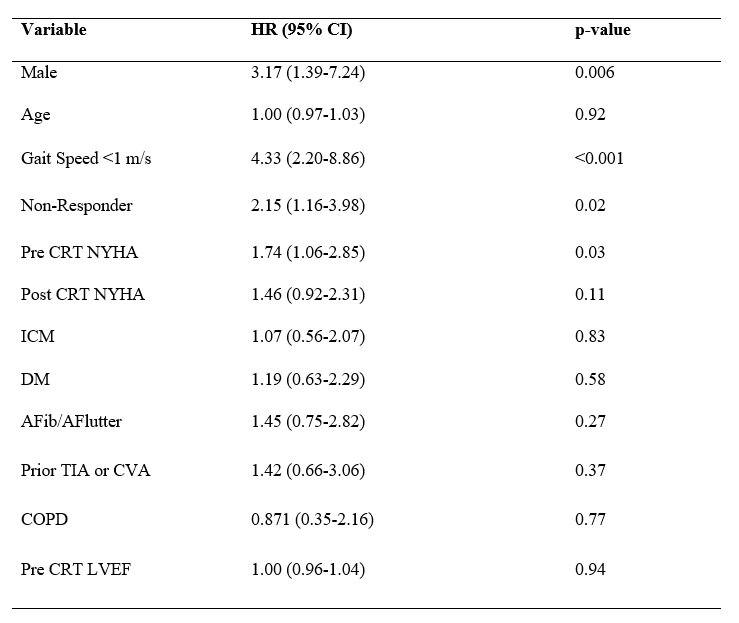
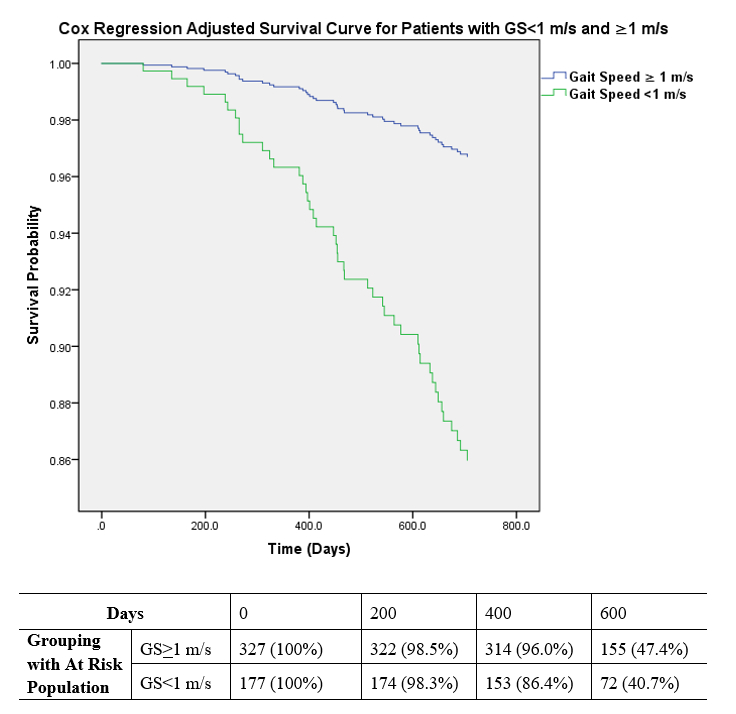
Abstract Body (Do not enter title and authors here): Background: Identifying predictors of mortality in CRT patients remains an active area of investigation. Objective: To establish a relationship between gait speed (GS) and mortality in heart failure patients with CRT. Hypothesis: Patients with slower gait speeds have worse survival rates after CRT implantation. Methods: This retrospective study included 504 patients who underwent CRT implantation at our institution between 2017-2022. All patients were followed up with a multidisciplinary team, including electrophysiology and heart failure physicians about 6 months after CRT implantation, where frailty was assessed. We used GS as a measure of frailty and divided patients into 2 groups: GS: <1 m/s (n=177) and ≥ 1 m/s (n=327). The primary endpoint was a composite of left ventricular assist device implantation, transplant, or death at 2 years post-CRT. Data was collected retrospectively from electronic medical records. Results: The study population was 65.7% male, with a mean age of 69.1 years, with majority of the devices being CRT-D (79.6%). Response was defined as an improvement in LVEF >5% with reduction in LVESV>10%; anybody not meeting this definition was classified as a non-responder. Responder and non-responder rates among GS< 1 m/s and GS > 1 m/s were 53.8% vs 66.4%; and 35.1% vs 26.2%, respectively. The median (IQR) GS was 1.15 m/s (0.91-1.37 m/s). 52 (10.3%) patients had a composite outcome within 2 years follow up. Non-parametric univariate analysis revealed that lower GS was significantly associated higher composite outcome rates (median GS 0.8 vs 1.18 m/s; p<0.001). Multivariate cox regression also revealed GS<1 m/s to be an independent predictor of our composite outcome [HR- 4.33 (2.20-8.86); p<0.001] (Table 1), with survival graphs showing patients with GS<1m/s having worse 2-year survival (Figure 1). Conclusion: Frailty testing using GS post-CRT implantation is a strong predictor of mortality in CRT patients.
Paul, Aritra
( Cleveland Clinic Foundation
, Cleveland
, Ohio
, United States
)
Demian, Joe
( Cleveland Clinic Foundation
, Cleveland
, Ohio
, United States
)
Varma, Niraj
( Cleveland Clinic Foundation
, Cleveland
, Ohio
, United States
)
Finet, J. Emanuel
( Cleveland Clinic Foundation
, Cleveland
, Ohio
, United States
)
Kochar, Arshneel
( Cleveland Clinic Foundation
, Cleveland
, Ohio
, United States
)
Bader, Feras
( Cleveland Clinic
, Cleveland
, Ohio
, United States
)
Wazni, Oussama
( Cleveland Clinic Foundation
, Cleveland
, Ohio
, United States
)
Tang, Wilson
( Cleveland Clinic Foundation
, Cleveland
, Ohio
, United States
)
Rickard, John
( Cleveland Clinic Foundation
, Cleveland
, Ohio
, United States
)
Author Disclosures:
Aritra Paul:DO NOT have relevant financial relationships
| Joe Demian:DO NOT have relevant financial relationships
| Niraj Varma:DO have relevant financial relationships
;
Researcher:Impulse Dynamics:Active (exists now)
| J. Emanuel Finet:DO NOT have relevant financial relationships
| Arshneel Kochar:DO NOT have relevant financial relationships
| Feras Bader:DO NOT have relevant financial relationships
| Oussama Wazni:DO have relevant financial relationships
;
Consultant:boston scientific:Active (exists now)
; Speaker:Boston Scientific:Past (completed)
| Wilson Tang:No Answer
| John Rickard:No Answer