Logo

American Heart Association

  125
  0


Final ID: Sa3072

Association of Body Roundness Index and Cardiovascular Disease among US Adults

Abstract Body (Do not enter title and authors here): Background: Obesity is one of the major risk factors for cardiovascular disease (CVD), body roundness index (BRI) is more comprehensive in assessing fat distribution than traditional measurements. However, evidence regarding the association between BRI and the risk of CVD was limited, particularly in American people. This current study aimed to investigate the association between BRI and the risk of CVD among US adults.
Hypothesis: We hypothesized that higher BRI was associated with a higher risk of CVD.
Methods: A total of 21,852 participants were included in the National Health and Nutrition Examination Surveys from 6 survey cycles (2003-2004, 2005-2006, 2007-2008, 2009-2010, 2011-2012, 2013-2014, 2015-2016 and 2017-2018). Weighted multivariate logistic regression was carried out to examine the relationship between BRI and the risk of CVD. Restricted cubic spline (RCS) curves were employed to analyze nonlinear relationships.
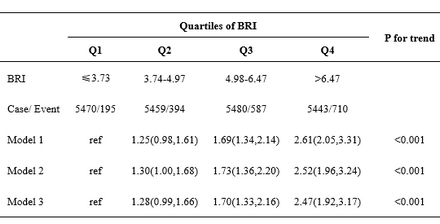
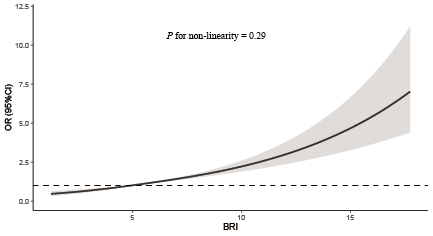
Results: Among 21,852 US adults, the mean (SD) age was 47.5 (17.3) years, 10,669 (48.8%) were female, and 1886 were diagnosed with CVD. In the weighted multi-variable logistic regression model with adjustment for demographics, lifestyle, economic status and dietary factors, higher BRI was significantly associated with a substantially higher risk of CVD. Compared with the participants in the lowest quartile of BRI, those in the highest quartile of BRI had a higher CVD, with OR and 95%CI of 2.47 (1.92-3.17). Furthermore, the RCS demonstrated a linear dose-response relationship between BRI and CVD (Pnon-linearity=0.29).
Conclusion: This national cohort study found a higher BRI was associated with a higher risk of CVD among US adults. BRI may provide a new perspective for CVD prevention among adults.
  • Wang, Kang  ( Second Xiangya Hospital of Central South University , Changsha , China )
  • Chen, Pengfei  ( Second Xiangya Hospital of Central South University , Changsha , China )
  • Tan, Bohao  ( Second Xiangya Hospital of Central South University , Changsha , China )
  • Wei, Cheng  ( Second Xiangya Hospital of Central South University , Changsha , China )
  • Tan, Jianjun  ( Second Xiangya Hospital of Central South University , Changsha , China )
  • Fang, Zhen-fei  ( Second Xiangya Hospital of Central South University , Changsha , China )
  • Liu, Qiming  ( Second Xiangya Hospital of Central South University , Changsha , China )
  • Zhou, Shenghua  ( Second Xiangya Hospital of Central South University , Changsha , China )
  • Chen, Zhangling  ( Second Xiangya Hospital of Central South University , Changsha , China )
  • Author Disclosures:
    Kang Wang: DO NOT have relevant financial relationships | Pengfei Chen: No Answer | Bohao Tan: DO NOT have relevant financial relationships | Cheng Wei: No Answer | Jianjun Tan: No Answer | Zhen-fei Fang: No Answer | Qiming Liu: DO NOT have relevant financial relationships | Shenghua Zhou: DO NOT have relevant financial relationships | Zhangling Chen: DO NOT have relevant financial relationships
Meeting Info:

Scientific Sessions 2024

2024

Chicago, Illinois

Session Info:

CVD Science Smorgasbord II

Saturday, 11/16/2024 , 10:30AM - 11:30AM

Abstract Poster Session

More abstracts on this topic:
A multi-proteomic Risk Score Predicts Adverse Cardiovascular Outcomes in Patients with Angina and Non-obstructive Coronary Artery Disease

Huang Jingwen, Lodhi Rafia, Lodhi Saleha, Eldaidamouni Ahmed, Hritani Wesam, Hasan Muhammet, Haroun Nisreen, Quyyumi Arshed, Mehta Puja, Leon Ana, Ko Yi-an, Yang Huiying, Medina-inojosa Jose, Ahmed Taha, Harris Kristen, Alkhoder Ayman, Al Kasem Mahmoud

A Machine Learning-Derived Socio-Environmental Risk Score More Accurately Predicts Cardiovascular Events and Better Addresses Health Inequities than Social Deprivation Index

Chen Zhuo, Nasir Khurram, Al-kindi Sadeer, Rajagopalan Sanjay, Ponnana Sai Rahul, Dazard Jean-eudes, Zhang Tong, Dong Weichuan, Okyere Robert, Sirasapalli Santosh, Deo Salil, Khraishah Haitham

More abstracts from these authors:
The Association Between Oxidative Balance Score and Hypertension: A Cross-Sectional Study

Wang Kang, Chen Pengfei, Tan Bohao, Wei Cheng, Tang Jianjun, Fang Zhen-fei, Liu Qiming, Chen Zhangling, Zhou Shenghua

Associations between plant-based diets and total mortality among Chinese older participants with cardiometabolic diseases: a prospective cohort study

Tan Bohao, Zhou Shenghua, Chen Zhangling, Chen Pengfei, Wang Kang, Wei Cheng, Luo Fei, Tang Jianjun, Fang Zhen-fei, Liu Qiming, Hu Xinqun

You have to be authorized to contact abstract author. Please, Login
Not Available