Using Three-Dimensional Strain Deformation Imaging To Quantify Replacement Fibrosis In Hypertrophic Cardiomyopathy
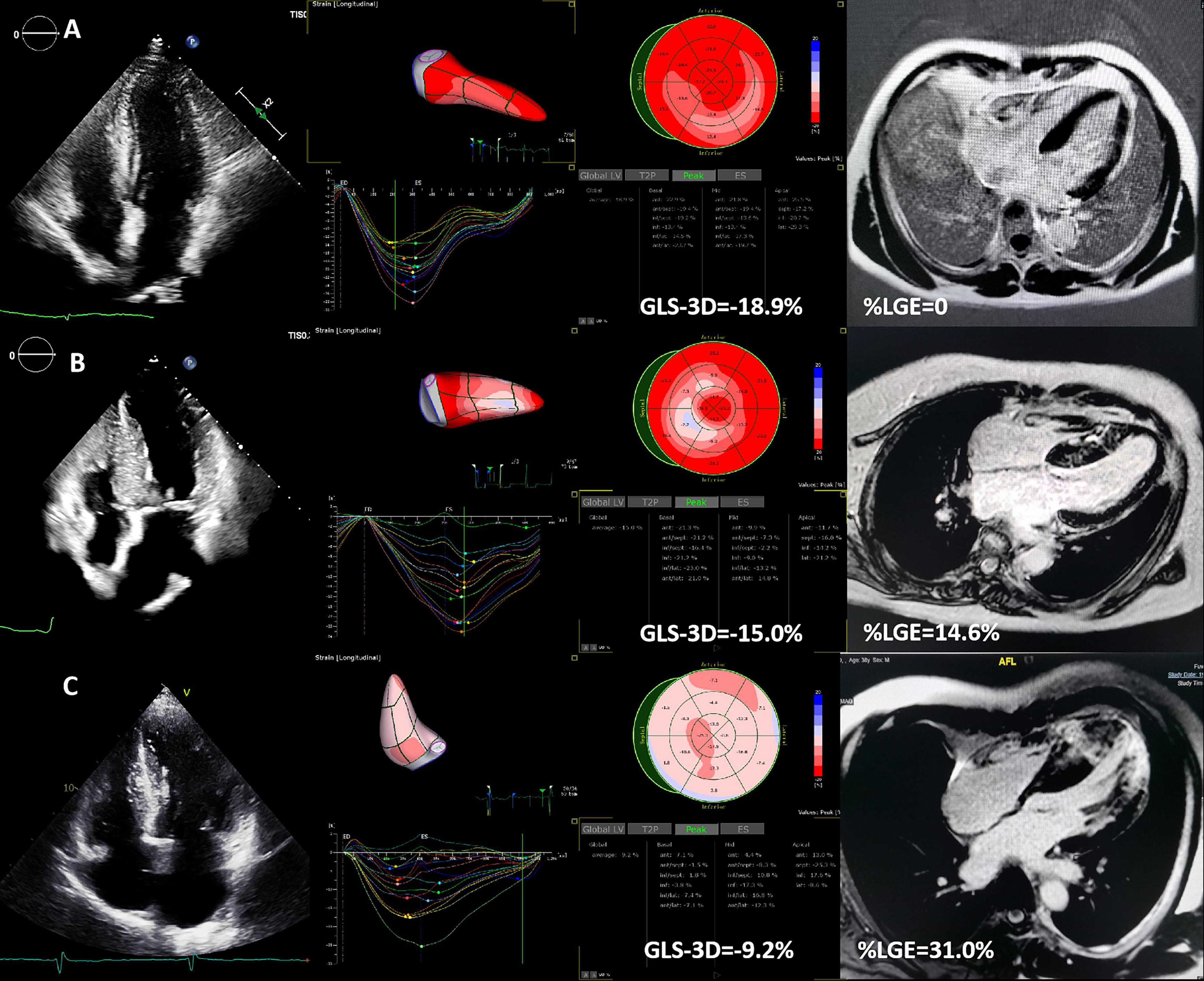
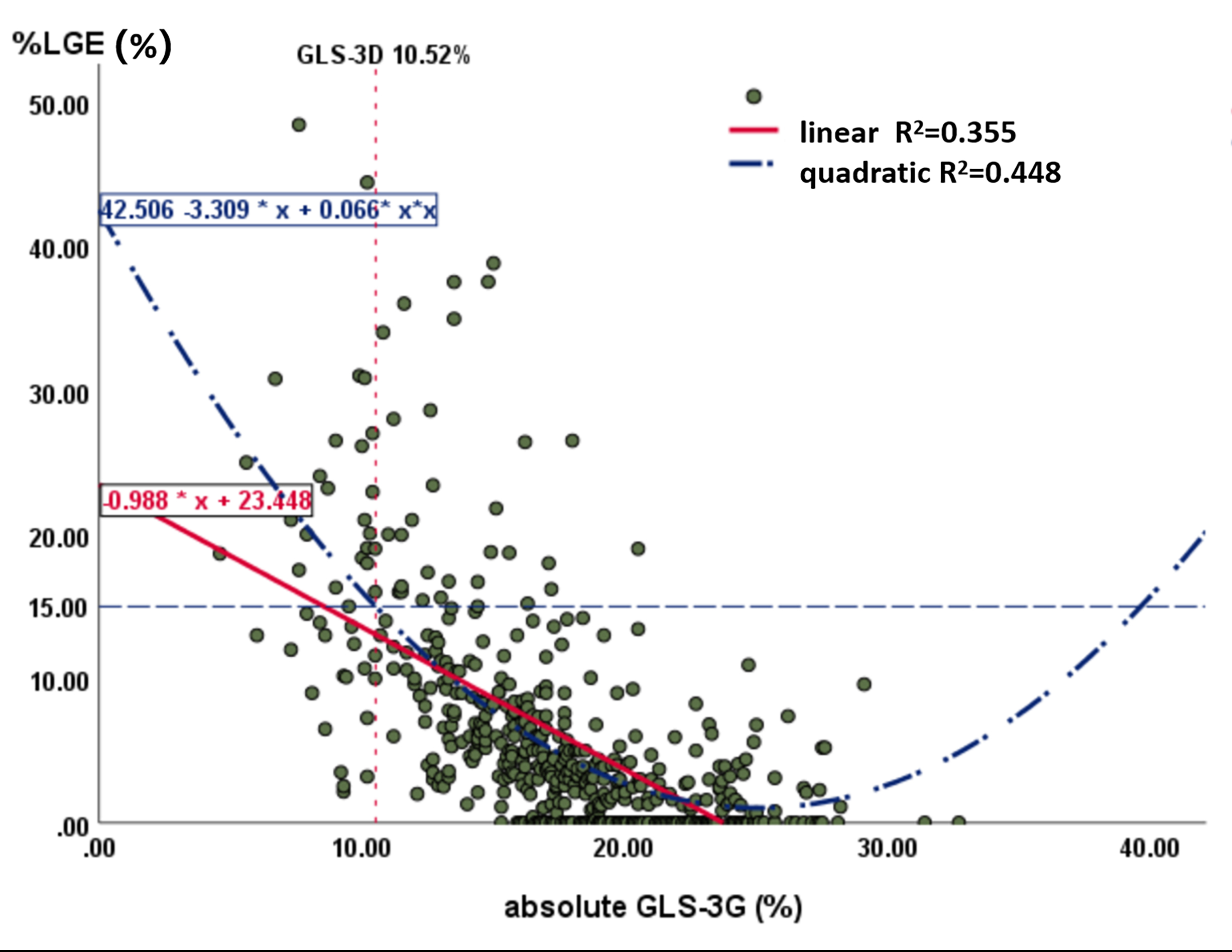
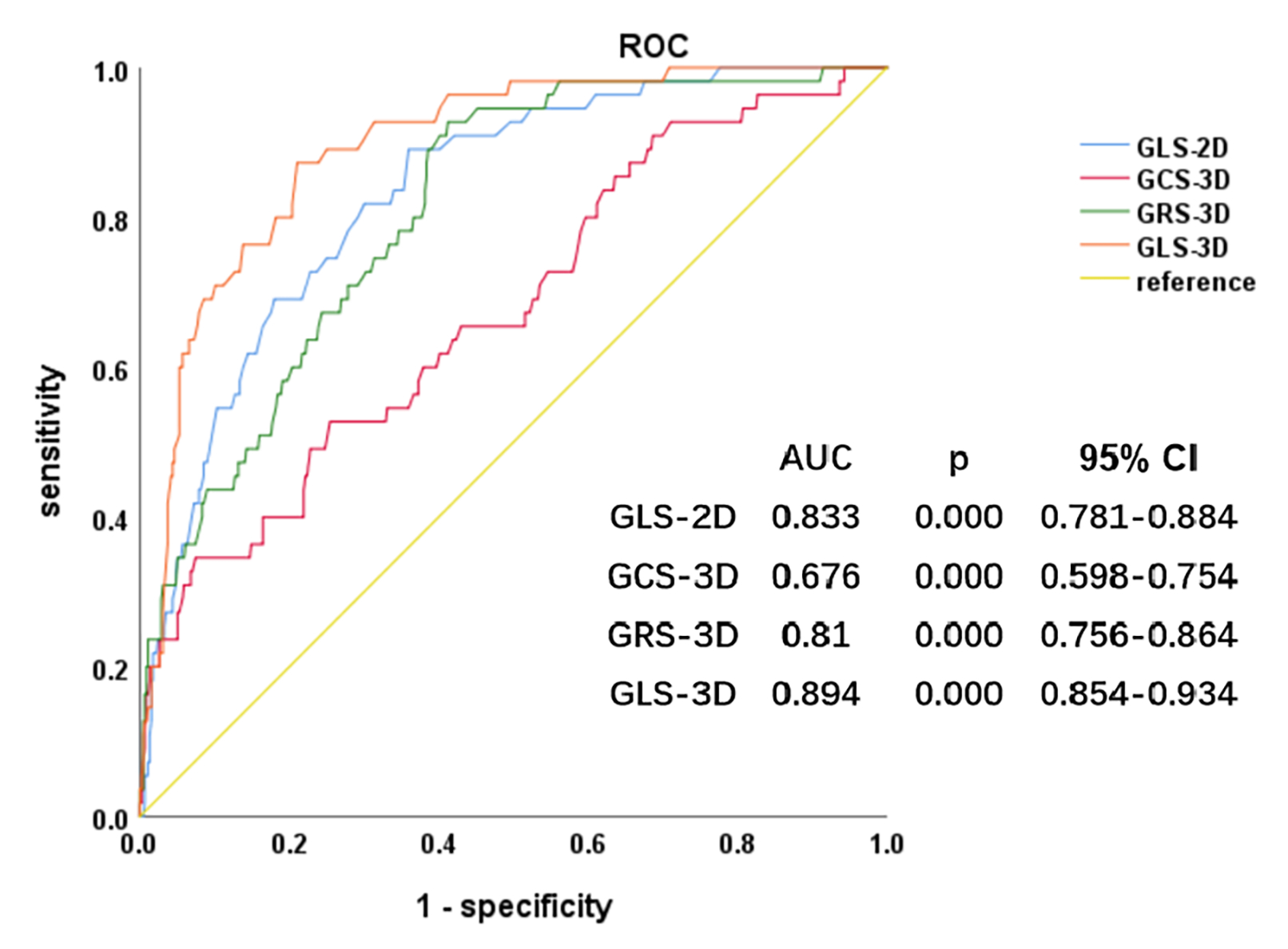
Abstract Body (Do not enter title and authors here): Background Three-dimensional speckle tracking deformation STE (3D-STE) can overcome some limitations of 2D imaging. This study aims to verify the feasibility of using 3D-STE to quantify replacement fibrosis against enhanced cardiac magnetic resonance imaging (CMR-LGE). Method 3D-STE and the extent of LGE (%LGE) were prospectively measured in a large cohort of HCM patients, with an interval ≦ of 72 hours. Results 511 HCM patients (age 49.0 ± 14.3 years; 66.5% male) were enrolled. Three-dimensional global longitudinal strain (GLS-3D) moderately correlated with GLS-2D (r=0.622, p=0.000). GLS-3D showed the strongest correlation with %LGE (r = 0.699, p < 0.001). A quadratic model (R2=0.448, p=0.000) for the relationship between GLS-3D and %LGE performed better than a linear model. GLS-3D (OR = 0.632, p < 0.001) was independently associated with extensive LGE (%LGE≧15%). GLS-3D exhibited the highest area under the curve (AUC 0.894, p < 0.001) for detecting extensive LGE With a cutoff of -15.25%, sensitivity 87.3%, specificity 78.3%. Conclusion GLS-3D is the most strongly correlated with %LGE among all strain parameters, demonstrating potential as a surrogate marker for LGE in HCM.
Pang, Kunjing
( Fuwai Hospital, National Center for Cardiovascular Disease, Chinese Academy of Medical Sciences and Peking Union Medical College
, Beijing
, China
)
Wang, Rong
( Fuwai Hospital, National Center for Cardiovascular Disease, Chinese Academy of Medical Sciences and Peking Union Medical College
, Beijing
, China
)
Song, Lei
( Cardiovascular Institute and Fu Wai Hospital, CAMP
, Beijing
, China
)
Author Disclosures:
kunjing pang:DO NOT have relevant financial relationships
| Rong Wang:DO NOT have relevant financial relationships
| lei song:No Answer