“Prophylactic VT Ablation” of Repaired Tetralogy of Fallot: Comparison with Historical Risk Stratification Strategies
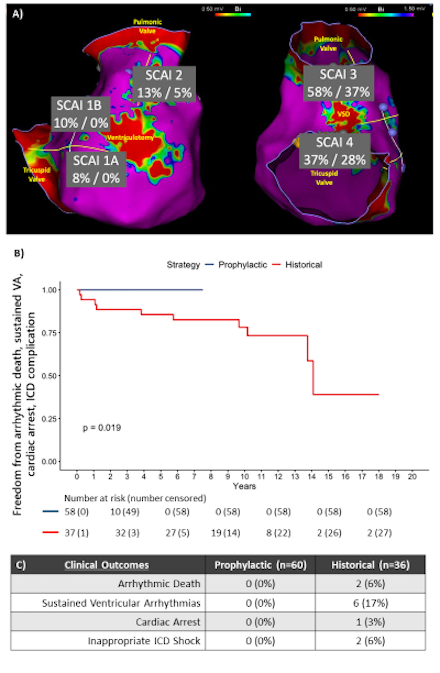
Abstract Body (Do not enter title and authors here): Background Patients with repaired Tetralogy of Fallot (rToF) are at risk of ventricular tachycardia (VT) and sudden cardiac death (SCD). Most VAs arise from 5 slowly conducting isthmuses (SCAI) bound by the right ventriculotomy, ventricular septal defect (VSD) patch, tricuspid and pulmonic valves. Traditional risk stratification involves ventricular programmed stimulation (Vstim) only, with ICD implantation +/- ablation in response to inducible VT (“Historical” strategy). Hypothesis “Prophylactic” ablation of SCAI, even in absence of inducible VT, reduces arrhythmic events in patients with rToF. Aims To compare safety, efficacy of prophylactic SCAI ablation in rToF compared to the Historical strategy described above. Methods “Prophylactic” patients underwent voltage and activation mapping in sinus rhythm. Abnormal isthmuses were identified by low voltage (≤ 1.5 mV) without pre-existing conduction block. Isthmuses with conduction velocity ≤ 0.5 m/s (SCAI) were ablated. Vstim was performed pre- and post-ablation with up to triple extrastimuli from 2 sites. A composite endpoint of SCD, sustained VT, and ICD complication was compared between Prophylactic and Historical strategies. Results Indications for risk stratification in the Prophylactic vs Historical cohorts were pre-pulmonic valve replacement (PVR) (78% vs 64%), atrial arrhythmia ablation (13% vs 11%), other risk factors (5% vs 25%). Of 60 Prophylactic patients, SCAI were identified/ablated in 53% (only 31% of these had inducible sustained VT prior to ablation). One patient (2%) in the Prophylactic group underwent ICD implant (for inducible polymorphic VT). Of 36 Historical patients, 42% had inducible VT; 2 inducible patients had cryoablation during PVR, the rest (11, 31%) underwent ICD implantation (p<0.001). No Prophylactic patients met the composite endpoint over median 19 months (IQR 7,34) versus 11% of the Historical group over median 124 months (IQR 88,142; p= 0.019). There were no complications of SCAI ablation. Conclusion Compared with the “Historical” strategy of responding only to inducible VT, “Prophylactic” SCAI ablation in patients with rToF is associated with fewer ICD implants and a reduction in incident VT without ablation-related complications.
Johnson, Bryce
( University of Washington
, Shoreline
, Washington
, United States
)
Robinson, Melissa
( Providence St. Patrick
, Missoula
, Montana
, United States
)
Nazer, Babak
( University of Washington
, Shoreline
, Washington
, United States
)
Sonderman, Mark
( University of Washington
, Shoreline
, Washington
, United States
)
Pistner, Andrew
( University of Washington
, Shoreline
, Washington
, United States
)
Hanna, Bishoy
( Baptist Health
, South Miami
, Florida
, United States
)
Bevan, Graham
( University of Washington
, Shoreline
, Washington
, United States
)
Mcdonagh, Rosemary
( Biosense Webster
, Seattle
, Washington
, United States
)
Krieger, Eric
( University of Washington
, Shoreline
, Washington
, United States
)
Akoum, Nazem
( University of Washington
, Shoreline
, Washington
, United States
)
Chatterjee, Neal
( University of Washington
, Shoreline
, Washington
, United States
)
Author Disclosures:
Bryce Johnson:DO NOT have relevant financial relationships
| Melissa Robinson:No Answer
| Babak Nazer:DO NOT have relevant financial relationships
| Mark Sonderman:No Answer
| Andrew Pistner:DO NOT have relevant financial relationships
| Bishoy Hanna:DO NOT have relevant financial relationships
| Graham Bevan:DO NOT have relevant financial relationships
| Rosemary McDonagh:DO have relevant financial relationships
;
Employee:Johnson & Johnson:Active (exists now)
| Eric Krieger:DO NOT have relevant financial relationships
| Nazem Akoum:DO NOT have relevant financial relationships
| Neal Chatterjee:DO NOT have relevant financial relationships