Ventricular Arrhythmia Risk in Repaired Tetralogy of Fallot: Implications of Prior Pulmonic Valve Interventions
Abstract Body (Do not enter title and authors here): Background Ventricular tachycardia (VT) is common in adult patients with repaired Tetralogy of Fallot (rTOF). The majority of VT originates from 1 of 5 arrhythmogenic slowly conducting anatomic isthmuses (SCAI) that exist between non-conducting anatomic and surgical borders. Catheter and surgical ablation of spontaneous VT, as well as of inducible VT at time of risk stratification electrophysiologic study (EPS), frequently target SCAI. The effects of prior pulmonary valve (PV) interventions on the prevalence of SCAI is unknown.
Aims We sought to quantitate differences in the prevalence of SCAI and VT inducibility based on prior PV interventions. This may help identify patients more or less likely to benefit from risk stratification EPS.
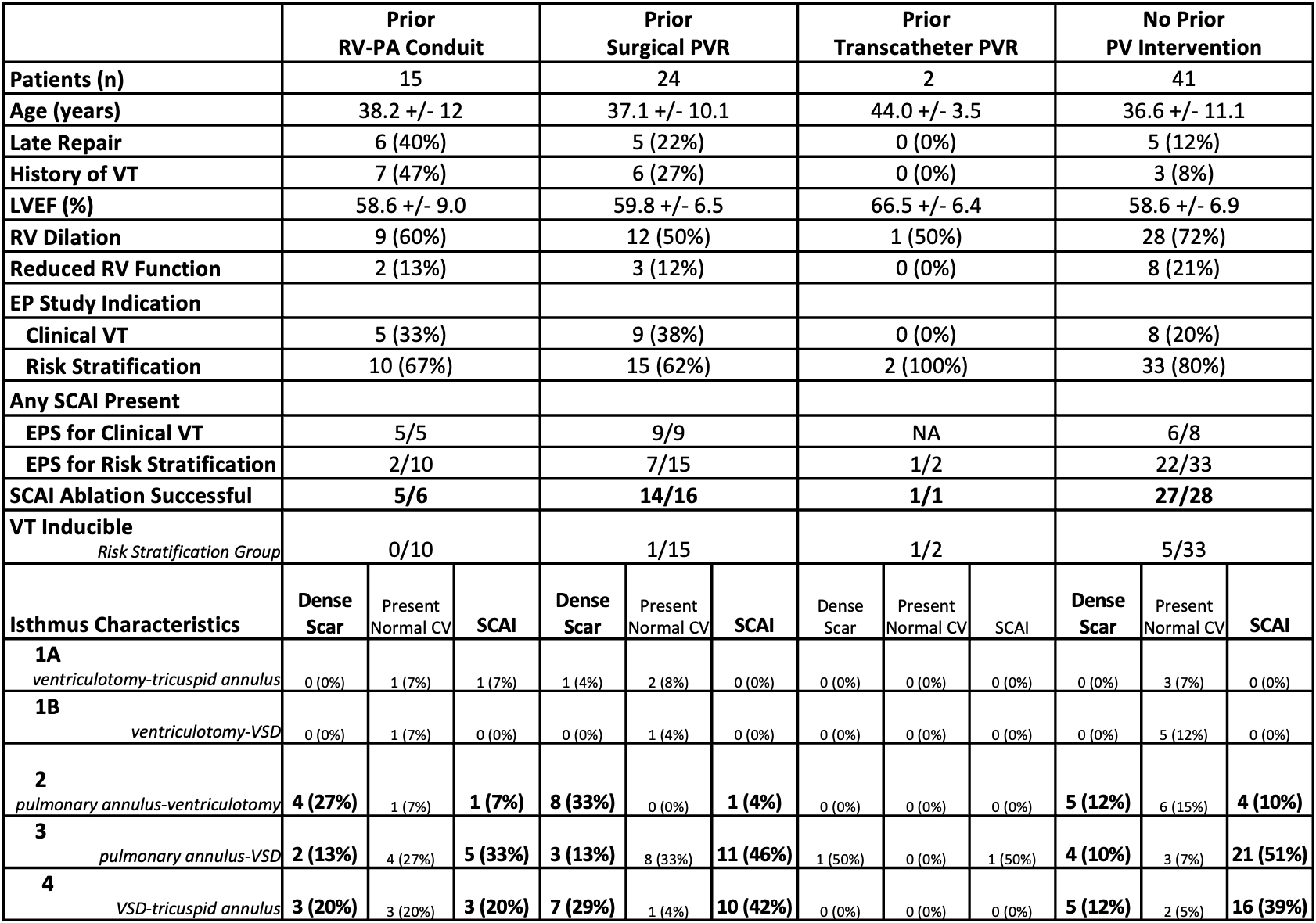
Methods We compared patients with rTOF who underwent EPS with electroanatomic mapping for either clinical history of spontaneous VT (n=22) or risk stratification (n=60). Patients were divided in 4 groups based on presence of: RV-PA conduit, prior surgical PV replacement, prior transcatheter PV replacement, or no PV intervention after initial repair. We described the presence of SCAI, VT inducibility prior to ablation, and rates of ablation success among patients in these groups.
Results SCAI were more frequently identified in patients undergoing VT ablation than risk stratification (91% vs 53%, p=0.004). Among risk stratification patients, SCAI were present in 37% of patients with prior PV interventions versus 66% of patients without (p=0.04). Prior RV-PA conduit and surgical PV replacement frequently had dense, inexcitable scar in isthmuses 2-4, but SCAI were still present in 36% of these patients even without a history of VT. There was no significant difference in incidence of pre-ablation VT inducibility (7% vs 15%, p=0.60) or SCAI ablation success (87% vs 96%, p=0.47) between patients with prior PV interventions and those without.
Conclusion Compared with patients with no prior PV interventions, those with prior interventions were less likely to have SCAI due to pre-existing scar in isthmuses 2-4, but SCAI still remained frequent and was ablated successfully at a similar rate. The presence of prior PV interventions should not influence the decision to pursue risk stratification EPS.
Sonderman, Mark
(
University Of Washington
, Kirkland , Washington , United States )
Johnson, Bryce
(
University of Washington
, Shoreline , Washington , United States )
Bevan, Graham
(
University Of Washington
, Kirkland , Washington , United States )
Mcdonagh, Rosemary
(
Biosense Webster
, Seattle , Washington , United States )
Pistner, Andrew
(
University of Washington
, Shoreline , Washington , United States )
Krieger, Eric
(
University of Washington
, Shoreline , Washington , United States )
Akoum, Nazem
(
UNIV WASHINGTON
, Seattle , Washington , United States )
Chatterjee, Neal
(
University Of Washington
, Kirkland , Washington , United States )
Robinson, Melissa
(
Providence St. Patrick Hospital
, Missoula , Montana , United States )
Nazer, Babak
(
University of Washington
, Shoreline , Washington , United States )
Author Disclosures:
Mark Sonderman:DO NOT have relevant financial relationships
| Babak Nazer:DO NOT have relevant financial relationships
| Bryce Johnson:DO NOT have relevant financial relationships
| Graham Bevan:DO NOT have relevant financial relationships
| Rosemary McDonagh:DO have relevant financial relationships
;
Employee:Johnson & Johnson:Active (exists now)
| Andrew Pistner:DO NOT have relevant financial relationships
| Eric Krieger:DO NOT have relevant financial relationships
| Nazem Akoum:DO NOT have relevant financial relationships
| Neal Chatterjee:DO NOT have relevant financial relationships
| Melissa Robinson:No Answer