
Logo

American Heart Association

  105
  0


Final ID: Sa3028

SGLT-2 Inhibitors and Atrial Fibrillation Incidence Following Heart Failure Hospitalization in a Diabetic Population

Abstract Body (Do not enter title and authors here): Introduction: The development of atrial fibrillation (AF) in patients with heart failure (HF) is associated with increased morbidity and mortality. Initially developed as a diabetic medication, SGLT-2 inhibitors have been shown to improve hospitalization rates and mortality in patients with heart failure. Meta-analyses of large prospective trials suggest SGLT-2 inhibitors prevent the incidence and burden of atrial fibrillation, though this specific question has not been specifically addressed by prospective trials.

Hypothesis: SGLT-2 inhibitors reduce the incidence of atrial fibrillation in patients who have diabetes following heart failure hospitalization.

Aims: The goal of this study was to evaluate the effect of SGLT-2 inhibitors on the incidence of atrial fibrillation in a diabetic population following hospitalization for heart failure.

Methods: The study included consecutive patients with diabetes admitted to an academic tertiary care center over a 3 year time period with a primary diagnosis of heart failure exacerbation and without prior diagnosis of AF. The primary outcome is incidence of new AF within 12 months after hospitalization. Demographic, comorbidity, echocardiographic data, and medications were obtained from the medical record. Cox-regression analysis was performed to identify the predictors of AF following HF hospitalization.

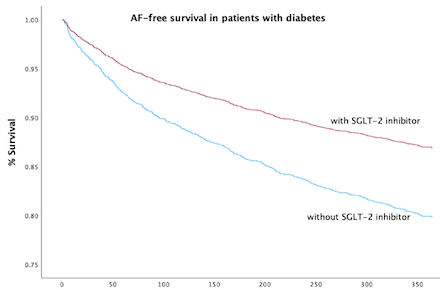
Results: A total of 2,300 patients were included, 24.3% of whom were prescribed SGLT-2 inhibitors. Of those included, 499 (21.7%) have HFrEF, 309 (13.4%) have HFmrEF, and 1492 (64.9%) have HFpEF. The use of SGLT-2 inhibitor demonstrated a statistically significant association with lower incidence in AF at one year following heart failure hospitalization. Patients on an SGLT-2 inhibitor had a AF incidence of 13.2% compared to an incidence of 20.2% in those not taking an SGLT-2 inhibitor. This difference was found to be statistically significant (p<0.001; RR 0.62; 95% CI: 0.48-0.80).

Conclusion: The use of SGLT-2 inhibitors is associated with a statistically significant reduction in new-onset AF at one year following hospitalization for heart failure in patients with diabetes.
  • Fretz, Thomas  ( Indiana University , Indianapolis , Indiana , United States )
  • Ilonze, Onyedika  ( Indiana University , Indianapolis , Indiana , United States )
  • Tanawuttiwat, Tanyanan  ( Indiana University , Indianapolis , Indiana , United States )
  • Das, Mithilesh  ( Indiana University , Indianapolis , Indiana , United States )
  • Author Disclosures:
    Thomas Fretz: DO NOT have relevant financial relationships | Onyedika Ilonze: DO have relevant financial relationships ; Consultant:Astrazeneca:Active (exists now) ; Consultant:Bridgebio:Active (exists now) | Tanyanan Tanawuttiwat: DO NOT have relevant financial relationships | Mithilesh Das: No Answer
Meeting Info:

Scientific Sessions 2024

2024

Chicago, Illinois

Session Info:

Novel Glycemic and Lipid Lowering Therapies

Saturday, 11/16/2024 , 02:00PM - 03:00PM

Abstract Poster Session

More abstracts on this topic:

4-5 Years Outcomes of Left Atrial Appendage Closure vs. Oral Anticoagulants in Atrial Fibrillation: A Systematic Review and Meta-Analysis:

Khan Muhammad Aslam, Haider Taimoor, Bhattarai Shraddha, Afzal Hafsa, Khan Bilal, Muhammad Anza, Shafique Nouman, Bhatia Hitesh, Aafreen Asna, Adil Abid Nawaz Khan, Akbar Usman, Khan Alamzaib, Haider Muhammad Adnan

A novel deep learning framework identified associated genes and Interpretable deep learning translation of GWAS findings for drug repurposing in Atrial Fibrillation

Tonegawa-kuji Reina, Xu Jielin, Guntupalli Suman, Barnard John, Chung Mina, Cheng Feixiong

More abstracts from these authors:
You have to be authorized to contact abstract author. Please, Login
Not Available