
The Association of the Muscle Mass with Exercise Capacity and Childhood Opportunity Index in Patients with Fontan Circulation
Abstract Body (Do not enter title and authors here): Background: The Child Opportunity Index (COI) is a validated, comprehensive measure of social context, comprised of 29 indicators of child neighborhood opportunity, split into three domains (education, health and environment, and socioeconomic). Our previous work showed that low COI is associated with a 10% lower percent of predicted peak VO2 post-Fontan. Exercise intolerance is a known prognostic factor for this patient population. Previous studies have shown that health inequities in education, environment, and socioeconomics factor into worse exercise outcomes. Cardiac MRI (CMR) measured muscle mass is a novel practical technique to evaluate muscle mass. We hypothesized that lower muscle mass by CMR is associated with lower exercise capacity and lower COI z-scores.
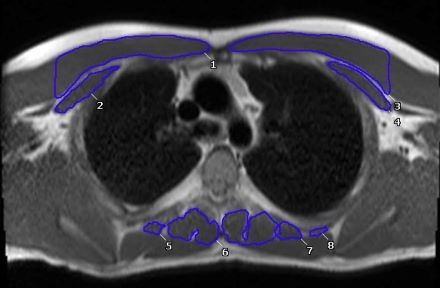
Methods: A retrospective, single-center study was performed, analyzing 75 post-Fontan patients who had CMR completed between 2010 and 2022. The anterior and paraspinal muscles were measured (Figure). COI z-scores were split into low and high levels, and univariate analyses were subsequently performed to determine associations between COI levels, exercise capacity and muscle mass.
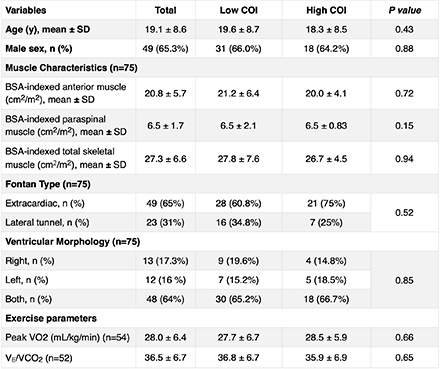
Results: The mean age of the population was 19.09 years ± 8.58 with the majority being male (65.3%). Most patients underwent an extracardiac conduit repair (65.3%) (Table). There was a positive correlation between anterior (r=0.36, p=0.007) and paraspinal (r=0.34, p=0.01) muscle mass to peak VO2. There was no significant difference in paraspinal (p=0.15) or anterior (p=0.72) muscle mass between COI groups. Similarly, there were no significant associations between muscle mass and specific COI domains.
Conclusion: Muscle mass correlated with exercise capacity in our population and is easy to measure by CMR. There was no correlation between COI level and muscle mass in this study, suggesting that the COI impact on exercise capacity is not directly mediated by lower muscle mass and that other factors should continue to be explored.
Tercek, Abigail
( UPMC CHILDRENS HOSP of PITTSBURGH
, Pittsburgh
, Pennsylvania
, United States
)
Smith, Kevin
( UPMC CHILDRENS HOSP of PITTSBURGH
, Pittsburgh
, Pennsylvania
, United States
)
Karolcik, Brock
( UPMC CHILDRENS HOSP of PITTSBURGH
, Pittsburgh
, Pennsylvania
, United States
)
Arora, Gaurav
( UPMC CHILDRENS HOSP of PITTSBURGH
, Pittsburgh
, Pennsylvania
, United States
)
Kreutzer, Jacqueline
( UPMC CHILDRENS HOSP of PITTSBURGH
, Pittsburgh
, Pennsylvania
, United States
)
Olivieri, Laura
( UPMC CHILDRENS HOSP of PITTSBURGH
, Pittsburgh
, Pennsylvania
, United States
)
Christopher, Adam
( UPMC CHILDRENS HOSP of PITTSBURGH
, Pittsburgh
, Pennsylvania
, United States
)
Alsaied, Tarek
( UPMC CHILDRENS HOSP of PITTSBURGH
, Pittsburgh
, Pennsylvania
, United States
)
Author Disclosures:
Abigail Tercek:DO NOT have relevant financial relationships
| Kevin Smith:No Answer
| Brock Karolcik:No Answer
| Gaurav Arora:No Answer
| Jacqueline Kreutzer:DO have relevant financial relationships
;
Researcher:Edwards Lifesciences LLC:Active (exists now)
; Consultant:Medtronic :Active (exists now)
; Researcher:Medtronic:Active (exists now)
| Laura Olivieri:DO NOT have relevant financial relationships
| Adam Christopher:DO NOT have relevant financial relationships
| Tarek Alsaied:DO NOT have relevant financial relationships