Logo

American Heart Association

  155
  0


Final ID: Sa2075

Low-Dose Apixaban Safety and Efficacy in Patients with Atrial Fibrillation Who Have Gastrointestinal Bleed; A Nationwide Cohort Study

Abstract Body (Do not enter title and authors here): Introduction: Anticoagulation (AC) is the mainstay of thromboprophylaxis for stroke prevention in atrial fibrillation (AF) and is recommended. Gastrointestinal bleeding (GIB) is a common complication with varied severity and often poses a challenge for cardiologists and gastroenterologists. The decision of whether to continue anticoagulation, when to resume and at what dose is often the challenge. Our study assesses the safety and efficacy of low-dose apixaban compared to a full-dose in patients with AF who had GIB over the course of 5 years.

Methods: We queried the US Collaborative Network (which contains 63 healthcare organizations) of TriNetX deidentified research database. Patients with atrial fibrillation who have history of gastrointestinal bleed who received apixaban were identified and divided into two cohorts; patients on low dose of 2.5mg and those on full dose of 5mg. We excluded patients with serum creatinine ≥ 1.5 mg/dL and patients with body weight ≤ 132 lbs.
Two well-matched cohorts were created using a 1:1 propensity-score matching (PSM) model using patients’ baseline characteristics and comorbidities. PSM components were age, gender, race, PPI use, anti-platelets, hypertension, coronary artery disease, heart failure, COPD, and CKD. We compared the risk of stroke, GIB, and mortality in 5 years.

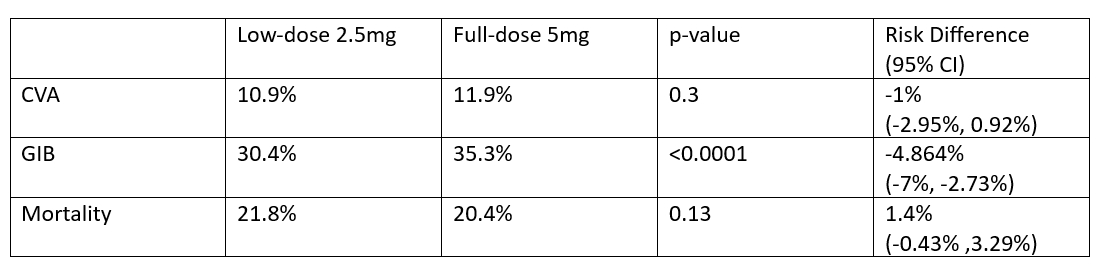
Results: A total of 19,427 patients with UGIB who have AFIB received oral apixaban were identified. Of those, 19% (n=3,701) were on low dose of 2.5mg and 81% (n=15,726) were on full dose of 5mg of apixaban. After PSM, each cohort included 3,701 patients. There was no statistically significant difference in the risk of stroke in 5 years between the patients on low dose compared to those on full dose (10.9% vs 11.9%, p=0.3). However, patients on low dose had a statistically significant lower risk of GIB compared to those on full dose (30.4% vs 35.3%, p<0.0001). Mortality rates were not different between patients on low dose compared to full dose (21.8% vs 20.4%, p=0.13).

Conclusion: The use of low-dose (2.5mg) apixaban in patients with GIB who have AF decreases the risk of GIB without significantly affecting the rate of stroke or mortality when compared to full-dose of 5mg. The use of a low-dose apixaban is safer and as efficacious as full-dose in patients with GIB who have AF.
  • Faris, Carol  ( BMC , Bayonne , New Jersey , United States )
  • Ayoub, Mark  ( CAMC , Charleston , West Virginia , United States )
  • Author Disclosures:
    Carol Faris: DO NOT have relevant financial relationships | Mark Ayoub: No Answer
Meeting Info:

Scientific Sessions 2024

2024

Chicago, Illinois

Session Info:

Atrial Fibrillation Comparative Data on Medical Therapies and Anticoagulation

Saturday, 11/16/2024 , 10:30AM - 11:30AM

Abstract Poster Session

More abstracts on this topic:
Association Between Antiphospholipid Antibody and Ischemic Stroke: A Systematic Review and Meta-Analysis

Watson Nathan, Kanthi Yogen, Secemsky Eric, Connors Jean, Barnes Geoffrey, Goldhaber Samuel, Weitz Jeffrey, Costenbader Karen, Piazza Gregory, Krumholz Harlan, Cushman Mary, Bukhari Syed, Bikdeli Behnood, Rashedi Sina, Weber Brittany, Anderson Christopher, Elkind Mitchell, Pfeferman Mariana, Ujueta Francisco, Zarghami Mehrdad

Antithrombotic trends before and after publication of randomized clinical trials in cervical artery dissection: A secondary analysis of the STOP-CAD Study

Penckofer Mary, Salehi Omran Setareh, Seiffge David, Arnold Marcel, Marialuisa Zedde, Zubair Adeel, Marto Joao Pedro, Ghannam Malik, Engelter Stefan, Traenka Christopher, Mac Grory Brian, Shu Liqi, Kam Wayneho, Elnazeir Marwa, Romoli Michele, Saleh Velez Faddi, Siegler James, Strelecky Lukas, Yaghi Shadi, Henninger Nils, Muppa Jayachandra, Bakradze Ekaterina, Heldner Mirjam, Katheryna Antonenko

You have to be authorized to contact abstract author. Please, Login
Not Available