
Clinical Outcomes of Endovascular versus Surgical Revascularization in Frail and Non-Frail Older Adults
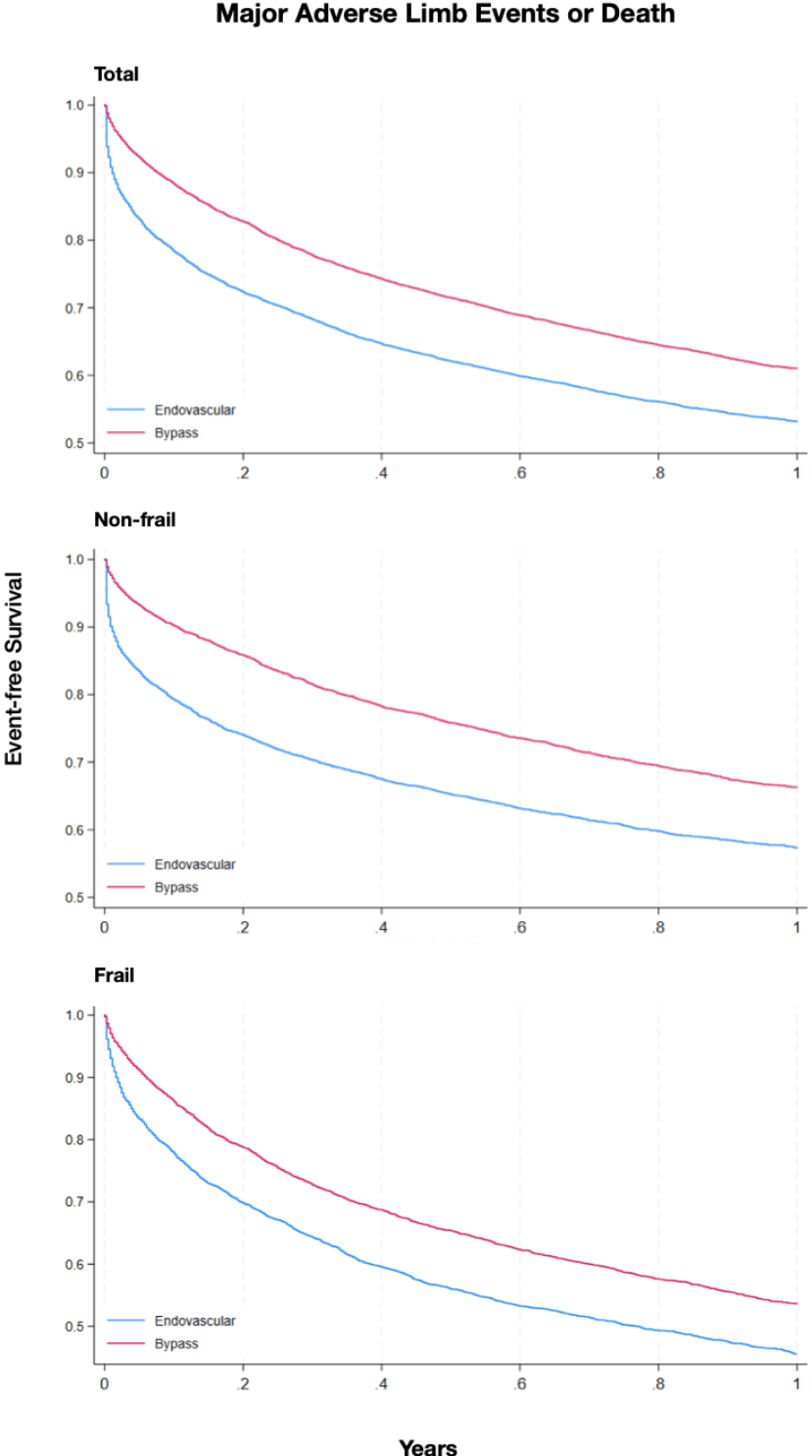
Abstract Body (Do not enter title and authors here): Background: Recent clinical trials (BEST-CLI and BASIL-2) have produced divergent results comparing endovascular vs surgical therapy in chronic limb-threatening ischemia (CLTI). The difference may be related to varying levels of frailty among the patient included. Objective: To compare the risk of major adverse limb events (MALE) or death in endovascular vs surgical therapy in real-world older adults with and without frailty Methods: We applied target trial emulation framework. This retrospective study using the 2016-2022 Medicare data included patients aged ≥65 years with CLTI who underwent surgical or endovascular therapy without revascularization in the prior year. Frailty was defined as a claims-based frailty index ≥0.25. The primary outcome was a composite of MALE or death. After propensity score (PS) matching, we estimated hazard ratios (HRs) using the Cox proportional hazards model for the total population and by frailty levels. Results: Before PS matching, the endovascular group (n=37513) was older (78 vs 76 years), more likely to be women (43% vs 39%), dually eligible for Medicaid (35% vs 28%), frail (56% vs 40%), and more likely to have diabetes (79% vs 67%), chronic kidney disease (81% vs 68%) and prior stroke (32% vs 27%) compared to the surgical group (n=8754). After PS matching (n=8116 per group), surgical therapy was associated with a lower rate of the primary outcome in the total population (55 vs 77 per 100 person-years, HR 0.73, 95% CI 0.70-0.77). The benefit of surgical therapy was consistent in frail patients (71 vs 95 per 100 person-years, HR 0.76, 95% CI 0.71-0.81) and non-frail patients (45 vs 67 per 100 person-years, HR 0.68, 95% CI 0.64-0.73) (Figure). Mortality rates per 100 person-years for surgical and endovascular groups were 42 and 47, respectively, in frail patients and 17 and 22 in non-frail patients. Conclusion: The effect estimates from our real-world data study were consistent with the effect estimate from BEST-CLI trial, with no treatment effect heterogeneity by frailty levels. The rate of primary outcome was very high in the frail group with nearly half dying within one year after surgical or endovascular therapy.
Ko, Darae
( Hinda and Arthur Marcus Institute for Aging Research
, Boston
, Massachusetts
, United States
)
Park, Chan Mi
( Hinda and Arthur Marcus Institute for Aging Research
, Boston
, Massachusetts
, United States
)
Evans, Peter
( Boston University Medical Center
, Boston
, Massachusetts
, United States
)
Pande, Ashvin
( Boston University Medical Center
, Boston
, Massachusetts
, United States
)
Hamburg, Naomi
( Boston University Medical Center
, Boston
, Massachusetts
, United States
)
Kim, Dae Hyun
( Hinda and Arthur Marcus Institute for Aging Research
, Boston
, Massachusetts
, United States
)
Author Disclosures:
Darae Ko:DO have relevant financial relationships
;
Consultant:Windrose Consulting Group:Past (completed)
; Research Funding (PI or named investigator):Boston Scientific Corporation:Past (completed)
; Consultant:AcademicCME:Past (completed)
| Chan Mi Park:No Answer
| Peter Evans:DO NOT have relevant financial relationships
| Ashvin Pande:DO NOT have relevant financial relationships
| Naomi Hamburg:DO have relevant financial relationships
;
Consultant:Boston Scientific:Past (completed)
; Consultant:fukuda:Past (completed)
| Dae Hyun Kim:DO NOT have relevant financial relationships