Fitbit-Measured Physical Activity Is Inversely Associated With Incident Atrial Fibrillation Among All Of Us Participants
Abstract Body (Do not enter title and authors here): Background: Studies show that moderate to vigorous physical activity (MVPA) reduces atrial fibrillation (AF) risk. However, these studies used subjective questionnaires or short-term (<1 week) accelerometry assessments.
Objective: This study investigated the link between MVPA levels and AF incidence using long-term (1-year) accelerometry data from the NIH All of Us Fitbit database.
Methods: The study included All of Us participants who agreed to share electronic health record (EHR) and Fitbit data between January 1, 2016 to July 1, 2022. Among participants without an existing diagnosis of AF, the average weekly minutes of MVPA over the first year of Fitbit use was computed. Incident AF events were identified using validated ICD-10 codes in a five-year follow-up period. The risk of incident AF was evaluated using Cox proportional hazards regression models, for both MVPA as a continuous and a categorical variable (<30, 30-150,151-300, and >300 minutes MVPA per week; aligned with WHO guidelines). Covariates included age, sex, race/ethnicity, BMI, smoking status, and diagnoses of hypertension and diabetes. In a subset of participants with whole genome data, we evaluated if the association between MVPA and AF incidence varied by a participant’s AF genetic risk score (GRS)
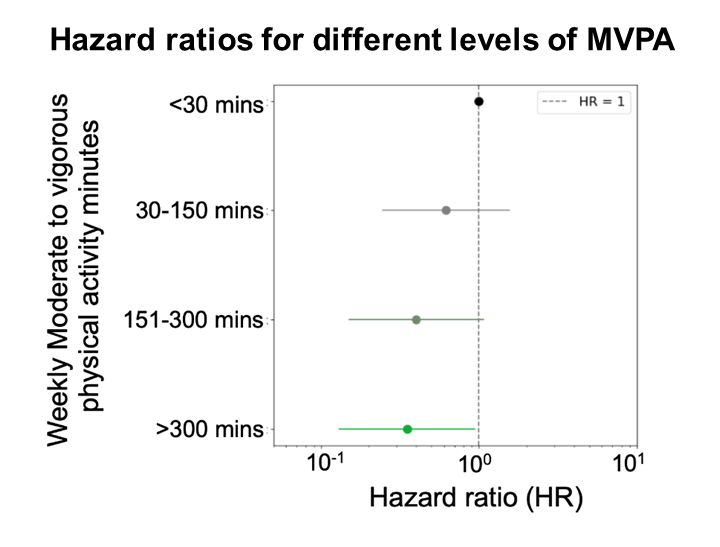
Results: 6086 participants (mean age 50 years, 71% female, 83% White) had EHR and at least 1 year of Fitbit data. Over the 1-year MVPA assessment period, participants had 41±12 weeks of complete data and a median 202 [241] minutes of MVPA per week. 55 participants (0.9%) experienced incident AF in the five-year follow-up period. In adjusted analysis, every additional hour of MVPA was associated with an 11% reduced risk of AF (HR = 0.89 [0.81,0.98], p = 0.02). There was a step-wise reduction in risk of AF by MVPA category with <30 min/week as the reference: 30-150 (HR = 0.62 [0.24,1.6], p = 0.31), 151-300 (HR = 0.40 [0.15,1.07], p = 0.07), and >300 (HR = 0.35 [0.13,0.95], p = 0.04) (Figure 1). These associations also held after adjusting for GRS.
Conclusion: Higher amounts of objectively measured MVPA were inversely associated with risk of incident AF, independent of clinical and genetic risk factors.
Barua, Souptik
(
NYU Grossman School of Medicine
, New York , New York , United States )
Upadhyay, Dhairya
(
NYU Grossman School of Medicine
, New York , New York , United States )
Surapaneni, Aditya
(
NYU Grossman School of Medicine
, New York , New York , United States )
Grams, Morgan
(
NYU Grossman School of Medicine
, New York , New York , United States )
Heffron, Sean
(
NYU Grossman School of Medicine
, New York , New York , United States )
Author Disclosures:
Souptik Barua:DO NOT have relevant financial relationships
| Dhairya Upadhyay:DO NOT have relevant financial relationships
| Aditya Surapaneni:No Answer
| Morgan Grams:DO NOT have relevant financial relationships
| Sean Heffron:No Answer