The effect of pulsatile vs. non-pulsatile perfusion on hospital stay, ICU stay, and intubation time in patients undergoing cardiopulmonary bypass: A meta-analysis randomized controlled trials.
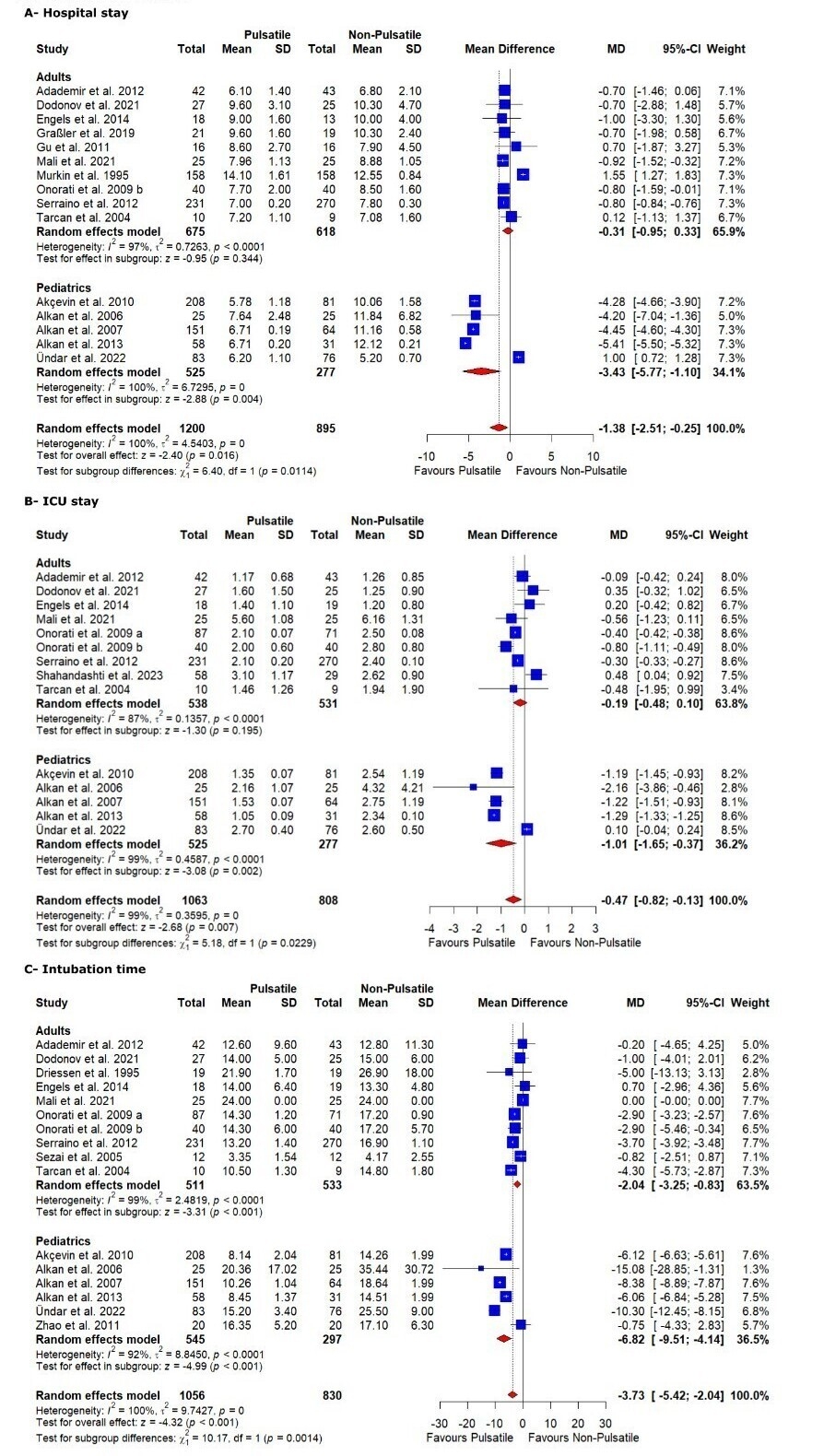
Abstract Body (Do not enter title and authors here): Abstract: Background: Pulsatile perfusion is a developing technique that attempts to mimic the natural pulsatile flow of blood during cardiopulmonary bypass (CBP). Purpose: Our meta-analysis was done to evaluate the effects of pulsatile perfusion in CPB compared to non-pulsatile on hospital stay, ICU stay, and intubation time. Methods: Randomized control trials that evaluated the implementation of pulsatile perfusion during CPB were identified by a literature search of the following databases (PubMed, Web of Science, Scopus, Central, and Embase) up to February 2024. Results: Our search yielded 33 trials with 3174 patients, the analysis showed that pulsatile perfusion led to a significant decrease in hospital stay [MD = -1.38, 95% CI (-2.51, -0.25), P = 0.016], ICU stay [MD = -0.47, 95% CI (-0.82, -0.13), P = 0.007], intubation time [MD = -3.73, 95% CI (-5.42, -2.04), P < 0.001]. However, no significant difference between the two regimens was detected in the adult subgroup when we performed sungroup analysis based on the age for hospital stay and ICU stay outcomes [MD = -0.31, 95% CI (-0.95, 0.33), P = 0.334] and [MD = -3.73, 95% CI (-5.42, -2.04), P < 0.001] respectively. Conclusion: Pulsatile perfusion showed positive effects on hospital stay, ICU stay, and intubation time. However, there was no difference between the two methods on hospital and ICU stay in the adult’s subgroup. Also, the outcomes showed significant heterogeneity, which requires more robust RCTs to be conducted to increase the quality and the certainty of evidence.
Ahmed, Ali Ashraf Salah
(
Minia universiy
, Minia, Egypt , Egypt )
Saeed, Abdallah
(
Tanta university
, Tanta , Egypt )
Ali, Mohamed Ahmed
(
Qena university
, Qena , Egypt )
Elshenawy, Salem
(
Alexandria university
, Alexandria , Egypt )
Ayman, Dina
(
Beni suef university
, Beni suef , Egypt )
Alshaker, Hassan
(
Brigham and Women's Hospital
, Boston , Massachusetts , United States )
Katamesh, Basant
(
Mayo Clinic
, Rochester , New York , United States )
Hassan, Abdul Rhman
(
Tanta university
, Tanta , Egypt )
M. Albarakat, Majd
(
Jordan University of Science and Technology
, Irbid , Jordan )
Alsaed, Mohamad
(
West Virginia University
, Morgantown , West Virginia , United States )
Abdelazeem, Basel
(
West Virginia University
, Morgantown , West Virginia , United States )
Author Disclosures:
Abdelrahman Mahmoud:DO NOT have relevant financial relationships
| Hassan Alshaker:DO NOT have relevant financial relationships
| Basant Katamesh:DO NOT have relevant financial relationships
| Abdul Rhman Hassan:DO NOT have relevant financial relationships
| Majd M. AlBarakat:DO NOT have relevant financial relationships
| Mohamad Alsaed:DO NOT have relevant financial relationships
| Basel Abdelazeem:DO NOT have relevant financial relationships
| Mohamed Ramadan:DO NOT have relevant financial relationships
| Ahmed Mazen Amin:DO NOT have relevant financial relationships
| Hazem Mohamed Salamah:DO NOT have relevant financial relationships
| Ali Ashraf Salah Ahmed:DO NOT have relevant financial relationships
| Abdallah Saeed:DO NOT have relevant financial relationships
| Mohamed Ahmed Ali:DO NOT have relevant financial relationships
| Salem Elshenawy:DO NOT have relevant financial relationships
| Dina Ayman:DO NOT have relevant financial relationships