Optimal Timing of Pharmacoinvasive Strategy and its Impact on Clinical in Patients with ST-Elevation Myocardial Infarction: a Real-World Perspective
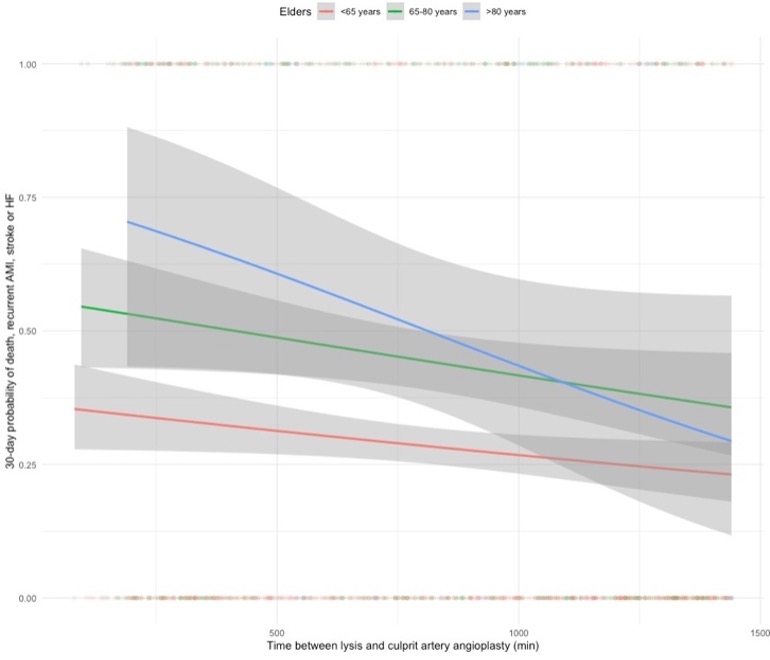
Abstract Body (Do not enter title and authors here): Background. Pharmacoinvasive strategy remains the cornerstone therapy for ST-elevation myocardial infarction (STEMI) where primary percutaneous coronary intervention (PCI) is unfeasible. Guidelines recommend PCI within 2 to 24 hours post-fibrinolysis. However, meta-analysis suggests that a shorter interval (<4h) between fibrinolysis and PCI (lysis-PCI time) significantly reduces the 30-day risk of death and reinfarction. Real-world applicability is limited due to trial exclusions of elderly patients and those with chronic kidney disease. This study aims to evaluate the impact of lysis-PCI timing on in-hospital mortality and major adverse cardiovascular events (MACE). Hypothesis. We hypothesize that shorter lysis-PCI times (<9h) increase in-hospital mortality and MACE, especially in patients over 80 years. Goals. To determine the impact of lysis-PCI timing on in-hospital mortality and MACE in STEMI patients. Methods. This retrospective cohort study of 1,043 STEMI patients in Brasília, Brazil, used multivariable categorical logistic regression models to assess the association of three lysis-PCI intervals (<9h; 9-18h; >18h) with in-hospital mortality and 4p-MACE (death, acute myocardial infarction, stroke, heart failure). Propensity score matching (1:1) was used to adjust for cardiovascular risk factors. Statistical significance was set at p<0.05. Results. The lysis-PCI timing groups showed no significant differences in admission Killip class, GRACE score, or age. However, the <9h group had higher incidences of in-hospital mortality (p=0.004), heart failure (p=0.002), cardiogenic shock (p=0.001), cardiac arrest within 24 hours (p=0.003), minor bleeding (p=0.006), and MACE (p=0.002). Multivariable categorical logistic regression revealed that each 4-h delay in lysis-PCI time reduced the risk of death (HR 0.560, 95% CI 0.381-0.771; p=0.001) and MACE (HR 0.877, 95% CI 0.811-0.948; p=0.001). These findings remained consistent after propensity score analysis (death: HR 0.721, 95% CI 0.516-0.956; p=0.034). Among patients older than 80, shorter lysis-PCI times were associated with increased mortality and MACE, even after propensity adjustment (Figure 1). Conclusion(s): Shorter lysis-PCI times (<9h) are associated with higher in-hospital mortality and MACE across all age groups, with a pronounced effect in patients over 80 years. These findings underscore the need for careful consideration of lysis-PCI timing, especially in elderly populations.
Stephanus, Andrea
(
Catholic University of Brasilia
, Brasília , Brazil )
Pacheco Santos, Alice
(
Catholic University of Brasilia
, Brasília , Brazil )
Machado Rodrigues Da Cunha, Ana Carolina
(
Catholic University of Brasilia
, Brasília , Brazil )
Augusto Rocha, Ana Carolina
(
Catholic University of Brasilia
, Brasília , Brazil )
De Amorim Meireles, Amanda
(
Catholic University of Brasilia
, Brasília , Brazil )
Guimaraes Souza De Oliveira, Mariana
(
Catholic University of Brasilia
, Brasília , Brazil )
Arissa Coelho Matsunaga, Pietra
(
Catholic University of Brasilia
, Brasília , Brazil )
De Sousa Munhoz Soares, Alexandre Anderson
(
Clarity Healthcare Intelligence
, Jundiai , Brazil )
Cavalcante Nogueira, Ana Claudia
(
State Department of Health of the Federal District
, Brasília , DF , Brazil )
De J B De Almeida Guimaraes, Adriana
(
State Department of Health of the Federal District
, Brasília , DF , Brazil )
De Almeida Alexim, Gustavo
(
State Department of Health of the Federal District
, Brasília , DF , Brazil )
Campos-staffico, Alessandra
(
Creighton University
, Omaha , Nebraska , United States )
Carvalho, Luiz Sergio
(
Catholic University of Brasilia
, Brasília , Brazil )
Author Disclosures:
Andrea Stephanus:DO NOT have relevant financial relationships
| Adriana de J B de Almeida Guimaraes:No Answer
| Gustavo de Almeida Alexim:No Answer
| Alessandra Campos-Staffico:DO NOT have relevant financial relationships
| Luiz Sergio Carvalho:DO NOT have relevant financial relationships
| Alice Pacheco Santos:No Answer
| Ana Carolina Machado Rodrigues da Cunha:No Answer
| Ana Carolina Augusto Rocha:No Answer
| Amanda de Amorim Meireles:No Answer
| Mariana Guimaraes Souza de Oliveira:No Answer
| Pietra Arissa Coelho Matsunaga:No Answer
| Alexandre Anderson de Sousa Munhoz Soares:No Answer
| Ana Claudia Cavalcante Nogueira:No Answer