
Logo

American Heart Association

  106
  0


Final ID: MDP1671

Effect of Obesity on Arrhythmia Recurrence and Complications following Pulmonary Vein Isolation for Paroxysmal Atrial Fibrillation in the REAL-AF Registry

Abstract Body (Do not enter title and authors here): Introduction
- Obesity is an important risk factor for atrial fibrillation and its prevalence in the United States is rising. The effect of obesity on outcomes following pulmonary vein isolation in a contemporary setting has not been extensively evaluated.
Research Questions
- Is higher body mass index (BMI) associated with increased risk of atrial arrhythmia recurrence following pulmonary vein isolation?
- Is higher BMI associated with increased risk of post-procedural complications?
Method
- The REAL-AF (Real-world Experience of Catheter Ablation for the Treatment of Symptomatic Paroxysmal and Persistent Atrial Fibrillation; ClinicalTrials.gov Identifier: NCT04088071) Registry is a multicenter, prospective observational registry of patients undergoing radiofrequency catheter ablation of atrial fibrillation. We included 2666 patients with paroxysmal atrial fibrillation undergoing index ablation from January 2018 through April 2023. We excluded patients with missing covariates.
- The primary outcome was freedom from atrial arrhythmia following ablation. Rhythm monitoring was standardized using patch monitor at 6 month and 1 year. Time-to-event analysis was performed using a 3-month blanking period.
Results
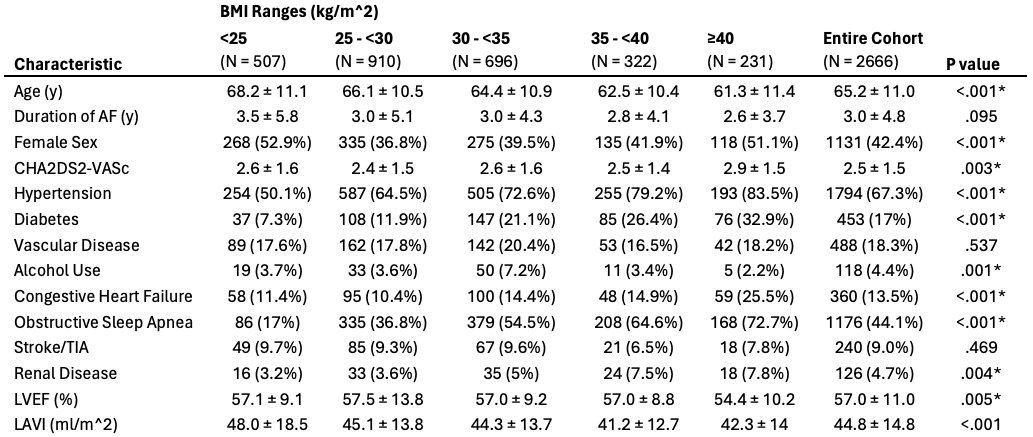
- Baseline characteristics are shown in Table 1. The median follow-up was 382 days (IQR: 363-410).
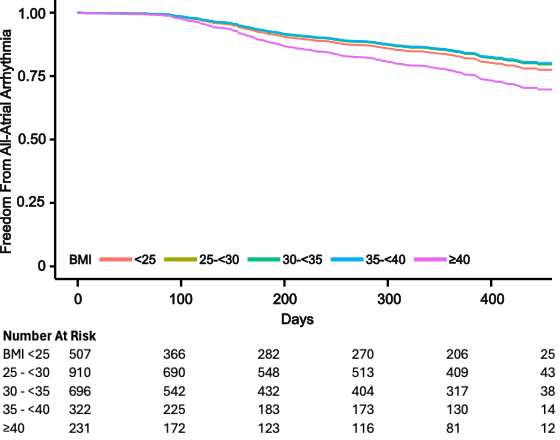
- There was a trend toward higher rate of atrial arrhythmia following ablation for patients in the highest BMI group compared with the reference group (BMI<25) (BMI≥40: HR = 1.41 (0.94-2.12), p= 0.092). There was no difference in the rate of atrial arrhythmia for other BMI groups (BMI 25 - <30: HR = 0.90 (0.65-1.23), p = 0.5; BMI 30 - <35: HR = 0.89 (0.64-1.23), p = 0.5; BMI 35 - <40: HR = 0.87 (0.57-1.32), p = 0.5). This trend persisted following adjustment for baseline covariates (BMI 25 - <30: HR = 1.01 (0.77-1.33), p > 0.9; BMI 30 - <35: HR = 0.97 (0.72-1.32), p = 0.9; BMI 35 - <40: HR = 1.01 (0.66-1.55), p > 0.9; BMI≥40: HR = 1.57 (0.96-2.57), p =0.071).
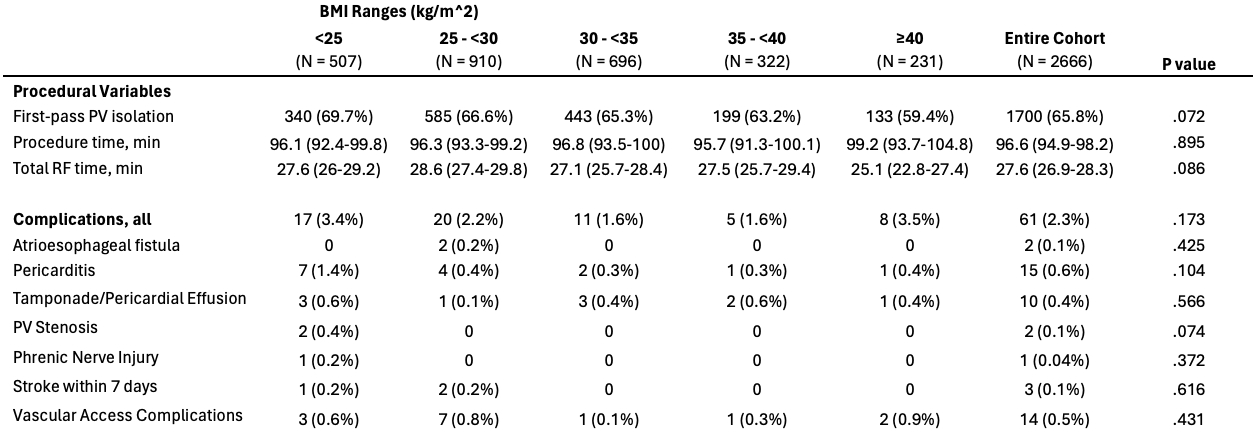
- First-pass isolation rates progressively decreased with higher BMI (Table 2).
- Complication rates were low across all BMI groups (Table 2).
Conclusions
- Severely obese patients with BMI ≥40 experience higher risk of atrial arrhythmia following radiofrequency catheter ablation of paroxysmal atrial fibrillation compared with normal weight individuals. This corresponds with lower rates of first-pass isolation at higher BMI.
- Patients across BMI categories experience similarly low rates of procedural complication.
  • Peng, Gary  ( Brigham and Women's Hospital , Boston , Massachusetts , United States )
  • Thorne, Christopher  ( Heart Rhythm Clinical and Research Solutions, LLC , Birmingham , Alabama , United States )
  • Varley, Allyson  ( Heart Rhythm Clinical and Research Solutions, LLC , Birmingham , Alabama , United States )
  • Osorio, Jose  ( Heart Rhythm Clinical and Research Solutions, LLC , Birmingham , Alabama , United States )
  • Goyal, Sandeep  ( Piedmont Heart Institute Buckhead , Atlanta , Georgia , United States )
  • Zei, Paul  ( Brigham and Women's Hospital , Boston , Massachusetts , United States )
  • Author Disclosures:
    Gary Peng: DO NOT have relevant financial relationships | Christopher Thorne: No Answer | Allyson Varley: DO have relevant financial relationships ; Employee:HRCRS:Active (exists now) | Jose Osorio: No Answer | Sandeep Goyal: No Answer | Paul Zei: DO have relevant financial relationships ; Research Funding (PI or named investigator):Biosense Webster:Active (exists now) ; Advisor:HRCRS:Active (exists now) ; Consultant:Volta:Active (exists now) ; Consultant:Varian:Active (exists now) ; Consultant:Medtronic:Past (completed) ; Consultant:Abbott:Active (exists now)
Meeting Info:

Scientific Sessions 2024

2024

Chicago, Illinois

Session Info:

One and Done or Three-Peat? Understanding, Predicting and Preventing Recurrence in AFib Ablation

Monday, 11/18/2024 , 12:50PM - 02:05PM

Moderated Digital Poster Session

More abstracts on this topic:
A Comparison of Anxiety and Depression in Patients with Symptoms of Palpitations Compared to High Risk Arrythmia Patients.

Treuth Mark, Patel Kunnal, Rissmiller Justin, Holdai Veera

4D Cardiac Optogenetics Enable Complex Arrhythmia Modelling and Precise Interventional Simulation

Wexler Yehuda, Grinstein Harel, Landesberg Michal, Glatstein Shany, Huber Irit, Arbel Gil, Gepstein Lior

More abstracts from these authors:
In the EP Lab: Leveraging AI during procedures - where are we, where are we going?

Zei Paul, Saluja Deepak

Patient and Procedural Characteristics Associated with GERD and Chest Pain After Atrial Fibrillation Ablation with Esophageal Cooling: Results from the Multicenter EVERCOOL AF Registry.

Silverstein Joshua, Sha Qun, Kulstad Erik, Bezenek Susan, Varley Allyson, Singh David, Metzl Mark, Shaw George, Phan Huy, Belden William, Thosani Amit, Liu Emerson, Costea Alexandru, Patel Parin, Sharkoski Tiffany

You have to be authorized to contact abstract author. Please, Login
Not Available