Provider understanding of Coronary Artery Calcium Scoring (CAC) testing in Atherosclerotic CArdiovascular Disease risk stratification and Racial Disparities Study (CAC-CARD) to reduce healthcare disparities
Abstract Body (Do not enter title and authors here): Background Coronary Artery Calcium (CAC) scoring is critical in assessing Atherosclerotic Cardiovascular Disease (ASCVD) risk. Despite its utility, many primary care physicians lack confidence and familiarity with its application. Significant racial disparities in CAC scoring utilization have been observed, potentially affecting patient outcomes.
Hypothesis We hypothesized that a short targeted educational intervention would enhance physicians' confidence, knowledge, and utilization of CAC scoring and awareness of racial disparities.
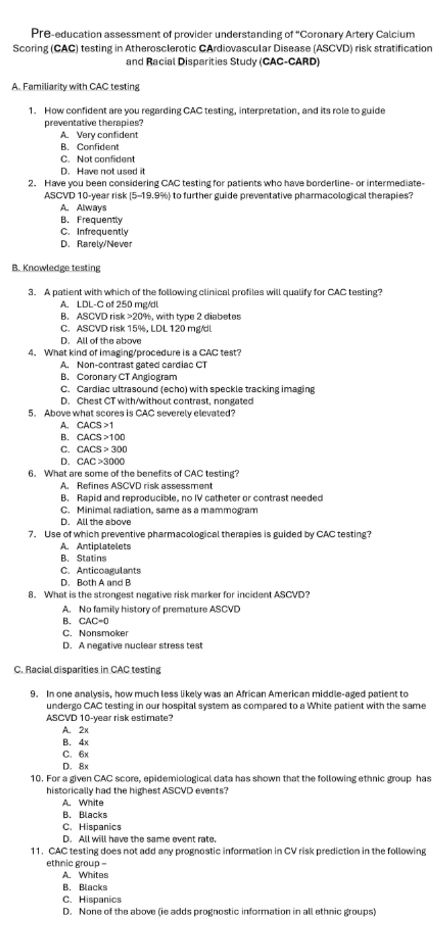
Methods A pre- and post-intervention study (Image 1) was conducted among 39 physicians at the University of Louisville. The intervention included a 20-minute educational session on CAC scoring and racial disparities. A video summarizing the ACC2018 guidelines for prevention and cholesterol treatment was provided. A summary of key points for clinical practice was given. The ASCVD plus calculator app was provided. Data were collected using a structured questionnaire before and after the intervention. Viewing time and engagement were recorded. Descriptive and inferential statistics analyzed the data.
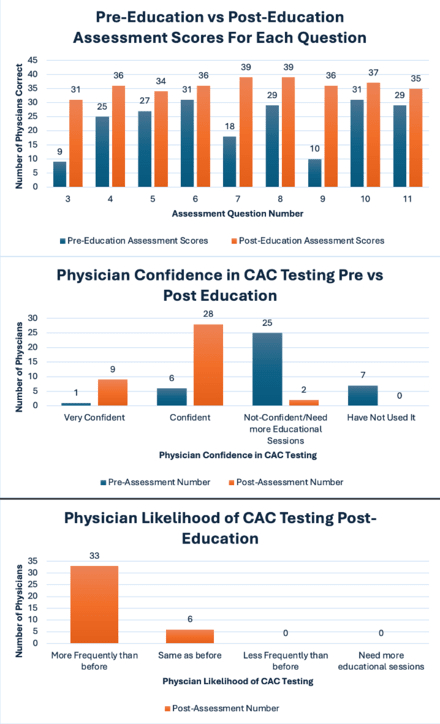
Results The average correct physician responses increased from a mean of 59.5% pre-intervention to 92.0% post-intervention. Post-intervention, the number of physicians who felt confident or very confident in CAC testing increased from 17.9% to 94.8%. Additionally, 33 out of 39 physicians (84.6%) reported likely to use CAC testing more frequently. Correct responses on racial disparities improved from 59% pre-intervention to 92.0% post-intervention. (Image 2). The average viewing time was 28 minutes. Time spent on the questionnaires was 14 min pre and 12 min post.
Conclusion Our targeted educational intervention significantly enhanced physicians' knowledge and confidence in CAC scoring for ASCVD risk assessment and raised awareness about racial disparities, promoting more equitable practices.
Daga, Pawan
( University of Louisville
, Louisville
, Kentucky
, United States
)
Devanand, Dakshinkumaar
( University of Louisville
, Louisville
, Kentucky
, United States
)
Umer, Muhammad
( University of Louisville
, Louisville
, Kentucky
, United States
)
Sagheer, Usman
( University of Louisville
, Louisville
, Kentucky
, United States
)
Menon, Tushar
( University of Louisville
, Louisville
, Kentucky
, United States
)
Singh, Gurnoor
( University of Louisville
, Louisville
, Kentucky
, United States
)
Kalra, Dinesh
( University of Louisville
, Louisville
, Kentucky
, United States
)
Author Disclosures:
Pawan Daga:DO NOT have relevant financial relationships
| Dakshinkumaar Devanand:No Answer
| Muhammad Umer:No Answer
| Usman Sagheer:No Answer
| Tushar Menon:DO NOT have relevant financial relationships
| Gurnoor Singh:No Answer
| Dinesh Kalra:DO NOT have relevant financial relationships