
Large-Scale Investigation on the Outcomes of Atrial Fibrillation Ablation in Liver Cirrhosis Patients
Abstract Body (Do not enter title and authors here): Background Catheter-based atrial fibrillation(AF) ablation is amongst the most commonly done EP procedures that have evolved over decades, improving patient outcomes and quality of life. Atrial fibrillation is seen in 5% of patients with cirrhosis and studies have shown AF in cirrhosis to be associated with increased mortality and adverse hospital outcomes.
Aim There is scarce literature on the outcomes of AF ablation in patients with cirrhosis. Our study aimed to study the safety and efficacy of catheter-based AF ablations in this population group and to ascertain if there is a difference compared to the general patient population.
Methods We used the Nationwide Inpatient Sample Database 2016-2020, the largest openly accessible inpatient healthcare database in the United States. Patients with a primary diagnosis of AF were identified using ICD-10 codes. We excluded patients with a secondary diagnosis of other arrhythmias, missing demographics, mortality, or age<18. The study population was divided into patients with and without cirrhosis. Information was collected regarding various patient demographic characteristics and comorbidities (comorbidity burden captured via Elixhauser Comorbidity Index). The primary endpoint was in-hospital mortality. The secondary endpoints were total complications, length of stay, and hospitalization charges.
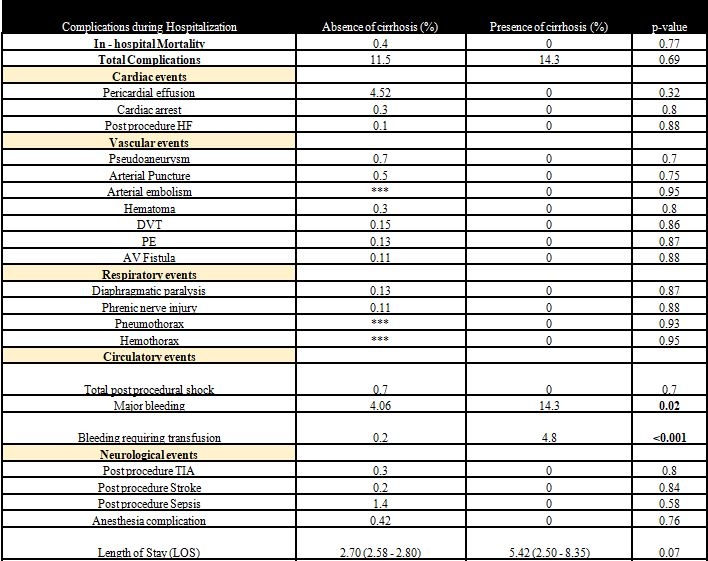
Results A total of 23,905 patients underwent ablation, with 23,800 being non-cirrhotic, and only 105 presenting with cirrhosis. This signifies a relatively low proportion of cirrhotic patients undergoing ablation procedures, approximately 0.6% (105 out of a total of 17,600 cirrhotic patients). Additionally, the Elixhauser comorbidity index is significantly higher in cirrhotic patients (6.62) compared to non-cirrhotic patients (3.65) with a p-value <0.001, indicating a higher burden of comorbidities in the cirrhotic group. Patients with cirrhosis undergoing ablation procedures exhibit a notably higher risk of major bleeding compared to those without cirrhosis (14.3% vs. 4.06%, p-value = 0.02). Furthermore, the incidence of bleeding requiring transfusion is significantly elevated in cirrhotic patients (4.8%) in contrast to non-cirrhotic patients (0.2%) (p-value < 0.001).
Conclusion Although the risk of major bleeding is high, overall mortality and other complications are comparable to those without cirrhosis. We believe that this can be mitigated by carefully selecting the patients with cirrhosis for this procedure.
Ravi, Soumiya
( University of Arizona
, Tucson
, Arizona
, United States
)
Brar, Ajit
( Hurley Medical Center
, Flint
, Michigan
, United States
)
Garg, Ayushi
( Trident Medical Center
, Charleston
, South Carolina
, United States
)
Sohal, Aalam
( Liver Institute Northwest
, Seattle
, Washington
, United States
)
Author Disclosures:
Soumiya Ravi:DO NOT have relevant financial relationships
| Ajit Brar:DO NOT have relevant financial relationships
| Ayushi Garg:No Answer
| Aalam Sohal:No Answer