
Logo

American Heart Association

  106
  0


Final ID: Sa4062

The Watchman Device needs to be Watched: A Case of Device Related Thrombus

Abstract Body (Do not enter title and authors here): Introduction
Left atrial appendage (LAA) harbors approximately 90% of thrombi in non-valvular atrial fibrillation (AF) for which an anticoagulant (AC) is indicated to prevent cardio-embolic stroke. Alternatively, the benefits of LAA occlusion (LAAO) devices to those patients who encounter life-threating bleeding with AC are also well established. However, the LAAO device comes with the risk of device related thrombus (DRT), which is a real challenge.

Case
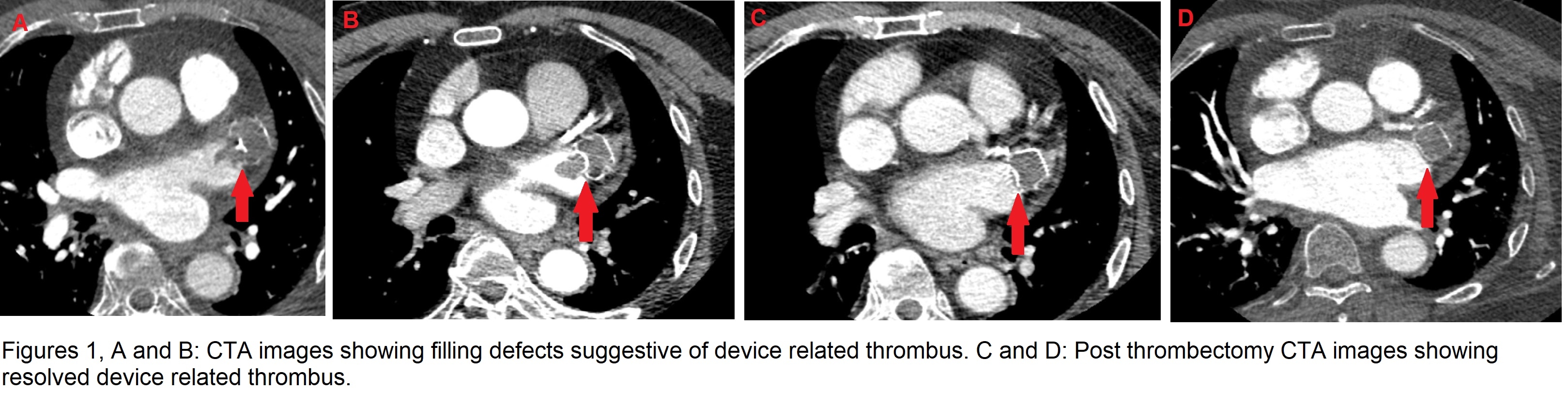
A 68 year-old-male with history of chronic AF on apixaban and recurrent ischemic and hemorrhagic stroke was evaluated for LAAO device placement procedure. Initially, when the patient was not taking AC, he had an ischemic stroke likely cardio-embolic source, which necessitated the initiation of apixaban. Unfortunately, while he was taking apixaban, he had a right thalamic bleed causing persistent left sided paresis. Subsequently, AC was held for 6 months and he underwent watchman device placement. He remained on apixaban for 45 days post procedure and was continued on aspirin only. After 10 months, on routine cardiac computerized tomographic arteriography (CTA), a large filling defect measuring 1.7 x 1.4 cm on the left atrial side of the watchman device was seen (Figure 1A) which was confirmed with transesophageal echocardiogram. Then, he was re-started on apixaban for a short period of time, which culminated him to have a right temporal bleed. After holding AC for 3 months, repeat CTA showed persistent filling defect suggestive of DRT (Figure 1B). Therefore, AC was permanently discontinued and patient was evaluated for DRT removal procedure. Utilizing a shared decision model, the option of mechanical thrombectomy with cerebral protection device (CPD) was chosen to mitigate the risk of embolic stroke. Post procedure, he was continued on apixaban 2.5 mg twice daily for 3 months and then aspirin forever. Subsequent surveillance CTA did not show DRT (Figures 1C and D). Patient has remained asymptomatic thereafter.

Conclusion
3-7% of patients with Watchman device suffer from DRT. Life threatening bleeding from AC further complicates the management of such patients. Mechanical thrombectomy with CPD is an established procedure for the removal of intra-arterial or intravenous thrombus. However, the feasibility of the routine use of mechanical thrombectomy with CPD for persistent DRT in-patient like ours is yet to be studied in detail.
  • Acharya, Sameer  ( Cayuga Medical Center , Ithaca , New York , United States )
  • Fiema, Bryan  ( Rochester General Hospital , Rochester , New York , United States )
  • Akram, Ali  ( Cayuga Medical Center , Ithaca , New York , United States )
  • Depta, Jeremiah  ( Rochester General Hospital , Rochester , New York , United States )
  • Author Disclosures:
    Sameer Acharya: DO NOT have relevant financial relationships | Bryan Fiema: No Answer | ali akram: DO NOT have relevant financial relationships | Jeremiah Depta: No Answer
Meeting Info:

Scientific Sessions 2024

2024

Chicago, Illinois

Session Info:

Managing the Rarest of Cases: Super Hero Interventionalist to the Rescue!

Saturday, 11/16/2024 , 10:30AM - 11:30AM

Abstract Poster Session

More abstracts on this topic:
A First-in-Class Humanized Antibody Fragment Targeting Platelet Glycoprotein Ibα: A Comprehensive Preclinical Study of CA1001 for the Treatment of Acute Ischemic Stroke

Xu Xiaohong, Preeti Preeti, Yu Ruoying, Shaykhalishahi Hamed, Zhang Cheng, Shen Chuanbin, Li Bei, Tang Naping, Chang Yan, Xiang Qian, Cui Yimin, Lei Xi, Ni Heyu, Zhu Guangheng, Liu Zhenze, Hu Xudong, Slavkovic Sladjana, Neves Miguel, Ma Wenjing, Xie Huifang

A Delayed Diagnosis of Anti-HMG-CoA Reductase Immune-Mediated Necrotizing Myopathy

Jadhav Reshma, Shekar Arush, Westenhaver Zack, Skandhan Amith

You have to be authorized to contact abstract author. Please, Login
Not Available