
Single Perclose Plus Angioseal Versus Double Perclose for Percutaneous Femoral Access: A Systematic Review and Meta-Analysis
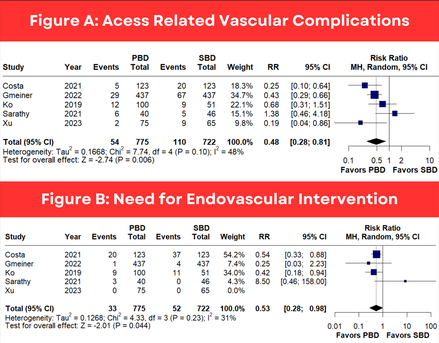
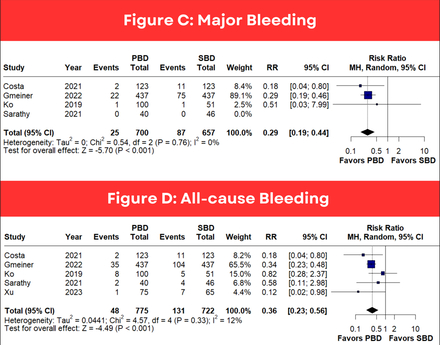
Abstract Body (Do not enter title and authors here): Background: Vascular Closure utilizing Suture Based Devices (SBD) is an established approach for large-bore arterial access in percutaneous procedure patients. Standard of care uses two devices when accessing the artery with 8 Fr sheaths and above. The bailout use of Plug-based devices (PBD) is well established, but little is known about the intentional combination of SBD with PBD and how this technique compares to the standard approach. We aimed to compare these different approaches in this meta-analysis. Methods: PubMed, Scopus, and Cochrane databases were searched for observational studies comparing the hybrid approach to the standard one utilizing exclusively SBDs for arterial closure in large bore vascular access and reported the outcomes of (1) Access-related complications (ARC); (2) Major bleeding; (3) All bleeding events; (4) Need for surgical intervention; (5) Need for endovascular intervention ; (6) Device failure; (7) Pseudoaneurysm. Heterogeneity was examined with I2 statistics. A random-effects model was used for all outcomes. Results: We included five observational studies with 1,586 patients, of whom 1,489 (93.8%) underwent TAVI and 97 (6.1%) EVAR. Sheath size had an average of 20.56 Fr in the EVAR patients. ARC (RR 0.48; 95% CI 0.28-0.81; p<0.01), major bleeding (RR 0.29; 95% CI 0.19-0.44; p<0.01), all bleeding events (RR 0.36; 95% CI 0.23-0.56; p<0.01), surgical intervention (RR 0.28; 95% CI 0.10-0.78; p=0.01), or endovascular intervention (RR 0.53; 95 % CI 0.28-0.98; p=0.04), and device failure (RR 0.28; 95% CI 0.11-0.72; p<0.01) were significantly less common in patients treated with the hybrid technique compared to standard care. Pseudoaneurysm (RR 1.13; 95% CI 0.57-2.25; p=0.71) was not significantly different between groups. Conclusion:These findings suggest the hybrid technique, was associated with fewer access complications compared to the standard double SBD as a closure strategy in patients with large bore arterial access.
Bertolino, Enrico
( State University of Maringa
, Maringá
, Paraná
, Brazil
)
Monteiro Mastra Fontoura, Milena
( Federal University of Rio de Janeiro
, Rio de Janeiro
, Rio de Janeiro
, Brazil
)
Pimentel Junior, Dilson
( Fluminense Federal University School of Medicine
, Niterói
, Rio de Janeiro
, Brazil
)
Fernandez, Miguel
( Bahiana School of Medicine and Public Health
, Salvador
, Bahia
, Brazil
)
Mesquita, Cynthia
( Federal University of Pernambuco
, Recife
, Brazil
)
Queiroz, Ivo
( Universidade catolica de Pernambuco
, Recife
, Brazil
)
Diaz, Braiana
( Universidad Autónoma del Estado de Hidalgo and Instituto Nacional de Cardiología “Ignacio Chávez”
, Mexico City
, Federal District
, Mexico
)
Barbosa, Lucas
( Federal University of Minas Gerais
, Belo Horizonte
, Brazil
)
Mulatti, Grace
( University of São Paulo Medical School.
, São Paulo
, São Paulo
, Brazil
)
Author Disclosures:
Enrico Bertolino:DO NOT have relevant financial relationships
| Milena Monteiro Mastra Fontoura:DO NOT have relevant financial relationships
| Dilson Pimentel Junior:No Answer
| Miguel Fernandez:DO NOT have relevant financial relationships
| Cynthia Mesquita:DO NOT have relevant financial relationships
| Ivo Queiroz:DO NOT have relevant financial relationships
| Braiana Diaz:DO NOT have relevant financial relationships
| Lucas Barbosa:DO NOT have relevant financial relationships
| Grace Mulatti:No Answer