
Logo

American Heart Association

  104
  0


Final ID: Sa1065

Neutrophil-lymphocyte ratio as a marker of cardiovascular outcomes in patients with chronic coronary syndrome

Abstract Body (Do not enter title and authors here): Background: Inflammation is one of the pathophysiological processes involved in the genesis and progression of atherosclerosis and has been increasingly used as a therapeutic target in recent years. The neutrophil-lymphocyte ratio (NLR) is a promptly accessible inflammatory biomarker strongly associated with prognosis in the acute coronary setting. However, there are few data in patients with chronic coronary syndrome (CCS).
Objective: Analyze the association between NLR and cardiovascular outcomes in patients with CCS.
Methods: Patients with CCS, defined as a previous revascularization procedure (surgical or percutaneous), previous myocardial infarction (MI) or stenosis > 50% in at least one epicardial coronary artery, were included and followed up on an outpatient basis. The NLR was calculated using the baseline blood count. The main outcome was the composite of death, non-fatal myocardial infarction and non-fatal stroke.
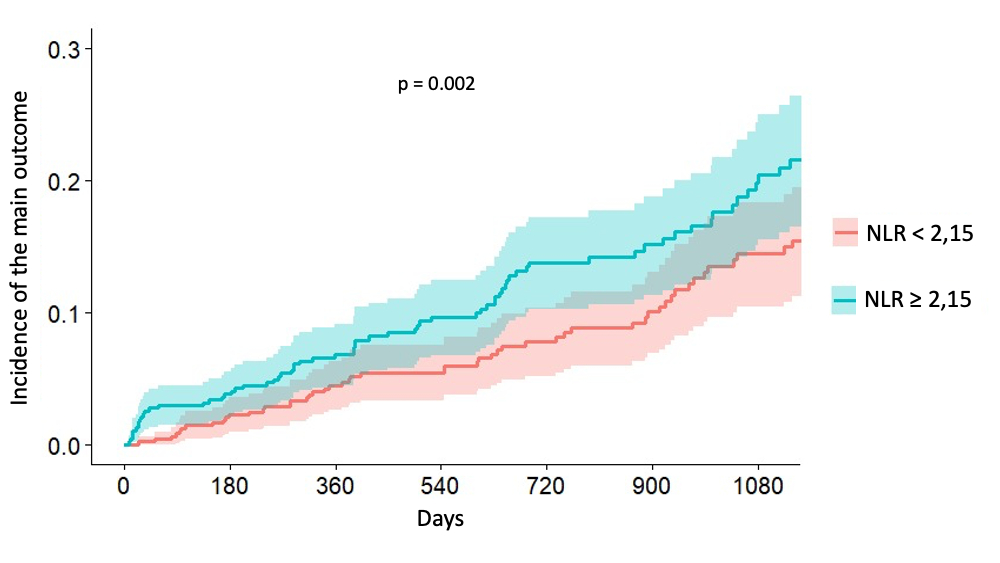
Results: The study population consisted of 975 patients, with a median age of 65 years and 30% were women. Previous MI was present in 61%, 30% had undergone previous revascularization surgery and 46% had percutaneous coronary intervention. Diabetes was prevalent in 59% and hypertension in 95%. The median NLR was 2.15 (IQR 1.25 - 2.87). Patients with NLR ≥ 2.15, when compared to those with NLR < 2.15, presented more left ventricular (LV) dysfunction (58% vs. 55%; p=0.003) and lower LDL-C serum levels (81 vs. 88 mg/dL; p=0.004). There was no association between NLR and coronary anatomical severity. NLR correlated with age, LDL-C and LV function (p < 0.05 for all). During follow-up, 152 events of the composite primary outcome were registered, with an estimated 3-year incidence of 15.6% in the overall population – higher within patients with NLR ≥ 2.15 when compared to NLR < 2.15 (20% x 14%, p = 0.002), as shown in the figure. In the multivariate analysis, the 3rd quartile of NLR had a 31% higher risk than the 1st quartile (p < 0.05).
Conclusion: In this study, the NLR, an easily available inflammatory biomarker, independently correlates with cardiovascular outcomes in a population with CCS.
  • Trombini Pinesi, Henrique  ( Instituto do Coracao, Hospital das Clinicas, Faculdade de Medicina, Universidade de Sao Paulo , Sao Paulo , Brazil )
  • Moreira, Eduardo  ( Instituto do Coracao, Hospital das Clinicas, Faculdade de Medicina, Universidade de Sao Paulo , Sao Paulo , Brazil )
  • Barbosa, Marcelo  ( Instituto do Coracao, Hospital das Clinicas, Faculdade de Medicina, Universidade de Sao Paulo , Sao Paulo , Brazil )
  • Martins, Eduardo  ( Instituto do Coracao, Hospital das Clinicas, Faculdade de Medicina, Universidade de Sao Paulo , Sao Paulo , Brazil )
  • Pitta, Fabio Grunspun  ( Instituto do Coracao, Hospital das Clinicas, Faculdade de Medicina, Universidade de Sao Paulo , Sao Paulo , Brazil )
  • Lima, Eduardo  ( Instituto do Coracao, Hospital das Clinicas, Faculdade de Medicina, Universidade de Sao Paulo , Sao Paulo , Brazil )
  • Rached, Fabiana Hanna  ( Instituto do Coracao, Hospital das Clinicas, Faculdade de Medicina, Universidade de Sao Paulo , Sao Paulo , Brazil )
  • Serrano, Carlos  ( Instituto do Coracao, Hospital das Clinicas, Faculdade de Medicina, Universidade de Sao Paulo , Sao Paulo , Brazil )
  • Author Disclosures:
    Henrique Trombini Pinesi: DO NOT have relevant financial relationships | Eduardo Moreira: No Answer | Marcelo Barbosa: No Answer | Eduardo Martins: No Answer | FABIO GRUNSPUN PITTA: DO NOT have relevant financial relationships | Eduardo Lima: No Answer | FABIANA HANNA RACHED: DO NOT have relevant financial relationships | Carlos Serrano: DO NOT have relevant financial relationships
Meeting Info:

Scientific Sessions 2024

2024

Chicago, Illinois

Session Info:

Inflammation in Cardiovascular and Metabolic Disease

Saturday, 11/16/2024 , 02:00PM - 03:00PM

Abstract Poster Session

More abstracts on this topic:
Aging-Associated Protein Medin Induces Human Coronary Artery Endothelial Proinflammatory and Prothrombotic Activation

Karamanova Nina, Morrow Kaleb, Maerivoet Alana, Madine Jillian, Li Ming, Migrino Raymond

A Systematic Review and Network Meta-Analysis of Metastatic Castrate-Resistant Prostate Cancer Therapy Cardiotoxicity Given Metastatic Hormone-Sensitive Prostate Cancer Treatment History

Aziz Moez, Swaby Justin, Deng Brett, Hartshorne Taylor, Desai Shubh, Zhang Allan, Xiao Daniel, Sanchez Darren, Imber Jared, Song Jeffrey, Rivas Alexis, Molony Donald, Guhan Maya, Ranganath Shreyas, Jacob Jerril, Ziaolhagh Ali, Ali Abdelrahman, Yusuf Syed, Canfield Steven, Iliescu Cezar, Monlezun Dominique, Higgason Noel, Brunckhorst Oliver, Roland Jerry, Owen Christopher, Iacobucci Alexander Samuel, Galan Jacob

More abstracts from these authors:
Patient Demographics and Appropriateness of Elective Percutaneous Coronary Intervention in a Brazilian Cardiology Center

Del Vecchio Ziotti Sara, Pereira Thiago, Grobe Sarah, Serrano Carlos, Cesar Luiz, Abizaid Alexandre, Gowdak Luis Henrique

Effect of Colchicine on the Perivascular Inflammation Index of Coronary Computerized Tomography Angiogram: COPIX trial

Barbosa Camila, Serrano Carlos, Pitta Fabio Grunspun, Lima Eduardo, Rached Fabiana Hanna, Martins Eduardo

You have to be authorized to contact abstract author. Please, Login
Not Available