
Meta-Analysis of Outcomes in Patients Developing Acute Kidney Injury Following Thoracic Endovascular Aortic Repair for Stanford Type B Aortic Dissection
Abstract Body (Do not enter title and authors here): Background and Aims Thoracic endovascular aortic repair (TEVAR) is warranted in patients with Stanford Type-B aortic dissection who are at an increased risk of aneurysm rupture and enlargement. While studies indicate that development of post-operative acute kidney injury (AKI) (with incidence rate varying from 1.5% to 34%) may potentially worsen outcomes and increased mortality, the specific role of AKI in the postoperative period for patients undergoing TEVAR for Stanford Type-B aortic dissection remains understudied and unclear. Our meta-analysis aims to contribute valuable insights into this aspect.
Methods A comprehensive literature search spanning major bibliographic databases was conducted to retrieve studies comparing outcomes in Stanford Type-B aortic dissection patients undergoing TEVAR who developed AKI postoperatively versus those who did not. Our outcomes of interest included the risk of in-hospital mortality, stroke, and requirement for dialysis. Relative risks (RRs) were pooled from all studies using DerSimonian and Laird random-effects models in the ‘meta’ package of R software (Version: 2023.12.1+402). Statistical significance was set at p <0.05.
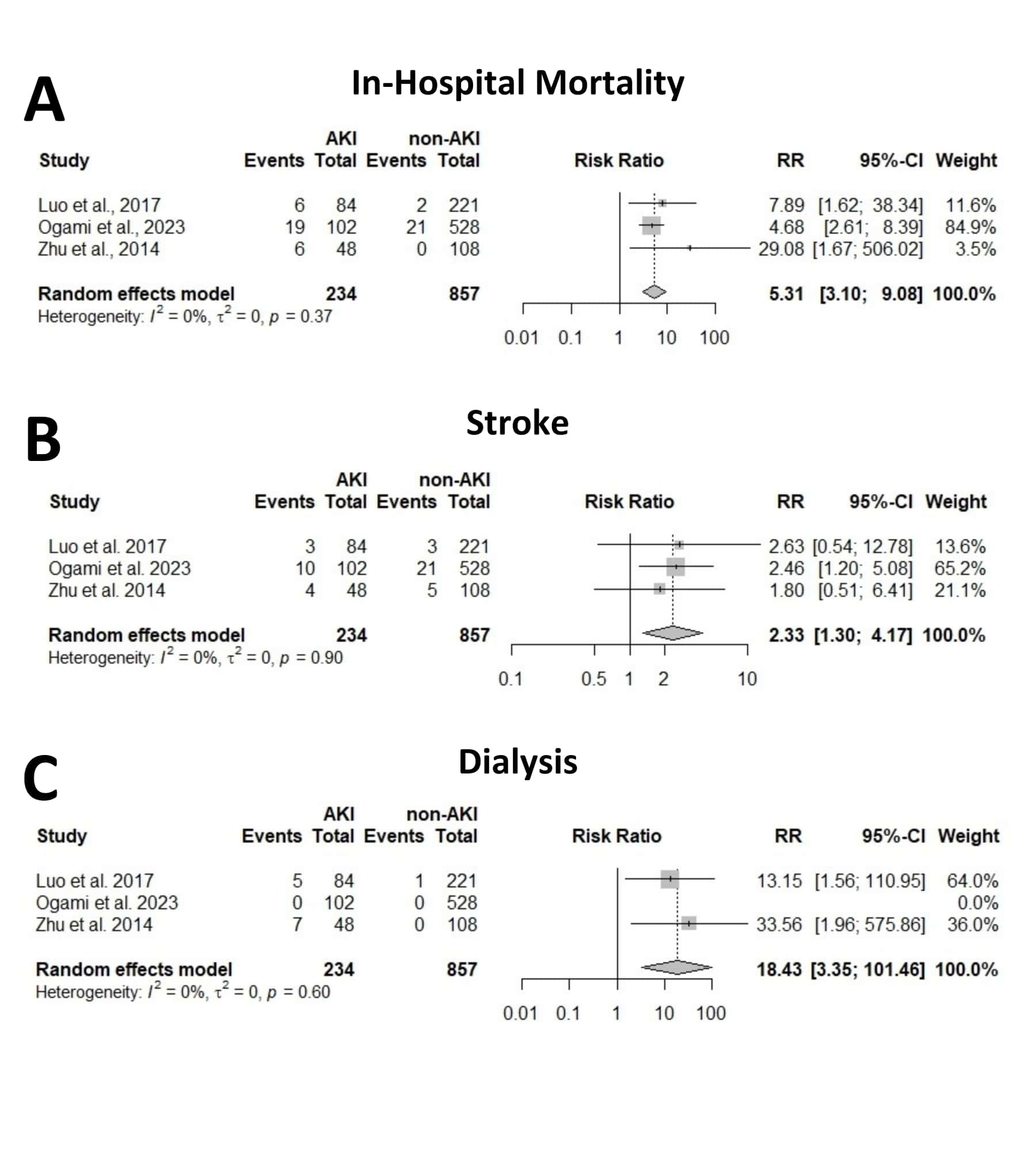
Results Three studies were included with 1091 patients (234 in the AKI group and 857 in the non-AKI group). The development of AKI was associated with a significantly higher risk of in-hospital mortality [RR: 5.31; 95% CI: 3.10, 9.08; p<0.0001; I2=0%], a higher risk of stroke [RR: 2.33; 95% CI: 1.30, 4.17; p=0.0046; I2=0%], and an increased risk of requiring dialysis [RR: 18.43; 95% CI: 3.35, 101.46; p=0.0008; I2=0%] (Figure 1). No heterogeneity was observed between the studies (Figure 1 and 2).
Conclusion The development of AKI after TEVAR in patients with Stanford Type-B aortic dissection is associated with an increased risk of in-hospital mortality, stroke, and dialysis requirement. Hence, further research into early recognition of the risk factors associated with the development of AKI after TEVAR is warranted, along with determining its effects in longer follow-up durations.
Goyal, Aman
( Seth GS Medical College and KEM Hospital
, Mumbai
, India
)
Belur, Agastya
( University of Louisville
, Louisville
, Kentucky
, United States
)
Sulaiman, Samia
( School of Medicine, University of Jordan
, Amman
, Jordan
)
Jain, Hritvik
( AIIMS Jodhpur
, Jodhpur
, India
)
Sohail, Amir
( University of New Mexico
, Albuquerque
, New Mexico
, United States
)
Shrestha, Abhigan
( Medical Research Hub, Nepal
, Kathmandu
, Nepal
)
Ullah, Irfan
( KABIR MEDICAL COLLEGE
, Peshawar
, Pakistan
)
Puttaswamy, Darshan
( Seth GS Medical College and KEM Hospital
, Mumbai
, India
)
Abbasi, Haleema Qayyum
( Ayub Medical College
, Abbottabad
, Pakistan
)
Raza, Fatima
( Karachi Medical and Dental College
, Karachi
, Pakistan
)
Author Disclosures:
Aman Goyal:DO NOT have relevant financial relationships
| Agastya Belur:No Answer
| Samia Sulaiman:DO NOT have relevant financial relationships
| Hritvik Jain:DO NOT have relevant financial relationships
| Amir Sohail:No Answer
| Abhigan Shrestha:DO NOT have relevant financial relationships
| Irfan Ullah:DO NOT have relevant financial relationships
| Darshan Puttaswamy:DO NOT have relevant financial relationships
| Haleema Qayyum Abbasi:DO NOT have relevant financial relationships
| Fatima Raza:DO NOT have relevant financial relationships