
Logo

American Heart Association

  108
  0


Final ID: 4116949

Specialized Pericyte Subtypes in the Pulmonary Capillary

Abstract Body (Do not enter title and authors here): Introduction: Lung pericytes (PCs) are mural cells in close contact with endothelial cells (ECs) in the microvasculature. A significant challenge in investigating PC biology is largely due to the absence of a unique cell marker, making it difficult to distinguish them from other mural cell populations. The identification of such a marker would allow investigators to describe the role of PCs in various diseases including pulmonary arterial hypertension.

Hypothesis: We hypothesize that HIG1 hypoxia-inducible domain family member 1B (Higd1b) is exclusively expressed in lung PCs, which contributes to hypoxia (Hx)-induced vascular remodeling.

Methods: We utilized single-cell RNA sequence (scRNA-seq) databases, spatial transcriptomics, and RNAscope from human and murine lungs to identify a PC-specific cell marker and compare the gene expression between PC subtypes. We utilized Cre-LoxP and CRISPR technology to construct a novel tamoxifen-inducible Higd1b-CreERT2 knock-in mouse model and performed lineage-tracing studies to describe the role of PC subtypes in Hx-induced pulmonary hypertension (PH).

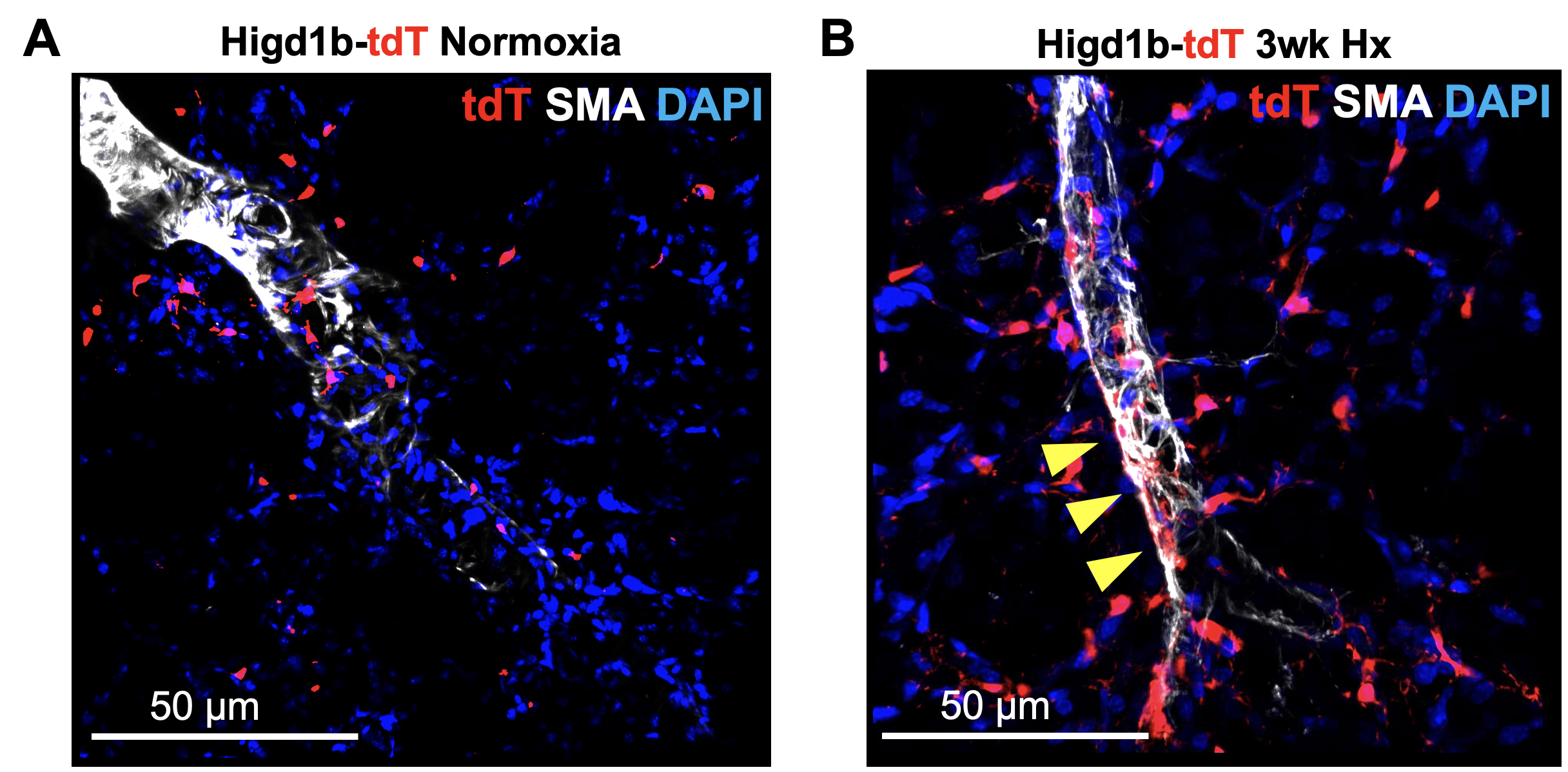
Results: ScRNA-seq analysis from the lungs of humans and mice identified Higd1b as a specific gene marker for PCs whose expression is absent in other mural cell populations. Validation with a reporter mouse line Higd1b-CreERT2::R26-tdT confirmed Higd1b-Cre+ cells specifically label PCs and no other mural cells (Fig 1A). Lineage tracing in the Hx-induced murine model of PH demonstrated the accumulation of PCs in the muscularized distal arterioles (Fig 1B). Through scRNA-seq and immunofluorescence validation, we identified two HIGD1B+ PC subtypes that exist in the pulmonary capillary: Type 1 PCs, which are quiescent in the capillaries, and Type 2 PCs exhibit multipotent cell-like properties and accumulate in the arterioles after exposure to Hx. Furthermore, we found Type 2 PCs transited into SMC-like cells via the upregulation of Vimentin, contributing to vascular remodeling in Hx-induced PH.

Conclusion: We identified Higd1b as a unique marker for PCs and generated a novel Higd1b-CreERT2 mouse that specifically labels PCs in the lungs. The discovery of PC-subtype specialization advances our understanding of lung pericyte biology and PC’s contribution to capillary remodeling under pathological conditions.
  • Klouda, Tim  ( Boston Childrens Hospital , Boston , Massachusetts , United States )
  • Dejesus, Vinicio  ( STANFORD UNIVERSITY , Palo Alto , California , United States )
  • Yuan, Ke  ( Boston Children's Hospital , Brooklyn , Massachusetts , United States )
  • Kim, Yunhye  ( Boston Childrens Hospital , Boston , Massachusetts , United States )
  • Baek, Han-seong  ( Boston Childrens Hospital , Boston , Massachusetts , United States )
  • Bhaumik, Mantu  ( Boston Children's Hospital , Boston , Massachusetts , United States )
  • Liu, Yu  ( Stanford Cardiovascular Institute , Stanford , California , United States )
  • Liu, Tiffany  ( Boston Childrens Hospital , Boston , Massachusetts , United States )
  • Que, Jianwen  ( Columbia University Medical Center , New York , New York , United States )
  • Wu, Joseph  ( Stanford Cardiovascular Institute , Stanford , California , United States )
  • Raby, Benjamin  ( Boston Childrens Hospital , Boston , Massachusetts , United States )
  • Author Disclosures:
    Tim Klouda: DO NOT have relevant financial relationships | Vinicio Dejesus: DO NOT have relevant financial relationships | Ke Yuan: DO NOT have relevant financial relationships | Yunhye Kim: DO NOT have relevant financial relationships | Han-Seong Baek: No Answer | Mantu Bhaumik: No Answer | Yu Liu: DO NOT have relevant financial relationships | Tiffany Liu: No Answer | Jianwen Que: No Answer | Joseph Wu: DO NOT have relevant financial relationships | Benjamin Raby: DO NOT have relevant financial relationships
Meeting Info:

Scientific Sessions 2024

2024

Chicago, Illinois

Session Info:

The Gang’s All Here: Cells That Mediate Pulmonary Vascular Disease

Sunday, 11/17/2024 , 09:45AM - 11:00AM

Abstract Oral Session

More abstracts on this topic:
CD38 Activation by Disturbed Flow (d-flow) Promotes Endothelial Cell (EC) Senescence-Associated Stemness (SAS) through Glutaminolysis Enhanced by Pyruvate Dehydrogenase (PDH) Inhibition, Leading to Atherothrombosis

Kotla Sivareddy, Ostos Mendoza Keila Carolina, Chau Khanh, Le Nhat Tu, Schadler Keri, Burks Jared K, Seeley Erin, Lorenzi Philip, Brookes Paul, Martin James, Wang Guangyu, Lee Jonghae, Chini Eduardo, Abe Junichi, Osborn Abigail, Pathania Rajneesh, Chen Weiqing, Samanthapudi Venkata Subrahman K, Mejia Gilbert, Hoang Oanh, Ko Kyung Ae

A NEW DOUBLE-HIT RAT MODEL OF MYOCARDIAL INFARCTION AND PULMONARY HYPERTENSION

Miklovic Matus, Molnar Matej, Kala Petr, Kroupova Katerina, Vanourkova Zdenka, Havlicek Dominik, Jirak Daniel, Melenovsky Vojtech

More abstracts from these authors:
Loss of Rgs5 Promotes Pericyte Differentiation into Contractile Cells and Vascular Remodeling

Kim Yunhye, Li Yan, Zhao Jocelyn, Yuan Ke

Fibro-proliferative Remodeling of the Endocardium in Pulmonary Vein Stenosis

Gaal Julia, Jenkins Kathy, Casar Berazaluce Alejandra, Melero-martin Juan, Del Nido Pedro, Yuan Ke, Friehs Ingeborg, Hammer Peter, Lee Umji, Kim Yunhye, Saraci Kerstin, Zajac Cindy, Klouda Tim, Diaz-gil Daniel, Baird Chris

You have to be authorized to contact abstract author. Please, Login
Not Available