
Disparities in Youth Cardiac Screening by Childhood Opportunity Index: Insights from the Heartbytes Database
Abstract Body (Do not enter title and authors here): Intro The AHA endorses screening youth athletes to identify risk for sudden cardiac arrest (SCA). Rates of SCA can be predicted by social determinants of health (SDOH) such as education level and proportion of Black residents in ZIP Code. The Child Opportunity Index (COI) quantifies neighborhood factors that influence health and development. The link between COI and youth cardiac screening findings and outcomes remains unclear.
Hypothesis Cardiac screening data will differ significantly by COI.
Aims To identify differences in cardiac screening data in children of varying COI.
Methods The HeartBytes Database, including sports exams, self-reported physical activity (PA), and zip codes from Simon's Heart screenings was augmented with COI index zip code data. Chi-squared and logistic regression were used to analyze demographics, cardiac risk factors, and screening results.
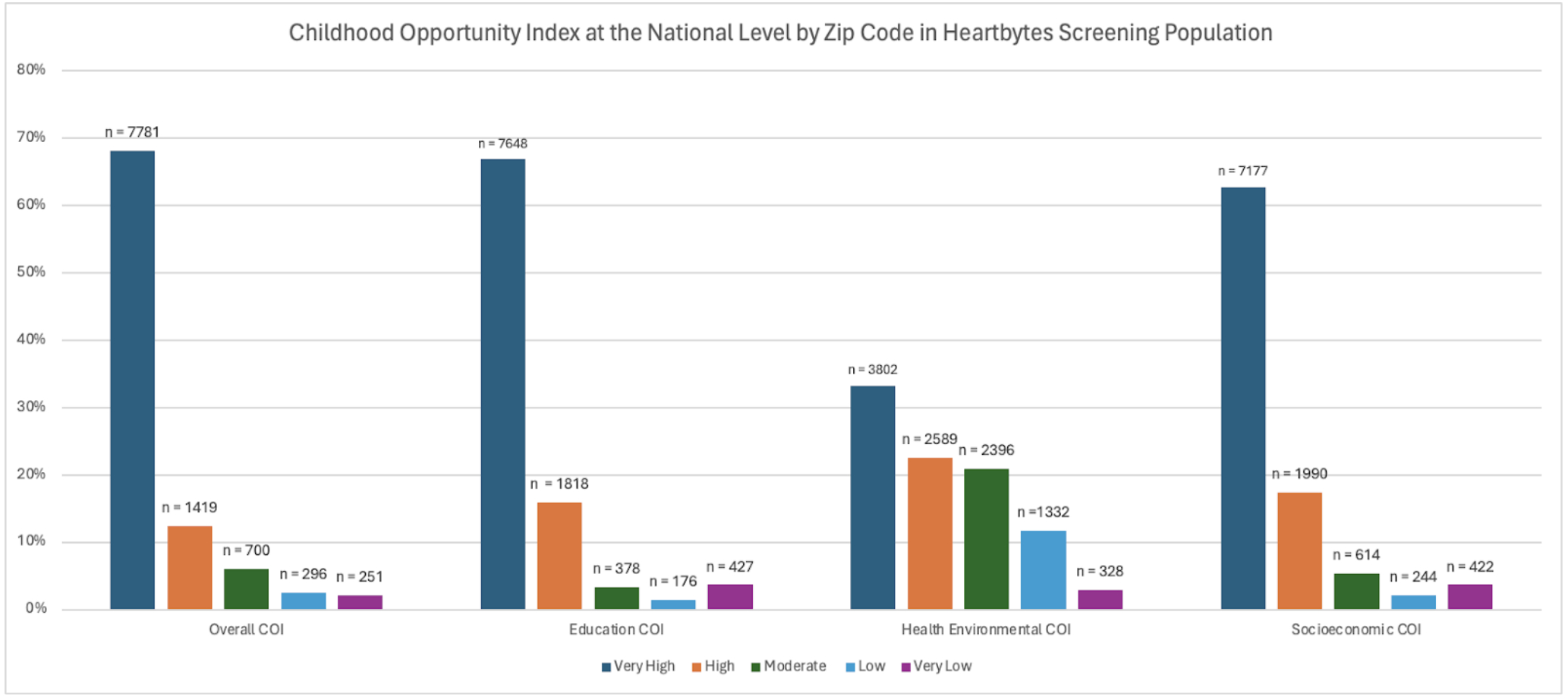
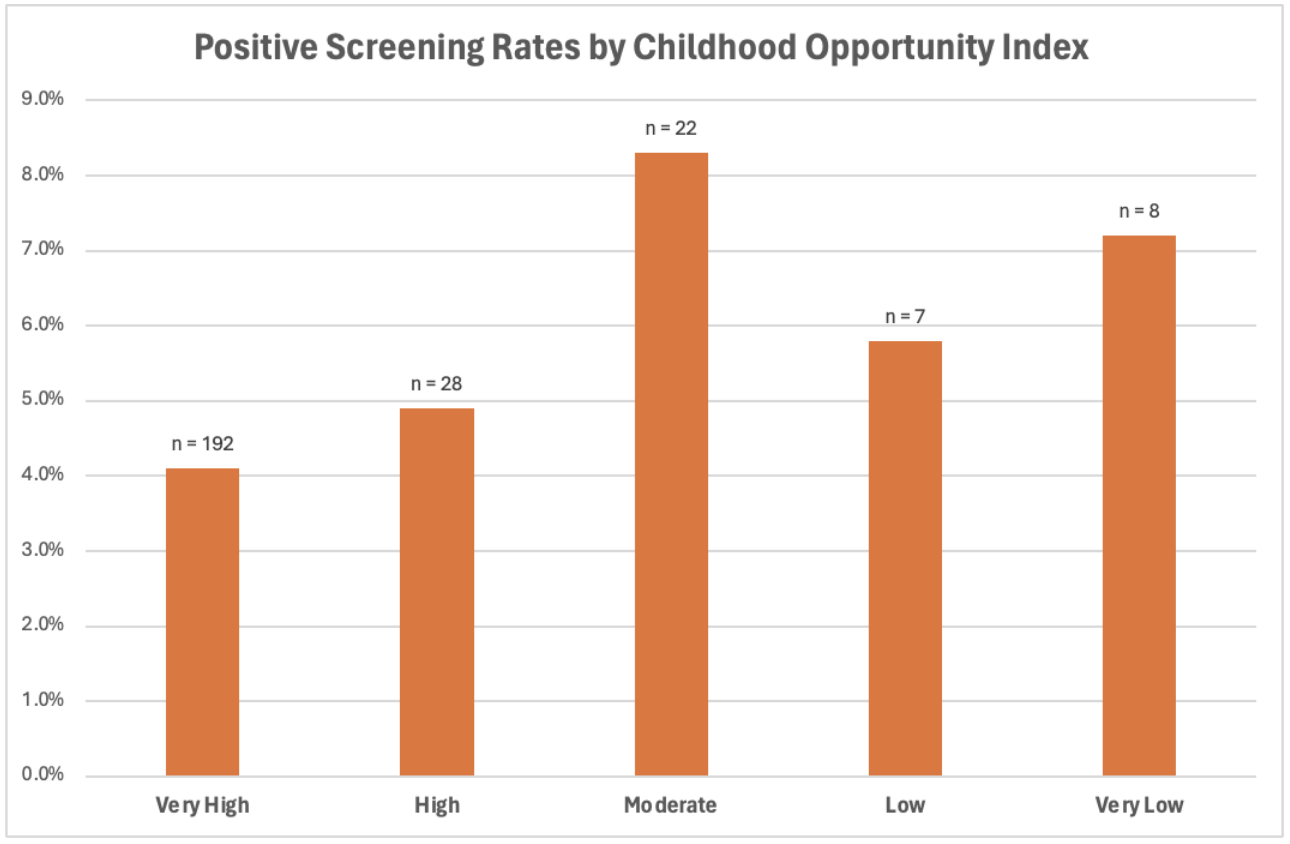
Data Screening data of 11,431 youth athletes (median age 14.3 (IQR = 3), BMI 20.6 (4.8), 53.7% male, 70.6% White) was analyzed. The majority of children had very high overall COI (Figure 1). Hypertension, hyperlipidemia, Kawasaki disease, and heart infection were similar across COI levels (p > 0.05). Levels of physical activity varied significantly across levels of overall COI, with the highest levels reported in the lowest COI group (50.4% with > 10 hours PA/week) (Chi-Squared; p = 0.007). Positive screening rates varied significantly by level of COI (p = 0.013) (Figure 2). The overall level of education, health environment, and socioeconomic COI did not predict positive screening outcomes in logistic regression analysis (all p>0.05).
Conclusion Prevalence of cardiac risk factors did not vary significantly across COI levels, however, positive screening rates were highest in moderate and very low COI levels. Simon’s Heart engaged communities across the COI spectrum; however, a majority of children had high or very high COI. Further efforts are needed to expand access to underserved populations of lower COI.
Corsi, Douglas
( Rutgers Robert Wood Johnson
, Philadelphia
, Pennsylvania
, United States
)
Osler, Brian
( Thomas Jefferson University
, Philadelphia
, Pennsylvania
, United States
)
Hajduczok, Alexander
( Thomas Jefferson University
, Philadelphia
, Pennsylvania
, United States
)
Johnson, Drew
( Thomas Jefferson University
, Philadelphia
, Pennsylvania
, United States
)
Shipon, David
( Thomas Jefferson University
, Philadelphia
, Pennsylvania
, United States
)
Saraiya, Avinash
( Sidney Kimmel Medical College
, Philadelphia
, Pennsylvania
, United States
)
Veltre, Vanessa
( Sidney Kimmel Medical College
, Philadelphia
, Pennsylvania
, United States
)
Qiu, Grace
( Sidney Kimmel Medical College at Thomas Jefferson University
, Philadelphia
, Pennsylvania
, United States
)
Doyle, Margaret
( Sidney Kimmel Medical College
, Philadelphia
, Pennsylvania
, United States
)
O'malley, Blaise
( Sidney Kimmel Medical College
, Philadelphia
, Pennsylvania
, United States
)
Shah, Vacha
( Sidney Kimmel Medical College
, Philadelphia
, Pennsylvania
, United States
)
Langstaff, Renee
( Thomas Jefferson University
, Philadelphia
, Pennsylvania
, United States
)
Masood, Imran
( Childrens Hospital of Philadelphia
, Philadelphia
, Pennsylvania
, United States
)
Author Disclosures:
Douglas Corsi:DO NOT have relevant financial relationships
| Brian Osler:No Answer
| Alexander Hajduczok:No Answer
| Drew Johnson:No Answer
| David Shipon:No Answer
| Avinash Saraiya:DO NOT have relevant financial relationships
| Vanessa Veltre:DO NOT have relevant financial relationships
| Grace Qiu:DO NOT have relevant financial relationships
| Margaret Doyle:DO NOT have relevant financial relationships
| Blaise O'Malley:DO NOT have relevant financial relationships
| Vacha Shah:DO NOT have relevant financial relationships
| Renee Langstaff:No Answer
| Imran Masood:No Answer