
Logo

American Heart Association

  12
  0


Final ID: Wed005

Increased AAA Rupture Risk among Females is not impacted by Pharmacologic RIPK3 inhibition with Dabrafenib

Abstract Body: BACKGROUND: Abdominal aortic aneurysm (AAA) rupture carries significant mortality. Female AAA patients face higher rupture risks than male patients with comparable AAA sizes. Receptor Interacting Protein Kinase-3 (RIPK3) is a critical regulator of necroptosis, implicated in both human and murine AAA. We have previously shown that genetic or pharmacologic inhibition of RIPK3 attenuates aneurysm formation in male mice. In this study, we sought to determine whether the murine elastase/BAPN model can replicate the sex influence on AAA rupture. Additionally, we tested whether dabrafenib, an FDA-approved B-RafV600E inhibitor that shows RIPK3 antagonistic activity, impacts AAA progression and rupture in both sexes.
METHODS: 12–14-week-old C57BL/6J male and female mice were subject to AAA induction via the elastase/BAPN model. Researchers were blinded, and mice of both sexes were randomized to 3 mg/kg/d dabrafenib or DMSO (control) via subcutaneously implanted osmotic pumps (Alzet model 2006) 1-week post AAA-induction surgery. Weekly ultrasonography monitored AAA growth until study termination.
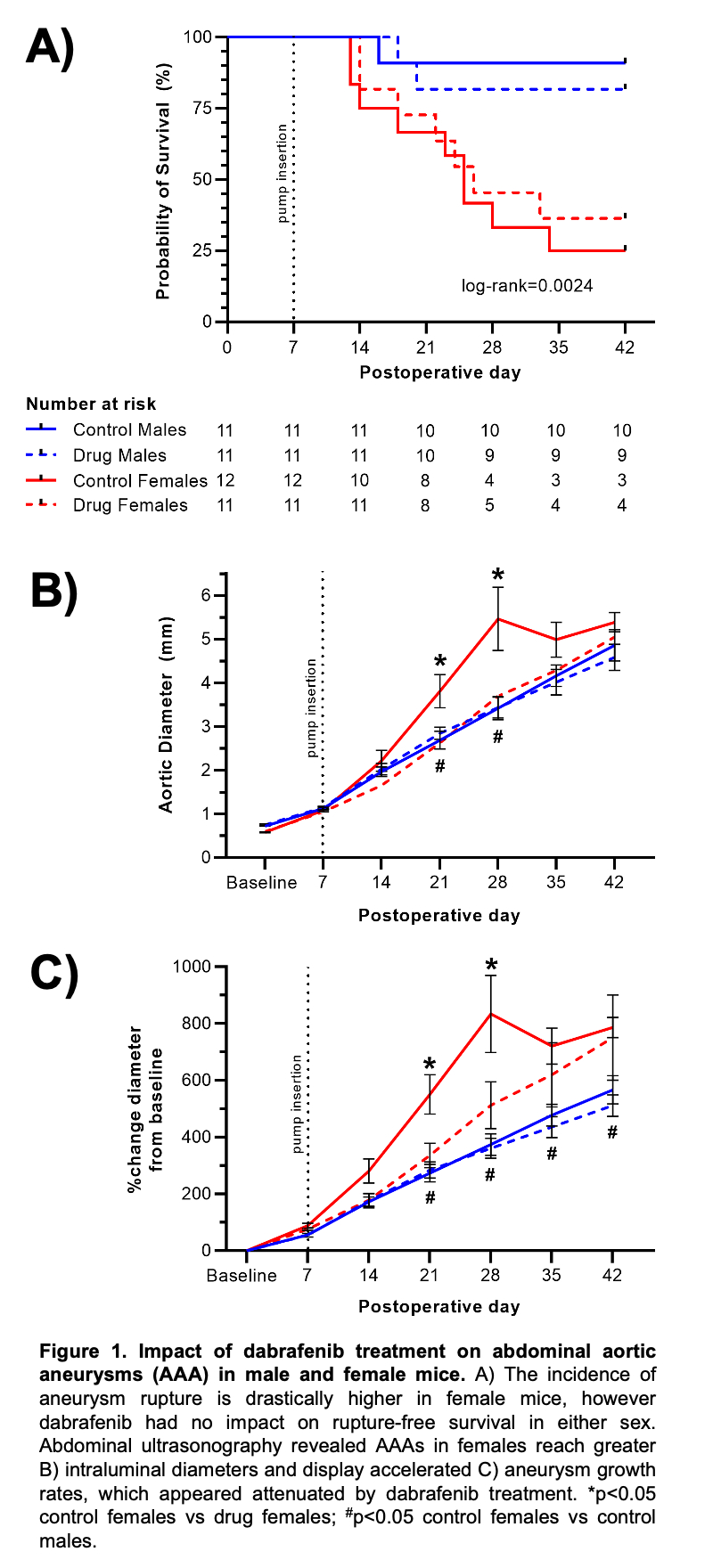
RESULTS: The anti-necroptosis activity of dabrafenib was conformed in cultured aortic smooth muscle cells. AAAs were successfully induced in all animals, however, females showed faster expansion in aortic diameter than males, mostly notable past 3 weeks. Furthermore, females exhibited a drastically higher incidence of aneurysm rupture (64-75%) than males (9-18%). Dabrafenib moderately reduced aortic growth in females but not in males, yet had no impact on rupture in either sex.
CONCLUSIONS: The elastase/BAPN model recapitulates the unfavorable sex-based increased risk of AAA rupture seen in female patients, which will help mechanistic studies and sex-specific treatment. Dabrafenib at 3 mg/kg/d reduced AAA growth in females, yet failed to impact males or improve survival; further exploration of dosing and delivery methods is necessary.
  • Bontekoe, Jack  ( University of Wisconsin-Madison , Madison , Wisconsin , United States )
  • Yang, Qianfan  ( University of Wisconsin-Madison , Madison , Wisconsin , United States )
  • Zhou, Ting  ( University of Wisconsin-Madison , Madison , Wisconsin , United States )
  • Li, Patrick  ( University of Wisconsin-Madison , Madison , Wisconsin , United States )
  • Kim, Jooyong  ( University of Wisconsin-Madison , Madison , Wisconsin , United States )
  • Liu, Bo  ( University of Wisconsin-Madison , Madison , Wisconsin , United States )
  • Author Disclosures:
    Jack Bontekoe: DO NOT have relevant financial relationships | Qianfan Yang: No Answer | Ting Zhou: No Answer | Patrick Li: No Answer | Jooyong Kim: No Answer | Bo Liu: DO NOT have relevant financial relationships
Meeting Info:
Session Info:

01. Poster Session 1 & Reception

Wednesday, 05/13/2026 , 06:00PM - 08:00PM

Poster

More abstracts on this topic:
An Unexpected MYOCD-Driven Constraint on VSMC Adaptive States Promotes Aortic Aneurysm

Ishimwe Nestor, Wu Xiaoliang, Shi Hong, Miano Joseph, Yan Chen, Long Xiaochun

18F-NaF and 18F-FDG and calcification predict the development of abdominal aortic aneurysms and is attenuated by drug therapy

Nakahara Takehiro, Miyazawa Raita, Iwabuchi Yu, Tonda Kai, Narula Nupoor, Strauss Harry, Narula Jagat, Jinzaki Masahiro

More abstracts from these authors:
Reduction of Abdominal Aortic Aneurysm Rupture by Modulating Smooth Muscle Cell Phenotype Switching

Bontekoe Jack, Dimusto Paul, Liu Bo, Yang Qianfan, Zhou Ting, Yang Huan, Silva-pedraza Zulmari, Kim Jooyong, Conte Michelle, Morgan Courtney, Aufhauser David

You have to be authorized to contact abstract author. Please, Login
Not Available