
Logo

American Heart Association

  11
  0


Final ID: Or120

Dedicated Smooth Muscle Progenitor Populations, Marked by Notch3 and Sox9, Show Distinct Atherosclerotic Plaque Fate

Abstract Body: Smooth muscle cell (SMC) phenotypic modulation and proliferation are a conserved cellular response to vascular insult in the pathogenesis of atherosclerosis, aneurysm and vascular injury. Pan-SMC lineage tracing previously revealed that few SMCs oligo-clonally expand in these diseases, while the majority remain dormant. However, it remains unclear whether SMC clone selection is stochastic or predetermined. Understanding which SMCs expand, and how, could reveal major new therapeutic targets for vascular disease.

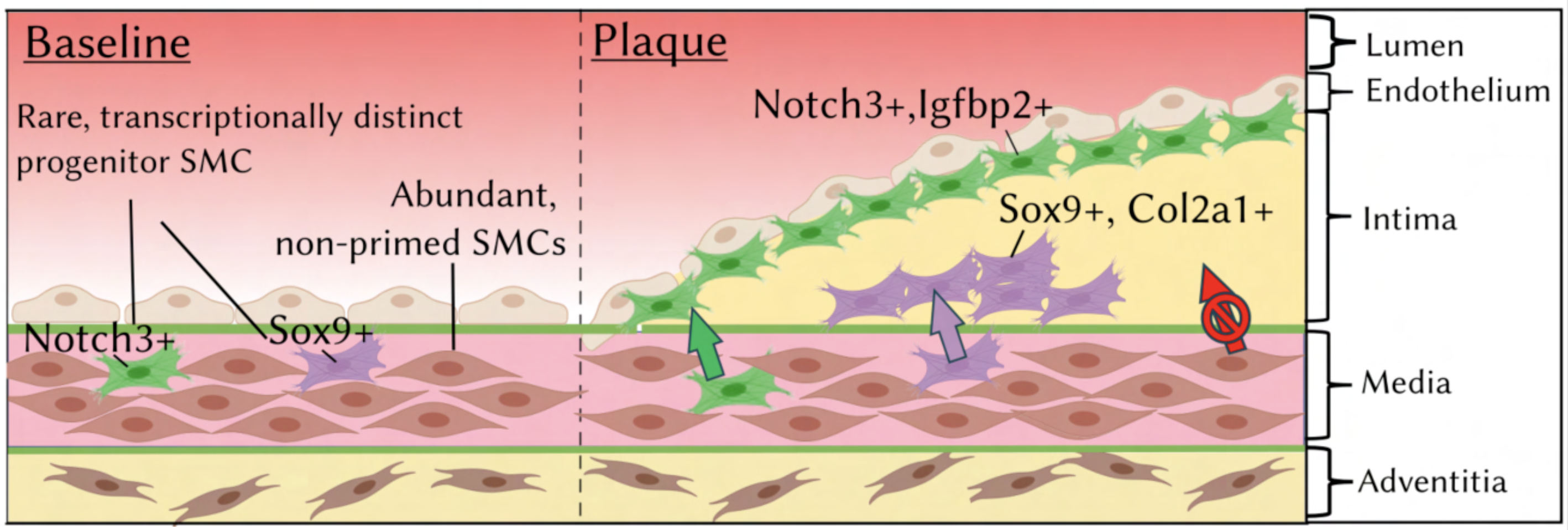
Notch3 and Sox9 are critical for arterial SMC specification during development. Using tamoxifen-inducible lineage-tracing and scRNAseq, we characterised rare, distinct populations of medial SMCs retaining Notch3 and Sox9 expression in healthy adult vessels. Despite low baseline abundance, lineage-traced Notch3/Sox9+ SMC progeny combined to contribute over half of SMC-derived lesional cells, suggesting that oligo-clonal SMC expansion arises mainly from pre-determined progenitors rather than stochastically.

Further, Notch3/Sox9+ SMCs showed distinct transcriptomic profiles at baseline and differing fates within the final lesion, suggesting differing roles in pathogenesis. At baseline, Sox9+ SMCs displayed downregulation of contractile markers and upregulation of a complement of genes typically only detected in lesional modulated SMCs, suggesting cell priming. Moreover, compared with other SMC-derived plaque cells, progeny of Notch3+ cells expressed a distinct inflammatory profile and were preferentially fated to the fibrous cap while avoiding chondrogenic transformation.

Finally, at baseline, Notch3/Sox9+ progenitor abundance varied between arterial regions, with lower frequency of both in the athero-resistant descending aorta and a higher Sox9+:Notch3+ ratio in the brachiocephalic artery, which forms more calcified plaque relative to fibrous cap. Overall, these findings suggest that the distinct, prespecified SMC progenitor populations may play functional roles in governing plaque structure and ultimately disease risk.
  • Worssam, Matthew  ( Stanford University , Palo Alto , California , United States )
  • Gu, Wenduo  ( Stanford University , Stanford , California , United States )
  • Li, Daniel  ( Stanford , Mountain View , California , United States )
  • Monteiro, Joao  ( Stanford University , Stanford , California , United States )
  • Steffes, Lea  ( Stanford University , Palo Alto , California , United States )
  • Kumar, Maya  ( Stanford University School of Medic , Stanford , California , United States )
  • Quertermous, Thomas  ( Stanford University , Stanford , California , United States )
  • Cheng, Paul  ( STANFORD UNIVERSITY , Stanford , California , United States )
  • Author Disclosures:
    Matthew Worssam: DO NOT have relevant financial relationships | Wenduo Gu: No Answer | Daniel Li: DO NOT have relevant financial relationships | Joao Monteiro: DO NOT have relevant financial relationships | Lea Steffes: No Answer | Maya Kumar: No Answer | Thomas Quertermous: DO NOT have relevant financial relationships | Paul Cheng: DO NOT have relevant financial relationships
Meeting Info:
Session Info:
More abstracts on this topic:
More abstracts from these authors:
Discrete Population of Rare SMC Progenitors Gives Rise Exclusively to the Fibrous Cap

Gu Wenduo, Monteiro Joao, Kumar Maya, Quertermous Thomas, Cheng Paul, Jackson William, Zhu Ashley, Li Daniel, Zhao Quanyi, Nguyen Trieu, Worssam Matthew, Ramste Markus, Weldy Chad

PRDM16 Alters Coronary Artery Disease Risk by Regulating Phenotypic Modulation of Smooth Muscle Cells Through Two Novel Mechanisms.

Palmisano Brian, Knowles Josh, Quertermous Thomas, Monteiro Joao, Nguyen Trieu, Li Daniel, Worssam Matthew, Kundu Ramendra, Gu Wenduo, Weldy Chad, Cheng Paul

You have to be authorized to contact abstract author. Please, Login
Not Available