
Logo

American Heart Association

  5
  0


Final ID: Or117

Dual Inhibition of Sodium-Glucose Cotransporters 1 and 2 Attenuates Atherosclerosis via Metabolic Reprogramming Toward Fatty Acid Oxidation

Abstract Body: Introduction: Sodium-glucose cotransporter-2 (SGLT2) inhibitors reduce cardiovascular mortality and chronic kidney disease (CKD) progression in patients with cardiovascular-kidney-metabolic syndrome. Sotagliflozin, a dual inhibitor of SGLT2 in the kidney and SGLT1 in the gastrointestinal tract, is the only SGLT inhibitor shown to significantly reduce atherosclerotic events in CKD and diabetes, independent of glucose lowering. However, the mechanisms driving these atherosclerotic benefits and the efficacy of sotagliflozin for non-diabetic CKD remain unknown. We hypothesized that sotagliflozin’s inhibition of postprandial glucose absorption increases endogenous GLP-1 secretion from L-cells in the ileum, thereby improving metabolic syndrome and reducing atherosclerosis.
Methods: Low-density lipoprotein receptor-deficient (Ldlr-/-) mice were treated with sotagliflozin (60 mg/kg/day), empagliflozin (20 mg/kg/day), or vehicle in drinking water with a high-fat diet (41% kcal) for 16 weeks. Oral glucose tolerance testing (OGTT) and indirect calorimetry for energy expenditure were performed after 15 weeks. Mice received 5% 2H2O in drinking water for the last 72 hours to label newly synthesized fatty acids. De novo lipogenesis was measured by quantifying 2H2O-labeled palmitic acid in the liver and plasma. Atherosclerotic burden was assessed en face after Oil Red O staining. Plasma cytokines and GLP-1 levels were measured using a MesoScale Diagnostics multiplex assay.
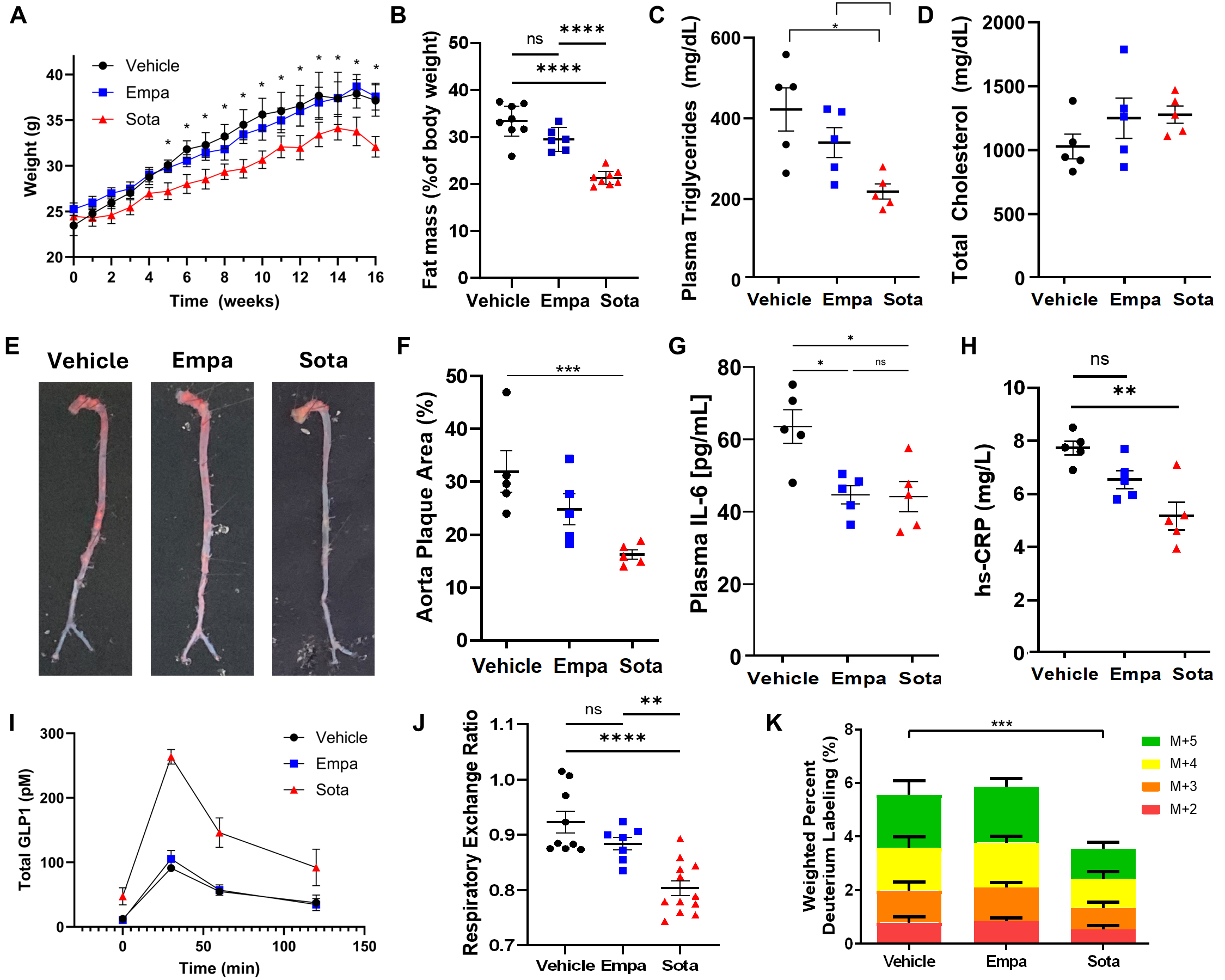
Results: Sotagliflozin significantly reduced weight gain, total fat mass, and plasma triglycerides compared to empagliflozin and vehicle. After 16 weeks, atherosclerosis burden, CRP, and interleukin-6 decreased most in sotagliflozin-treated mice. OGTT revealed increased insulin sensitivity and postprandial GLP-1 with sotagliflozin. Sotagliflozin also lowered the respiratory exchange ratio and increased VCO2, indicating greater fatty acid oxidation with no difference in total energy expenditure or intake. This was associated with a reduced rate of hepatic and plasma de novo lipogenesis.
Conclusions: Dual SGLT1/2 inhibition by sotagliflozin reduces atherosclerosis and metabolic syndrome to a greater extent than SGLT2 inhibition alone in mice by enhancing fatty acid metabolism. Further investigation into the role of GLP-1 in cardiovascular protection by sotagliflozin and if these benefits persist in the setting of CKD would support expanded use of sotagliflozin to reduce CVD in CKD patients without diabetes.
  • Saum, Keith  ( University of Michigan , Ann Arbor , Michigan , United States )
  • Simms, Jessica  ( University of Michigan , Ann Arbor , Michigan , United States )
  • Zeng, Lixia  ( University of Michigan , Ann Arbor , Michigan , United States )
  • Singh, Anand  ( University of Michigan , Ann Arbor , Michigan , United States )
  • Abdel-latif, Ahmed  ( University of Michigan , Ann Arbor , Michigan , United States )
  • Pennathur, Subramaniam  ( University of Michigan , Ann Arbor , Michigan , United States )
  • Author Disclosures:
    Keith Saum: DO NOT have relevant financial relationships | Jessica Simms: No Answer | lixia zeng: No Answer | Anand Singh: DO NOT have relevant financial relationships | Ahmed Abdel-latif: No Answer | Subramaniam PENNATHUR: No Answer
Meeting Info:
Session Info:
More abstracts on this topic:
Fatty Acid Dysregulation Drives Cardio-Hepatic Crosstalk in Heart Failure with Preserved Ejection Fraction (HFpEF)

Mushala Bellina, Stoner Michael, Mcmahon Brenda, Vandevender Amber, Mullett Steven, Gelhaus Stacy, Jurczak Michael, Scott Iain

Acculturation and Cardiovascular-Kidney-Metabolic Syndrome: a Study of Immigrant Adults From the National Health and Nutrition Examination Survey

Chakrabarti Amit, Le Austin, Elfassy Tali, Yang Eugene

More abstracts from these authors:
Activin Signaling Inhibition Enhances Cardiac Functional Recovery After Aortic Debanding

Singh Anand, Guseh James Sawalla, Xiao Chunyang, Babbs Keith, Seehra Jasbir, Li Haobo, Rosenzweig Anthony

You have to be authorized to contact abstract author. Please, Login
Not Available