
Logo

American Heart Association

  8
  0


Final ID: Thu116

Estrogen-mediated stimulation of G protein-coupled Estrogen Receptor (GPER) preserves skeletal muscle mass in response to hypoxia via inhibition of 15-hydroxy prostaglandin dehydrogenase (15-PGDH)

Abstract Body: Introduction: Prostaglandin E2 (PGE2) is essential for the preservation of skeletal muscle mass, and increased activity of PGE2-degrading enzyme, 15- hydroxy prostaglandin dehydrogenase (15-PGDH), contributes to aging-related sarcopenia. While peripheral arterial disease is more prevalent in men than women till the sixth decade of life, it equalizes or even exceeds in specific reports in women starting the seventh decade, with women experiencing greater tissue loss. This has sparked interest in the role of cytosolic (ERα) and membrane-bound estrogen receptors (GPER) activity in skeletal muscle’s response to hypoxia. We aimed to determine whether estrogen-mediated receptor signaling plays a role in muscle mass preservation under hypoxic conditions and to assess its impact on PGE2 signaling. We hypothesized that loss of estrogen-mediated signaling would lead to reduced muscle mass in hypoxic conditions and a concurrent decrease in PGE2 signaling via increased 15-PGDH activity.
Methods: We induced ischemia in one of the hindlimbs of two groups of mice via selective femoral artery ligation: one group of C57BL6 mice (n=12, 6 females, 6 males) and one group of homozygous GPER knockout (-/-) mice (n=11, 5 females, 6 males) that were all 12 weeks old. Laser speckle contrast imaging (LSCI) was performed to confirm successful ischemia induction pre- and postoperatively. On day 21, the gastrocnemius muscle was harvested and stained with hematoxylin and eosin to assess myofiber diameter. Reverse transcriptase polymerase chain reaction was used to analyze the expression of ERα, GPER, and HPGD (gene encoding 15-PGDH).
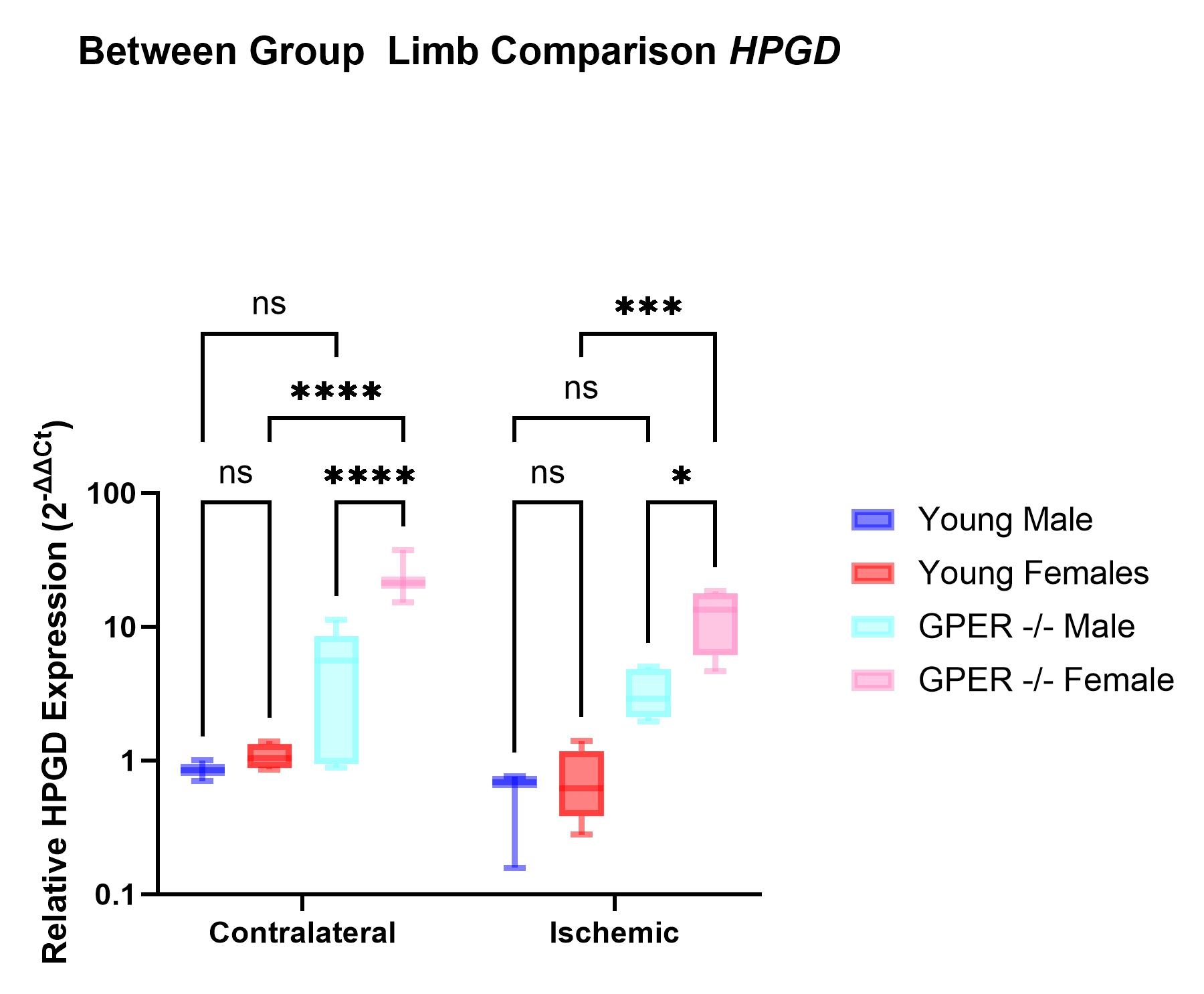
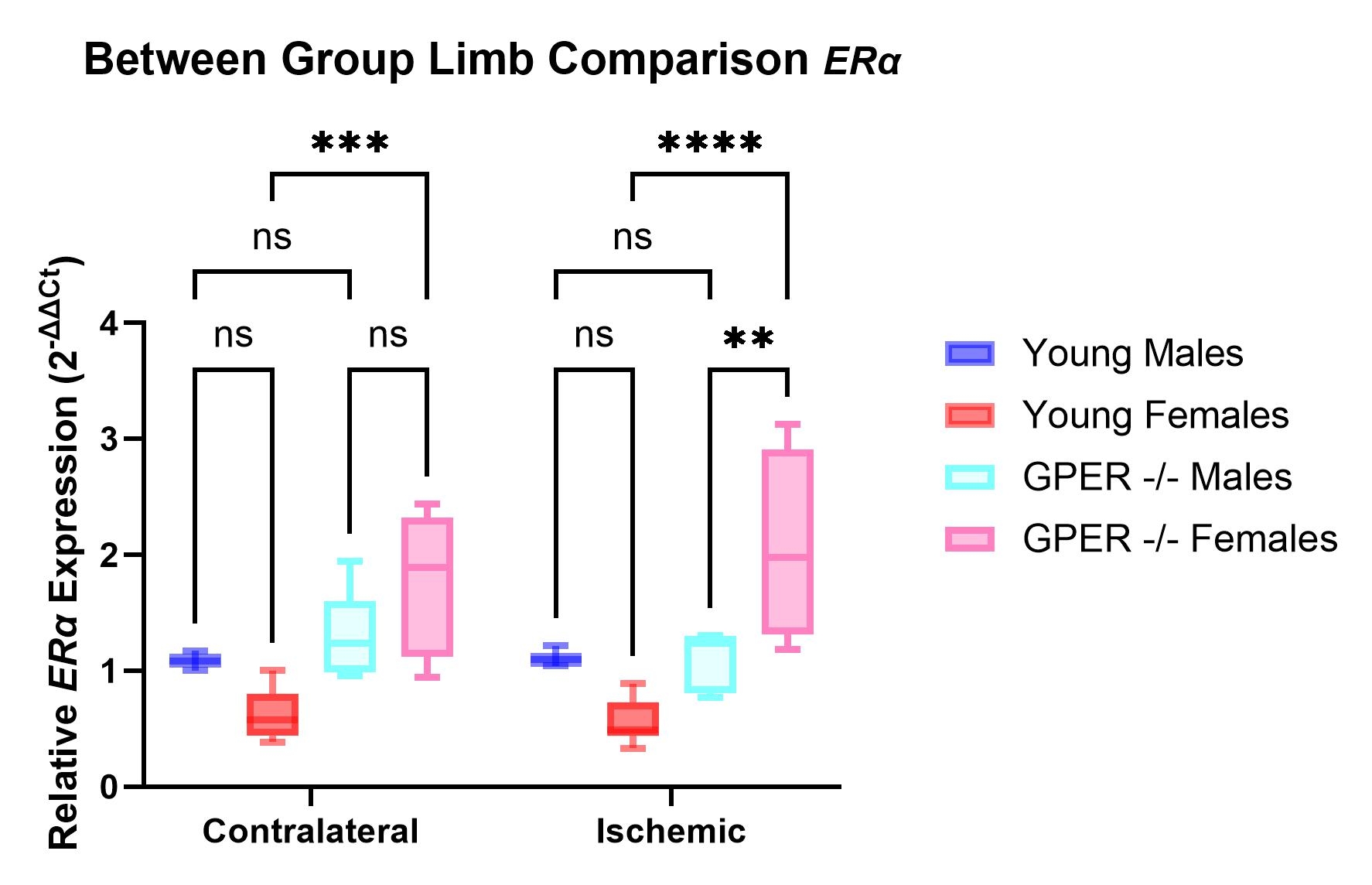
Results: GPER -/- mice had significantly lower myofibril diameters in the ischemic limb compared to C57BL6 mice. Compared to C57BL6 mice, HPGD was overexpressed in both GPER -/- male and female mice, and significantly more in female GPER -/- mice. ERα was also noted to be overexpressed in female GPER -/- mice, and significantly more so in their ischemic limbs.
Conclusion: Estrogen-mediated signaling preserves skeletal muscle mass in response to hypoxia. Loss of GPER signaling increases 15-PGDH expression, suggesting a mechanism by which estrogen-mediated GPER signaling contributes to muscle mass preservation during recovery from ischemia. ERα, which was overexpressed in GPER -/- female mice, may stimulate 15-PGDH expression in the absence of GPER signaling. These findings highlight a novel role played by estrogen-mediated signaling in ischemic myopathy.
  • Iturralde Carrillo, Andrea  ( University of New Mexico , Albuquerque , New Mexico , United States )
  • Risotto-urbanowicz, Erin  ( University of New Mexico , Albuquerque , New Mexico , United States )
  • Justus, Matthew  ( University of New Mexico , Albuquerque , New Mexico , United States )
  • Massie, Pierce  ( University of New Mexico , Albuquerque , New Mexico , United States )
  • Coffman, Brittany  ( Veterans Affairs , Albuquerque , New Mexico , United States )
  • Pace, Carolyn  ( University of New Mexico , Albuquerque , New Mexico , United States )
  • Prossnitz, Eric  ( University of New Mexico , Albuquerque , New Mexico , United States )
  • Clark, Ross  ( University of New Mexico , Albuquerque , New Mexico , United States )
  • Rumma, Rowza  ( University of New Mexico , Albuquerque , New Mexico , United States )
  • Author Disclosures:
    Andrea Iturralde Carrillo: DO NOT have relevant financial relationships | Erin Risotto-Urbanowicz: DO NOT have relevant financial relationships | Matthew Justus: No Answer | Pierce Massie: No Answer | Brittany Coffman: No Answer | Carolyn Pace: No Answer | Eric Prossnitz: No Answer | Ross Clark: DO NOT have relevant financial relationships | Rowza Rumma: DO NOT have relevant financial relationships
Meeting Info:
Session Info:

08. Poster Session 2 & Reception-Sponsored by the ATVB Journal

Thursday, 05/14/2026 , 05:00PM - 07:00PM

Poster

More abstracts on this topic:
A Non-odorant Olfactory Receptor Ligand Depolymerizes the Platelet Actin Cytoskeleton to Prevent Thrombosis

Aggarwal Anu, Godwin Matthew, Ali Mariya, Jennings Courtney, Rajasekar Bhairavi, Scalise Alliefair, Stauffer Shaun, Mccrae Keith, Mcintyre Thomas, Cameron Scott, Wang Nancy, Josyula Vara Prasad, Yang Moua, Young Shim, Kennedy Quinn, Samuel Reina, Sangwan Naseer, Guntupalli Suman

A Mechanistic Insight Into The Connection Between Metabolism And Differentiation In ACTA2 P. R179 Smooth Muscle Cells

Esparza Pinelo Jose, Krenz Hannah, Chen Jessica, Kaw Anita, Milewicz Dianna, Kwartler Callie

More abstracts from these authors:
The G Protein-Coupled Estrogen Receptor (GPER) Augments HIF1α Stabilization in Skeletal Myocytic Response to Hypoxia

Risotto-urbanowicz Erin, Rumma Rowza, Iturralde-carillo Andrea, Kulkarni Deepali, Massie Pierce, Justus Matthew, Coffman Brittany, Pace Carolyn, Prossnitz Eric, Clark Ross

Advanced Age Increases Susceptibility to Ischemic Myopathy after Murine Hindlimb Ischemia

Kulkarni Deepali, Massie Pierce, Justus Matthew, Mazloumibakhshayesh Milad, Coffman Brittany, Pace Carolyn, Clark Ross

You have to be authorized to contact abstract author. Please, Login
Not Available