Heavy Metal Exposure and Systemic Inflammation: Associations of Blood Lead, Cadmium, and Mercury with hs-CRP
Abstract Body: Background: Environmental heavy metal exposure has been associated with cardiovascular disease, potentially through promotion of vascular inflammation. High-sensitivity C-reactive protein (hs-CRP) is a well-established biomarker of systemic and vascular inflammation and predicts atherosclerotic cardiovascular events. We evaluated associations between blood lead, cadmium, and mercury and serum hs-CRP in a nationally representative sample of U.S. adults.
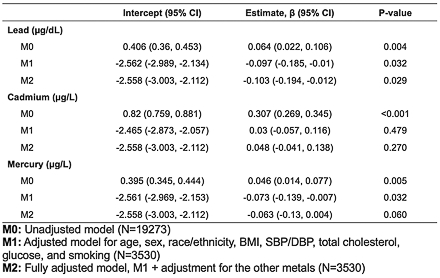
Methods: We analyzed NHANES 2015-2022 data among adults with available levels of blood lead (µg/dL), cadmium (µg/L), mercury (µg/L), and hs-CRP (mg/L), where (N = 19,273 in unadjusted analyses; N = 3,530 in fully adjusted models; mean age 49.7 ± 18.3 years; 48.4% male). Due to right-skewed distributions, metals and hs-CRP were log-transformed. Survey-weighted linear regression models were performed: unadjusted (M0), adjusted for demographic and cardiometabolic risk factors (M1), and additionally adjusted for co-exposure to other metals (M2). Covariates included age, sex, race/ethnicity, body mass index, systolic and diastolic blood pressure, total cholesterol, fasting glucose, and smoking status.
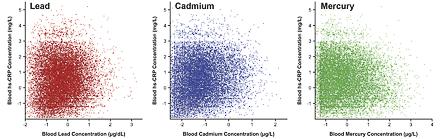
Results: In unadjusted models (M0), blood lead, cadmium, and mercury were each positively associated with hs-CRP (e.g. lead β (95% CI): 0.064 (0.022, 0.106); P = 0.004). After adjustment for demographic and vascular risk factors (M1), associations attenuated; lead (-0.097 (-0.185, -0.01); P = 0.032) and mercury (-0.073 (-0.139, -0.007); P = 0.032) demonstrated inverse associations, while cadmium was no longer significant. In multi-metal models (M2), only lead remained independently associated with hs-CRP (-0.103 (-0.194, -0.012); P = 0.029).
Conclusions: We found that associations between blood heavy metals and hs-CRP were observed in unadjusted analyses but were largely attenuated after adjustment for cardiometabolic risk factors and co-exposures. Persistent associations with lead suggest a potential independent influence on systemic and vascular inflammatory pathways. These findings underscore the complexity of environmental metal exposures and their relevance to vascular inflammation and cardiovascular disease risk.
Rao, Anamika
(
New York Institute of Technology College of Osteopathic Medicine
, Old Westbury , New York , United States )
Chong, Lionel
(
New York Institute of Technology College of Osteopathic Medicine
, Old Westbury , New York , United States )
Kim, Dokyeong
(
New York Institute of Technology College of Osteopathic Medicine
, Old Westbury , New York , United States )
Makhijani, Amrita
(
New York Institute of Technology College of Osteopathic Medicine
, Old Westbury , New York , United States )
Rampersaud, Hema
(
New York Institute of Technology College of Osteopathic Medicine
, Old Westbury , New York , United States )
Gujare, Isha
(
New York Institute of Technology College of Osteopathic Medicine
, Old Westbury , New York , United States )
Dharmasena, Pasani
(
New York Institute of Technology College of Osteopathic Medicine
, Old Westbury , New York , United States )
Elci, Gianna
(
New York Institute of Technology College of Osteopathic Medicine
, Old Westbury , New York , United States )
Rahman, Sumona
(
New York Institute of Technology College of Osteopathic Medicine
, Old Westbury , New York , United States )
Bukhari, Zoraiz
(
New York Institute of Technology College of Osteopathic Medicine
, Old Westbury , New York , United States )
Beatty, Brian
(
New York Institute of Technology College of Osteopathic Medicine
, Old Westbury , New York , United States )
Author Disclosures:
Anamika Rao:DO NOT have relevant financial relationships
| Zoraiz Bukhari:DO NOT have relevant financial relationships
| Brian Beatty:No Answer
| Lionel Chong:DO NOT have relevant financial relationships
| Dokyeong Kim:No Answer
| Amrita Makhijani:No Answer
| Hema Rampersaud:DO NOT have relevant financial relationships
| Isha Gujare:DO NOT have relevant financial relationships
| Pasani Dharmasena:DO NOT have relevant financial relationships
| Gianna Elci:DO NOT have relevant financial relationships
| Sumona Rahman:DO NOT have relevant financial relationships