
Logo

American Heart Association

  103
  0


Final ID:

Mitigating Sex-Specific Thrombotic Risk by Personalizing Thromboprophylaxis

Abstract Body: Background: Despite advances in endovascular revascularization techniques for peripheral arterial disease (PAD), thrombotic complications remain a significant cause of morbidity namely amputation. Women, despite having lower risk factors, are at increased risk for arterial thrombotic events and amputation. This is partially due to the fact that standard of care thromboprophylaxis is administered in a “one size fits all “ approach that may inadequarely treat women. The aim of this study is to evaluate the impact of using a novel personalized approach to thromboprophylaxis to achieve therapeutic antiplatelet levels in women.
Methods: We developed a novel approach to thromboprophylaxis called Thromboprophylaxis for Arterial Revascularization to Guide Elderly Therapy (TARGET) that uses objective viscoelastic testing, namely thromboelastrography (TEG), to guide anticoagulation. We implemented this protocol in a cohort of patients and compared thrombotic outcomes to those of patients who received the “one size fits all” standard of care.
We studied 339 patients (277 control: 159 male vs. 118 female; 62 intervention: 40 male vs. 22 female) over 20 months. The control group received standard dual antiplatelet therapy, while the intervention group received TEG-PM-guided antiplatelet adjustment. Primary endpoint was time to first imaging-confirmed thrombotic event, analyzed using Cox proportional hazards and Kaplan-Meier estimation, with Male-Control as reference.
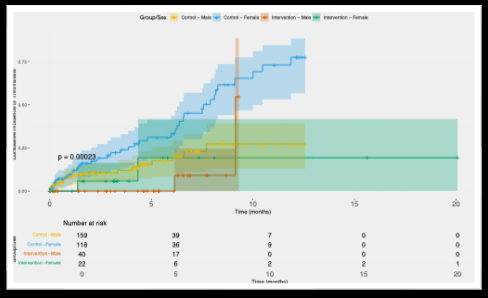
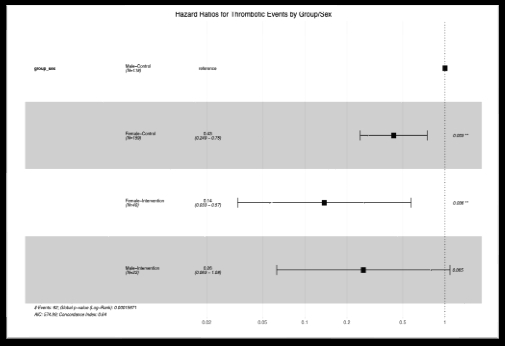
Results: The TEG-PM-guided intervention demonstrated significant sex-specific effects on thrombosis prevention. Control females exhibited the highest baseline thrombotic risk, with cumulative incidence reaching 75% during follow-up. Females showed the greatest benefit from TARGET intervention with an 86% risk reduction (HR 0.14, 95% CI 0.033-0.57, p=0.006) compared to male controls. Males demonstrated a trend toward benefit with a 74% risk reduction (HR 0.26, 95% CI 0.063-1.08, p=0.065). The cumulative incidence of thrombotic events differed significantly between groups (global p<0.00023), with lower event rates in the intervention groups.
Conclusion: Females showed the highest baseline thrombotic risk in PAD but gained most from TEG-PM-guided thromboprophylaxis. While males showed less improvement, the results suggest individualized TEG-PM-guided thromboprophylaxis may be especially important for female PAD patients.
  • Ferlini Cieri, Isabella  ( Massachusetts General Hospital , Boston , Massachusetts , United States )
  • Rodriguez Alvarez, Adriana  ( Massachusetts General Hospital , Boston , Massachusetts , United States )
  • Patel, Shiv  ( Massachusetts General Hospital , Boston , Massachusetts , United States )
  • Boya, Mounika  ( Massachusetts General Hospital , Boston , Massachusetts , United States )
  • Nurko, Andrea  ( Massachusetts General Hospital , Boston , Massachusetts , United States )
  • Dua, Anahita  ( Massachusetts General Hospital , Boston , Massachusetts , United States )
  • Author Disclosures:
    Isabella Ferlini Cieri: DO NOT have relevant financial relationships | Adriana Rodriguez Alvarez: DO NOT have relevant financial relationships | Shiv Patel: No Answer | Mounika Boya: DO NOT have relevant financial relationships | Andrea Nurko: DO NOT have relevant financial relationships | Anahita Dua: No Answer
Meeting Info:
Session Info:

04. Concurrent 1b: Thrombosis: Signaling, Mechanisms & Function

Wednesday, 04/23/2025 , 10:30AM - 12:00PM

Oral

More abstracts on this topic:
Acute Inferolateral STEMI as an Initial Presentation of Polycythemia Vera with Recurrent Coronary Thrombosis Despite Triple Therapy

Thiravetyan Ben, Olavarria-bernal Diego, Leelaviwat Natnicha, Yanpiset Panat, Puchongmart Chanokporn, Kanitthamniyom Chanakarn, Saowapa Sakditad, Martignoni Felipe, Sly Zhaunn

Acute Left Ventricular Thrombosis and Systemic Embolism Following Testosterone Therapy

Rasheed Ahmed Daniyaal, Naseer Ahmed, Nadig Vidya

More abstracts from these authors:
Comparative Effects of Apixaban and Rivaroxaban on Thrombin Generation Assessed by Viscoelastic Testing and Calibrated Thrombography

Rodriguez Alvarez Adriana, Ferlini Cieri Isabella, Patel Shiv, Boya Mounika, Dua Anahita

You have to be authorized to contact abstract author. Please, Login
Not Available