Sex-Based Evaluation Of Aspirin Therapy In Murine DVT And Secondary DVT Prevention
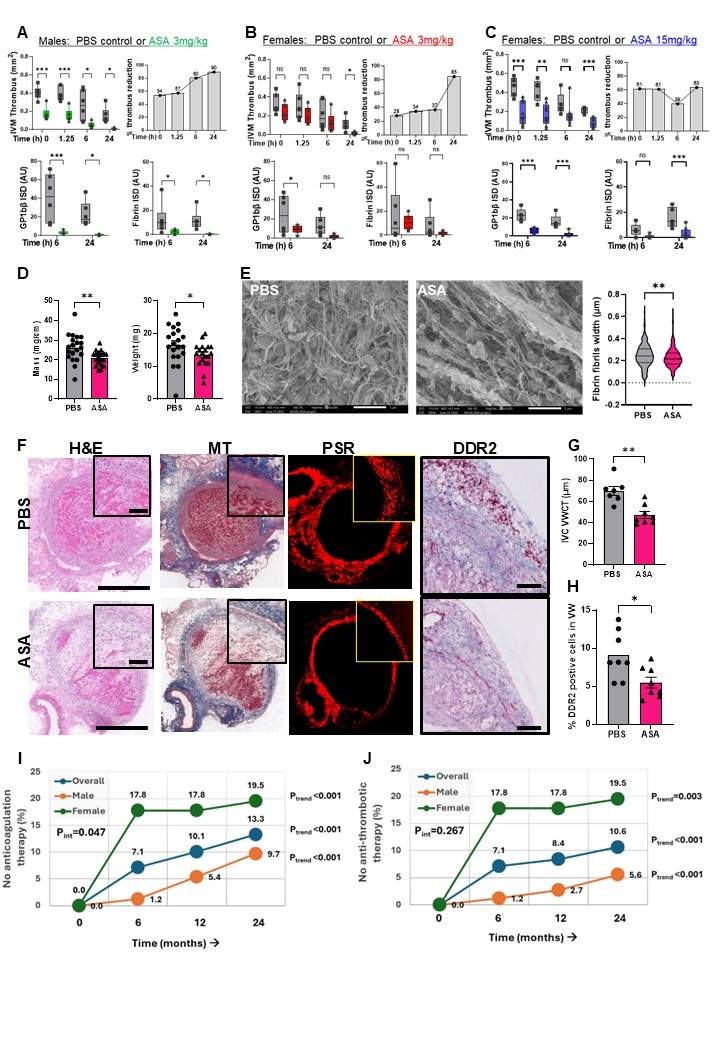
Abstract Body: Background: Acetylsalicylic acid (ASA) has been shown to reduce recurrent deep venous thrombosis (DVT) rates. However, limited mechanistic data is available regarding the efficacy of ASA on DVT resolution and measures of post-thrombotic syndrome (PTS), particularly in female subjects. Furthermore, real-world sex-specific data on ASA prescription and withdrawal rates in secondary DVT prevention patients are sparse. Methods: First the effects of ASA pretreatment on thrombogenesis were assessed in both female and male C57BL/6 mice (n=149) utilizing serial intravital microscopy in an extended murine DVT model. Next the effects of ASA on DVT resolution and vein wall inflammation were evaluated in male mice with IVC stasis DVT using histopathological and scanning electron microscopy analyses. Next, in a single-center clinical study, secondary DVT prevention patients with a history of unprovoked lower extremity DVT were assessed for ASA and anticoagulant prescription and withdrawal rates over 24 months. Results: In murine stasis DVT, utilizing serial IVM for 24 hours (n=82), ASA pretreatment (3 mg/kg/day) significantly reduced thrombogenesis and accelerated DVT resolution in males (Fig 1A p<0.05), with a higher ASA dose (15 mg/kg/day) required in females for efficacy (Fig 1B p>0.05 all, Fig 1C p<0.05 all). In complete-stasis DVT (n=67), ASA pretreatment reduced day 8 thrombus (Fig 1D-E, p<0.001), fibrin-rich area and fibrin fibril density, and increased plasminogen expression. ASA further reduced vein wall fibrosis and fibroblasts (Fig 1F-H, p<0.05), as well as vein wall MMP activity. Next, in a cohort of 131 patients with unprovoked DVT followed over 24 months, 13.3% of patients discontinued anticoagulation therapy (Fig 1I-J, ptrend<0.001). Discontinuation occurred more often in females (19.5% vs. 9.7% in males, pinteraction=0.047). ASA was infrequently prescribed in patients who stopped anticoagulation (3/7 males, 0/8 females). Conclusions: Preventative ASA treatment reduced murine thrombogenesis and improved DVT resolution, with females requiring a higher ASA dose to achieve efficacy. ASA further reduced vein wall injury and inflammation. Clinically, patients with unprovoked DVT showed increasing rates of anticoagulant withdrawal over 24 months, especially in female patients. Such patients further infrequently receive ASA. These results may motivate reconsideration of preventative ASA to reduce recurrent DVT and PTS in patients ineligible for anticoagulant therapy.
Vijay, Aatira
(
Massachusetts General Hospital, Harvard Medical School
, Boston , Massachusetts , United States )
Song, Andrew
(
Massachusetts General Hospital, Harvard Medical School
, Boston , Massachusetts , United States )
Abohashem, Shady
(
Massachusetts General Hospital, Harvard Medical School
, Boston , Massachusetts , United States )
Kassab, Mohamad
(
Massachusetts General Hospital, Harvard Medical School
, Boston , Massachusetts , United States )
Kawamura, Yoichiro
(
Massachusetts General Hospital, Harvard Medical School
, Boston , Massachusetts , United States )
Maino, Alessandro
(
Massachusetts General Hospital, Harvard Medical School
, Boston , Massachusetts , United States )
Mcdonald, Autumn
(
Massachusetts General Hospital, Harvard Medical School
, Boston , Massachusetts , United States )
Mccarthy, Jason
(
Masonic Medical Research Institute
, Utica , New York , United States )
Ha, Khanh
(
Masonic Medical Research Institute
, Utica , New York , United States )
Majireck, Max
(
Hamilton College
, Clinton , New York , United States )
Hara, Tetsuya
(
Laboratory of Clinical Pharmaceutical Science, Kobe Pharmaceutical University
, Kobe , Japan )
Mccrae, Keith
(
Lerner Research Institute
, Cleveland , Ohio , United States )
Reed, Guy
(
University of Arizona COM-P
, Phoenix , Arizona , United States )
Tawakol, Ahmed
(
Massachusetts General Hospital, Harvard Medical School
, Boston , Massachusetts , United States )
Henke, Peter
(
UNIVERSITY MICHIGAN
, Ann Arbor , Michigan , United States )
Rosovsky, Rachel
(
Massachusetts General Hospital, Harvard Medical School
, Boston , Massachusetts , United States )
Jaffer, Farouc
(
Massachusetts General Hospital, Harvard Medical School
, Boston , Massachusetts , United States )
Author Disclosures:
Aatira Vijay:DO NOT have relevant financial relationships
| Max Majireck:DO NOT have relevant financial relationships
| Tetsuya Hara:No Answer
| Keith McCrae:No Answer
| Guy Reed:No Answer
| Ahmed Tawakol:No Answer
| Peter Henke:DO NOT have relevant financial relationships
| Rachel Rosovsky:No Answer
| Farouc Jaffer:DO have relevant financial relationships
;
Researcher:Siemens, Canon, Shockwave, Teleflex, Boston Scientific, Amarin, Heartflow, Neovasc, OrbusNeich:Active (exists now)
; Ownership Interest:Intravascular Imaging Inc, DurVena Inc., Fastwave:Active (exists now)
; Royalties/Patent Beneficiary:Canon, Terumo, Spectrawave Intravascular Imaging Inc. – relationship managed by MGH/HMS:Active (exists now)
; Consultant:Shockwave, Novartis, Magenta Medical, Medtronic, Cleerly:Active (exists now)
| Andrew Song:No Answer
| Shady Abohashem:No Answer
| Mohamad Kassab:DO NOT have relevant financial relationships
| Yoichiro Kawamura:No Answer
| Alessandro Maino:No Answer
| Autumn McDonald:No Answer
| Jason McCarthy:DO NOT have relevant financial relationships
| Khanh Ha:DO NOT have relevant financial relationships