Pulmonary Artery-on-a-Chip Model of Endothelial Senescence in COVID-19 Vasculopathy
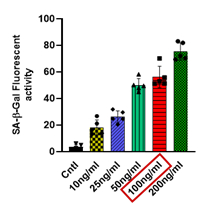
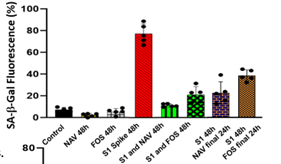
Abstract Body: Background: COVID-19 complications include ARDS, shock, and thrombotic angiopathy. Endothelial injury contributes to acute disease pathogenesis and likely increases risk of stroke and myocardial infarction among survivors. Here, human pulmonary artery endothelial cell (PAEC) senescence, an inflammatory, prothrombotic phenotype, was investigated in vitro after challenge with SARS-CoV-2 proteins that circulate for weeks after acute infections. However, more physiologically accurate in-vitro models with multiple cell types are needed to clarify mechanisms of endothelial dysfunction and evaluate appropriate therapies. Methods: We exposed PAECs to SARS-CoV-2 recombinant S1 spike protein and evaluated markers of senescence through β-galactosidase activity, cell proliferation by BrdU assessment, and annexin positive apoptotic cells measured by flow cytometry. Navitoclax (ABT263; BCL2 signaling inhibitor) and fostamatinib (spleen tyrosine kinase inhibitor) were tested as senolytic agents. To establish a more physiologically relevant in vitro model of the pulmonary artery, we manufactured a five-channel polydimethylsiloxane-based microfluidic chip that allows communication among multiple cell types. Chips will be loaded with PAECs, smooth muscle cells (SMCs), and adventitial fibroblasts, cultured under physiological conditions, and characterized using immunofluorescence staining. Results: 2D Cell cultures: Increasing concentrations of SARS-CoV-2 recombinant S1 protein increased β-galactosidase activity (Figure 1), reduced cell proliferation, and serum and growth factor withdraw-induced apoptosis in PAECs. Navitoclax or fostamatinib treatment of S1 exposed PAECs for 24 or 48 hours reduced the number of senescent cells (Figure 2), an effect that was linked to the induction of apoptosis. Chip platform: Sequential loading of chip channels was validated using beads, PAECs, and SMCs to confirm that cell types formed interfaces allowing for cell-cell interactions and did not leak into other channels. Conclusions: SARS-CoV-2 S1 spike protein induced a senescent phenotype in human endothelium. Cell viability, viral replication, cell-cell signaling, gene expression, cell phenotype, and response to senolytic agents will be investigated in the chip under physiological flow before and after introducing viral proteins or live SARS-CoV-2 into the endothelial channel. Endothelial senescence may underlie some of the acute and chronic vascular complications of COVID-19.
Patel, Isha
(
NIH Clinical Center
, Bethesda , Maryland , United States )
Keshavarz, Ali
(
NIH Clinical Center
, Bethesda , Maryland , United States )
Dougherty, Edward
(
NIH Clinical Center
, Bethesda , Maryland , United States )
Awad, Keytam S.
(
NIH Clinical Center
, Bethesda , Maryland , United States )
Wang, Shuibang
(
NIH Clinical Center
, Bethesda , Maryland , United States )
Knight, Colin
(
NIH Clinical Center
, Bethesda , Maryland , United States )
Ferreyra, Gabriela
(
NIH Clinical Center
, Bethesda , Maryland , United States )
Chertow, Daniel
(
National Heart Lung and Blood Institute
, Bethesda , Maryland , United States )
Strich, Jeffrey
(
National Heart Lung and Blood Institute
, Bethesda , Maryland , United States )
Elinoff, Jason
(
National Heart Lung and Blood Institute
, Bethesda , Maryland , United States )
Al-hilal, Taslim
(
University of Utah
, USA , Utah , United States )
Islam, Tamanna
(
University of Utah
, USA , Utah , United States )
Rezvan Sangsari, Paniz
(
National Institute of Biomedical Imaging and Bioengineering
, Bethesda , Maryland , United States )
Morgan, Nicole
(
National Institute of Biomedical Imaging and Bioengineering
, Bethesda , Maryland , United States )
Danner, Robert
(
NIH Clinical Center
, Bethesda , Maryland , United States )
Author Disclosures:
Isha Patel:DO NOT have relevant financial relationships
| Jason Elinoff:No Answer
| Taslim Al-Hilal:No Answer
| Tamanna Islam:No Answer
| Paniz Rezvan Sangsari:No Answer
| Nicole Morgan:No Answer
| Robert Danner:DO NOT have relevant financial relationships
| Ali Keshavarz:No Answer
| Edward Dougherty:No Answer
| Keytam S. Awad:No Answer
| Shuibang Wang:No Answer
| Colin Knight:DO NOT have relevant financial relationships
| Gabriela Ferreyra:No Answer
| Daniel Chertow:No Answer
| Jeffrey Strich:No Answer