
Logo

American Heart Association

  89
  0


Final ID:

Transcriptional Condensates Regulate Smooth Muscle Cell Phenotypic Switching

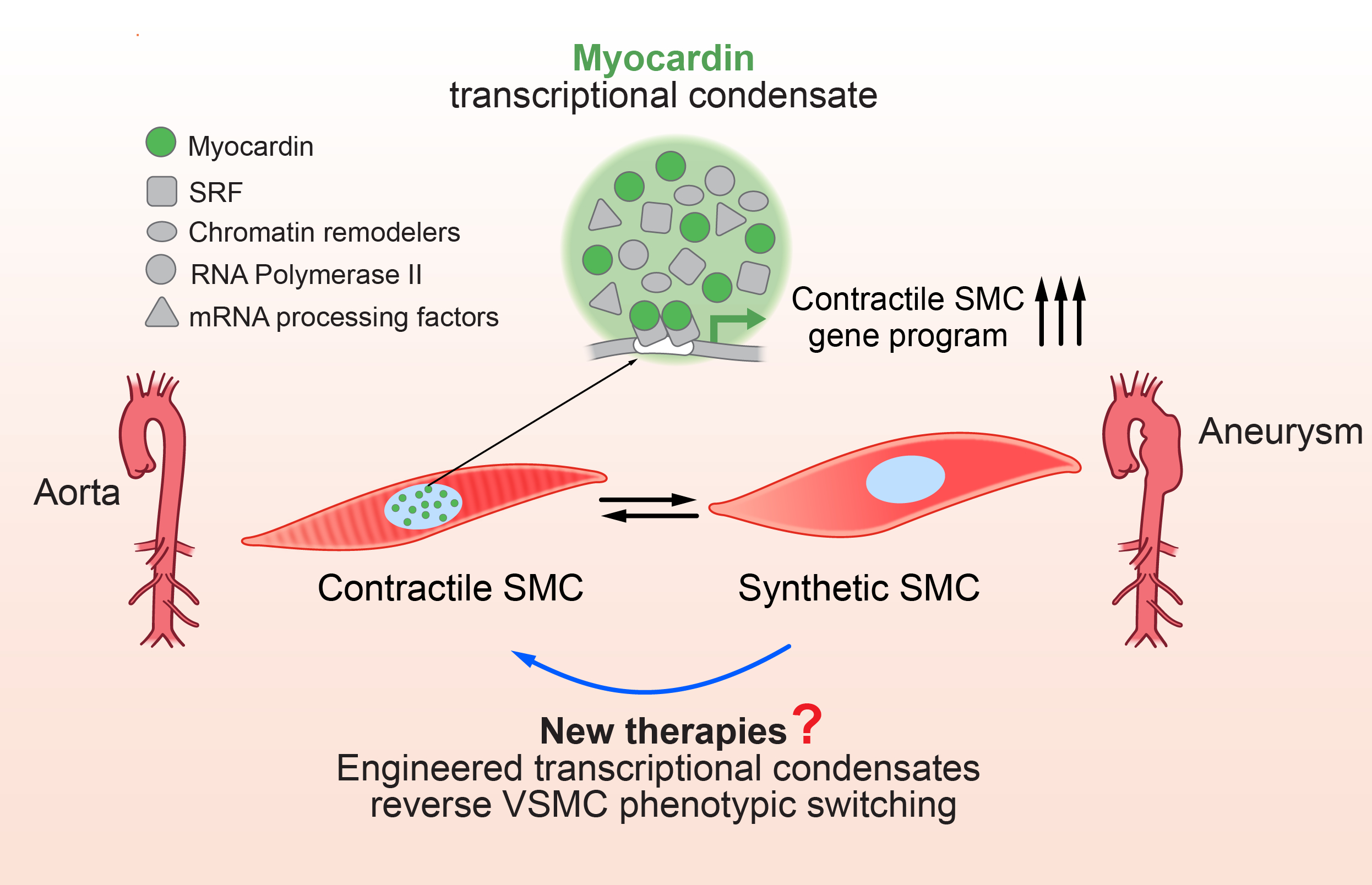
Abstract Body: Vascular smooth muscle cells (VSMC) exhibit high phenotypic plasticity during various vascular pathological conditions, such as aneurysm, atherosclerosis, and injury. VSMCs undergo phenotypic switching from contractile to synthetic states, weakening the vascular wall and accelerating the pathogenesis of vascular diseases. Modulation of SMC phenotypic switching is central to the treatment of vascular diseases. Myocardin is a highly potent transcriptional coactivator that regulates SMC differentiation and contractile gene expression. Our recent study demonstrated that Myocardin regulates SMC differentiation through forming liquid-liquid phase separation condensates. Myocardin condensates aggregate the transcriptional machinery to promote robust SMC marker gene expression and a switch-like cell fate change. Using human induced pluripotent stem cell-derived SMCs (hiPSC-SMCs) as an in vitro system, we found that Myocardin condensates only exist in contractile but not in synthetic SMCs. Reconstitution of Myocardin condensates can drive SMC phenotypic switching from synthetic to contractile states and rescue the differentiation failure of Myocardin knockout hiPSCs into SMCs. Integration of multiomics approaches, super-resolution confocal microscopy, and condensate-based gene activation assays demonstrate that Myocardin condensates directly regulate contractile SMC genes, including ACTA2, MYH11, and LMOD1. To elucidate the composition of Myocardin condensates, we performed nuclear protein proximity labelling assays followed by quantitative proteomic analysis and found that Myocardin condensates aggregate chromatin remodelers, RNA polymerase II, and mRNA processing machinery to amplify SMC gene expression. Myocardin functions by interacting with SRF, which does not efficiently activate SMC gene expression or form condensates by itself. We engineered SRF condensate formation by fusing SRF with a highly disordered sequence. Surprisingly, the engineered SRF condensates acquire strong transcriptional activity in driving SMC gene expression like Myocardin condensates. Our study provides new insights into the transcriptional control of VSMC phenotypic switching, opening new therapeutic approaches towards the treatment of vascular diseases.
  • Gan, Peiheng  ( UT Southwestern Medical Center , Dallas , Texas , United States )
  • Liu, Ning  ( UT Southwestern Medical Center , Dallas , Texas , United States )
  • Olson, Eric  ( UNIV TEXAS SOUTHWESTERN MED CTR , Dallas , Texas , United States )
  • Author Disclosures:
    Peiheng Gan: DO NOT have relevant financial relationships | Ning Liu: No Answer | Eric Olson: No Answer
More abstracts on this topic:
A Blood(y) Pressure Crisis: Diffuse Alveolar Hemorrhage as a Rare Manifestation of Severely Uncontrolled Hypertension

Nandyal Shreyas, Amdetsion Gedion Yilma, Varma Revati, Kohli Saksham, Hammo Hasan


A blood test based on RNA-seq and machine learning for the detection of steatotic liver disease: A Pilot Study on Cardiometabolic Health

Poggio Rosana, Berdiñas Ignacio, La Greca Alejandro, Luzzani Carlos, Miriuka Santiago, Rodriguez-granillo Gaston, De Lillo Florencia, Rubilar Bibiana, Hijazi Razan, Solari Claudia, Rodríguez Varela María Soledad, Mobbs Alan, Manchini Estefania

More abstracts from these authors:
You have to be authorized to contact abstract author. Please, Login
Not Available