Characteristics of perivascular adipose tissue in patients with coronary heart disease
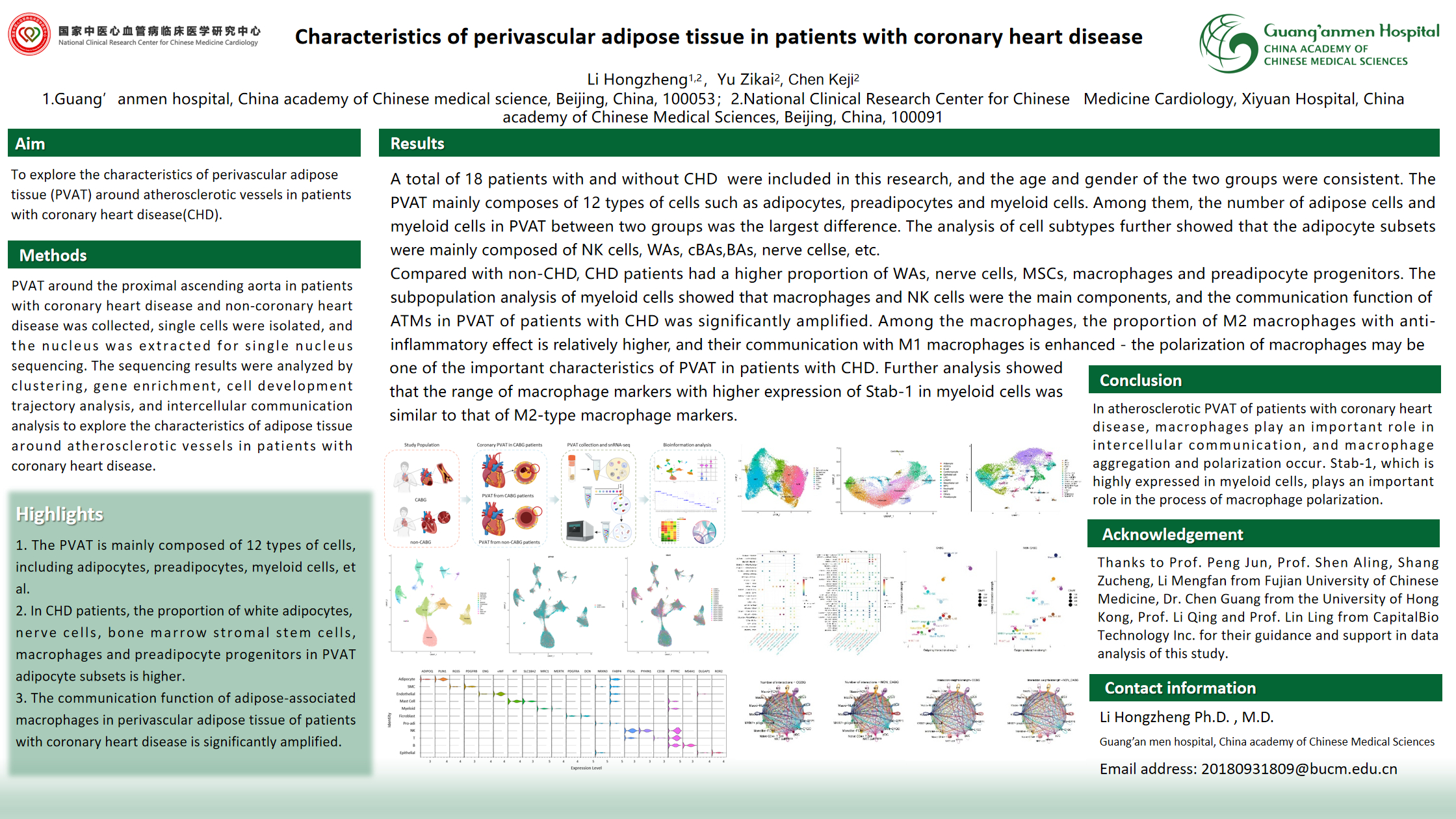
Abstract Body: Aim: To explore the characteristics of perivascular adipose tissue (PVAT) around atherosclerotic vessels in patients with coronary heart disease(CHD). Methods: PVAT around the proximal ascending aorta in patients with coronary heart disease and non-coronary heart disease was collected, single cells were isolated, and the nucleus was extracted for single nucleus sequencing. The sequencing results were analyzed by clustering, gene enrichment, cell development trajectory analysis, and intercellular communication analysis to explore the characteristics of adipose tissue around atherosclerotic vessels in patients with coronary heart disease. Results: A total of 18 patients with and without CHD were included in this research, and the age and gender of the two groups were consistent. The PVAT mainly composes of 12 types of cells such as adipocytes, preadipocytes and myeloid cells. Among them, the number of adipose cells and myeloid cells in PVAT between two groups was the largest difference. The analysis of cell subtypes further showed that the adipocyte subsets were mainly composed of NK cells, WAs, cBAs,BAs, nerve cellse, etc. Compared with non-CHD, CHD patients had a higher proportion of WAs, nerve cells, MSCs, macrophages and preadipocyte progenitors. The subpopulation analysis of myeloid cells showed that macrophages and NK cells were the main components, and the communication function of ATMs in PVAT of patients with CHD was significantly amplified. Among the macrophages, the proportion of M2 macrophages with anti-inflammatory effect is relatively higher, and their communication with M1 macrophages is enhanced - the polarization of macrophages may be one of the important characteristics of PVAT in patients with CHD. Further analysis showed that the range of macrophage markers with higher expression of Stab-1 in myeloid cells was similar to that of M2-type macrophage markers. Conclusion: In atherosclerotic PVAT of patients with coronary heart disease, macrophages play an important role in intercellular communication, and macrophage aggregation and polarization occur. Stab-1, which is highly expressed in myeloid cells, plays an important role in the process of macrophage polarization.
Li, Hongzheng
(
Guang'an men hospital, CACMS
, Beijing , China )
Yu, Zikai
(
National Clinical Research Center for Chinese Medicine Cardiology, Xiyuan Hospital, China academy of Chinese Medical Sciences
, Beijing , Beijing , China )
Chen, Keji
(
National Clinical Research Center for Chinese Medicine Cardiology, Xiyuan Hospital, China academy of Chinese Medical Sciences
, Beijing , Beijing , China )
Author Disclosures:
Hongzheng Li:DO NOT have relevant financial relationships
| Zikai Yu:No Answer
| Keji Chen:No Answer