
Effect of Constriction Rates on Indicators of Hemodynamics in Circumferential Thoracoabdominal Cardiopulmonary Resuscitation
Abstract Body: Introduction: Data from human case series suggest that the optimal compression rate for sternal piston type CPR may be in the range of 130 compressions/min. Existing mechanical devices have compression rates of between 80 and 100 per minute. Circumferential thoracoabdominal CPR (CTA-CPR) may have enhanced hemodynamic effects and a superior safety profile, but the optimal constriction rate is currently unknown.
Hypothesis: Constriction rates are positively correlated with indicators of hemodynamics in CTA-CPR.
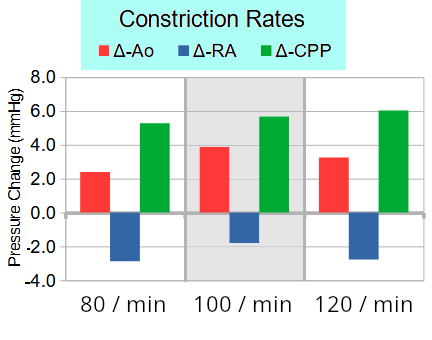
Methods: Ventricular fibrillation was induced in female Yorkshire swine (n = 9, ~30kg). CPR was provided by a prototype pneumatic CTA-CPR system. Constriction rates were varied in 45s epochs among 80, 100 and 120 per minute. Aortic (Ao) and right atrial (RA) pressures were measured using micromanometer catheters. Coronary perfusion pressure (CPP) was derived as the difference between the Ao and RA pressures. The change in CPP (Δ-CPP) from the beginning to the end of each treatment epoch was the principal indicator of hemodynamics. Data from all experiments were grouped by treatment type and subjected to Analysis of Variance.
Results: Final Ao pressures for 80, 100, and 120 constrictions per minute were 27, 31, and 28 mmHg, respectively. Final RA pressures were 6, 7, and 7 mmHg. This yields CPPs of 20, 24, and 21 mmHg. The Δ-CPPs trended upward 5.3, 5.7, and 6.0, respectively (p < 0.10).
Conclusion: Increasing constriction rates were associated with improved indicators of hemodynamics. The optimal rate may be similar to that seen in sternal piston CPR, and considerably higher than available with commercial automated devices.
Paradis, Aidan
( CPR Therapeutics, Inc.
, Putney
, Vermont
, United States
)
Paradis, Norman
( CPR Therapeutics, Inc.
, Putney
, Vermont
, United States
)
Gaddy, David
( CPR Therapeutics, Inc.
, Putney
, Vermont
, United States
)
Moodie, Karen
( CPR Therapeutics, Inc.
, Putney
, Vermont
, United States
)
Mader, Timothy
( UMass Chan Medical School, Baystate
, Wilbraham
, Massachusetts
, United States
)
Dufresne, Alexandre
( Baysate Medical Center
, Springfield
, Massachusetts
, United States
)
Couturier, Christine
( CPR Therapeutics, Inc.
, Putney
, Vermont
, United States
)
Dufresne, Simon
( Baysate Medical Center
, Springfield
, Massachusetts
, United States
)
Davis, Daniel
( UCSD
, San Diego
, California
, United States
)
Sims, Christopher
( The Alchemy Group LLC
, Amherst
, Massachusetts
, United States
)
Author Disclosures:
Aidan Paradis:DO have relevant financial relationships
;
Employee:CPR Therapeutics:Active (exists now)
; Other (please indicate in the box next to the company name):CPR Therapeutics (company owned by family):Active (exists now)
| Norman Paradis:DO have relevant financial relationships
;
Employee:CPR Therapeutics Inc.:Active (exists now)
; Ownership Interest:CPR Therapeutics Inc.:Active (exists now)
; Executive Role:CPR Therapeutics Inc.:Active (exists now)
| David Gaddy:No Answer
| Karen Moodie:No Answer
| Timothy Mader:DO NOT have relevant financial relationships
| Alexandre Dufresne:DO NOT have relevant financial relationships
| Christine Couturier:DO have relevant financial relationships
;
Other (please indicate in the box next to the company name):CPR Therapeutics, Inc, Board Member, Spouse, Volunteer:Active (exists now)
| Simon Dufresne:DO NOT have relevant financial relationships
| Daniel Davis:DO have relevant financial relationships
;
Advisor:CPRT:Active (exists now)
; Advisor:Philips Healthcare:Active (exists now)
| Christopher Sims:DO have relevant financial relationships
;
Ownership Interest:CPR Therapeutics:Active (exists now)
; Ownership Interest:Ompractice:Active (exists now)