Differences in the Medical Management of Post-Stroke Sequelae Among Patients Treated with Mechanical Thrombectomy vs Intravenous Thrombolysis
Abstract Body: Background: Mechanical thrombectomy (MT) as treatment for acute ischemic stroke (AIS) has demonstrated superior functional outcomes compared to intravenous thrombolysis (IVT). Yet AIS survivors often experience a range of unstudied post-stroke complications which negatively affect patient reported outcomes. To inform clinical practice, we assessed 90-day differences in the medical management of common stroke post-complications among patients treated with MT vs. IVT.
Methods: A retrospective cohort of hospitalized AIS patients treated with IVT or MT were identified from Electronic Medical Records of 92 large healthcare organizations (01/2015-09/2024). Matched propensity scores were used to adjust for baseline differences across 36 factors. Outcomes included the use of medication(s) for the management of fatigue, spasticity, mood, sleep, seizure, neurogenic bowel & neurogenic bladder. Pre-specified subgroup analyses included differences in post-stroke sequelae management stratified by NIHSS scores of ≤9 (mild AIS) or >9 (moderate/severe AIS) & differences in post-stroke sequelae between AIS patients treated with MT vs MT + IVT.
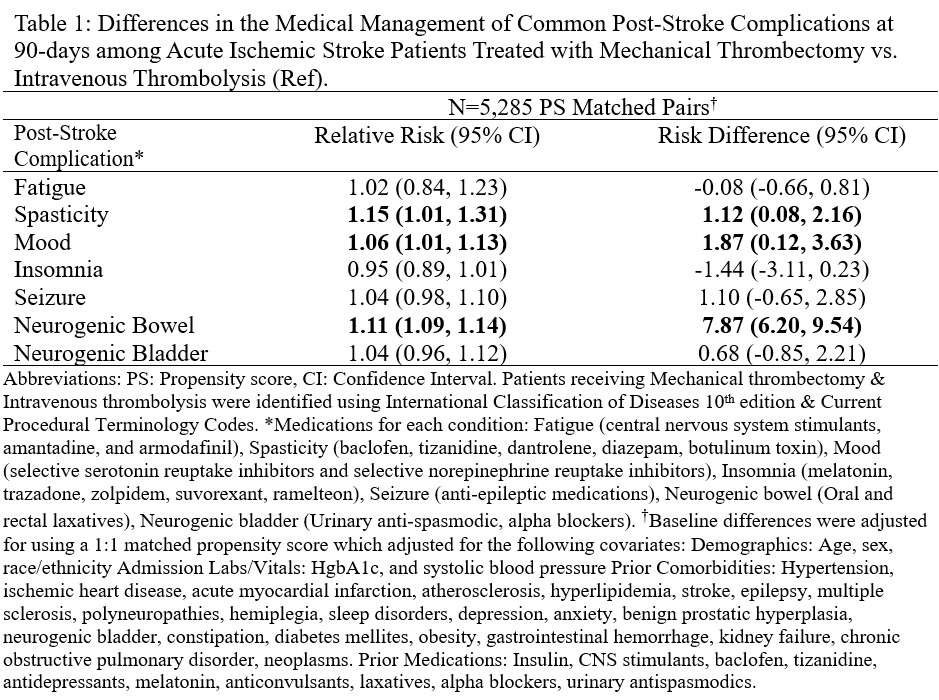
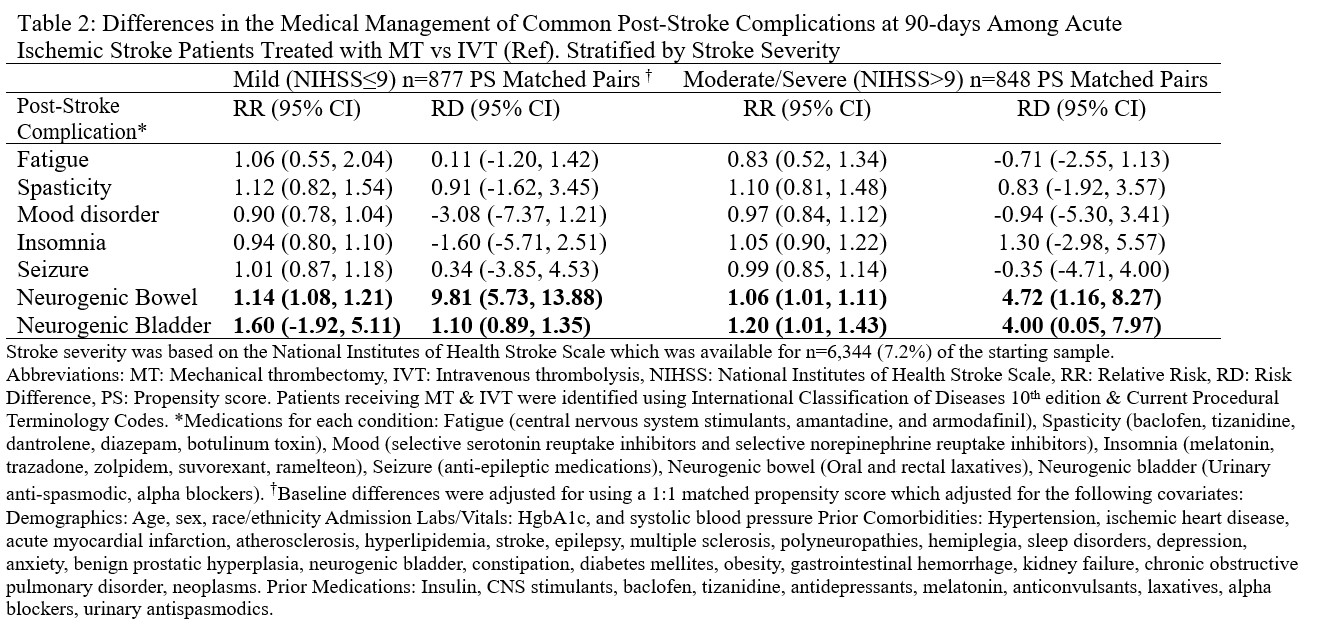
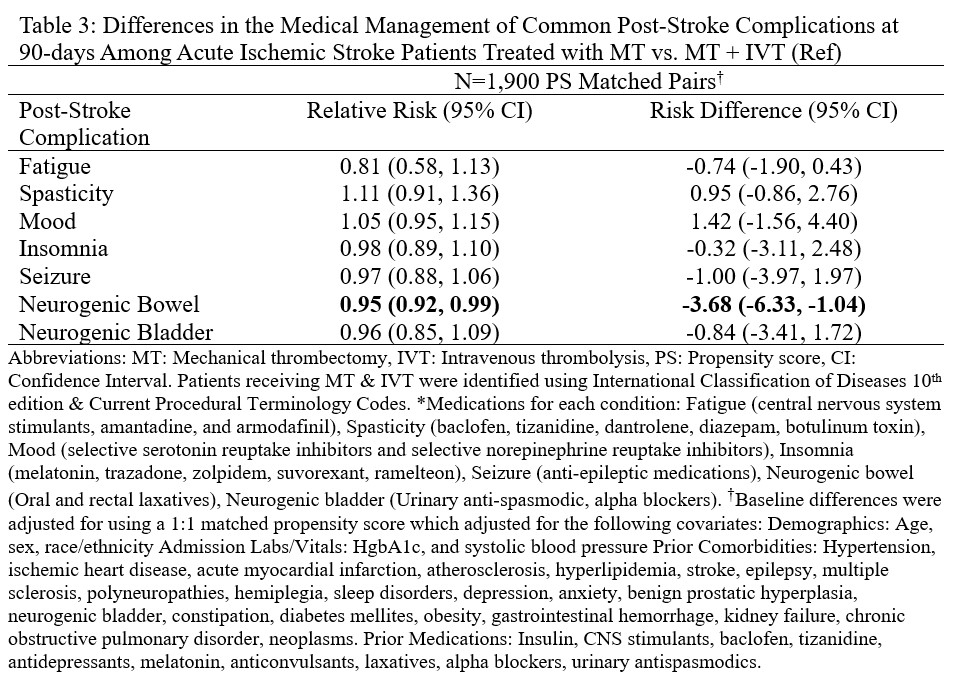
Results: The final cohort consisted of n=87,819 AIS patients treated with either IVT (n=82,534) or MT (n=5,285). PS matching resulted in 5,285 matched pairs with good balance across all baseline covariates. At 90-days, AIS patients treated with MT were more likely to receive medications for spasticity (RR: 1.15, 95%CI: 1.01, 1.31), mood (RR: 1.06, 95%CI: 1.01, 1.13) & neurogenic bowel (RR: 1.11, 95%CI: 1.09, 1.14) (Table 1). Approximately 7% (n=6,344) of AIS patients had NIHSS scores – PS matching resulted in 877 matched pairs with NIHSS ≤9 & 848 matched pairs with NIHSS>9. Following stratification, AIS patients treated with MT were significantly more likely to receive treatment of neurogenic bowel & bladder (Table 2). For the MT vs MT + IVT comparison, patients treated with MT were 5% less likely to receive treatment for neurogenic bowel RR: 0.95 (95%CI: 0.92, 0.99) among 1,900 matched pairs (Table 3).
Discussion: Using real world data, AIS patients treated with MT (vs IVT) were more likely to receive treatment for spasticity, mood & neurogenic bowel. Among patients with documented NIHSS scores, differences remained significant for treatment of neurogenic bowel and bladder after stratifying by stroke severity. Healthcare providers should screen for these post-stroke sequelae, which substantially affect quality of life for AIS survivors.
Simmonds, Kent
(
University of Texas Southwestern
, Dallas , Texas , United States )
Chavez, Audrie
(
University of Texas Health Science Center San Antonio
, San Antonio , Texas , United States )
Ifejika, Nneka
(
Ochsner Health
, New Orleans , Louisiana , United States )
Author Disclosures:
Kent Simmonds:DO NOT have relevant financial relationships
| Audrie Chavez:DO NOT have relevant financial relationships
| Nneka Ifejika:DO NOT have relevant financial relationships